Willy Walker:
Good afternoon, and welcome to another Walker Webcast, and a very special discussion with Jim Collins. I'm going to do a quick lead-in now to my discussion with Jim, because when he joined me, we just dove right into the conversation, and I thought I'd do a quick bio on Jim before we get to the discussion, which is one of the longer Walker Webcasts I've done, one of the more engaging Walker Webcasts I've done, and I must say, I'm extremely appreciative of Jim, his insight, his thoughts, and his friendship that make the next hour and a half such a great discussion.
To anyone who needs it, Jim Collins is a student and teacher of exceptional human endeavor, and a Socratic advisor to leaders across all sectors of society. Jim has authored or co-authored a series of books that have sold over 11 million copies, including the #1 bestseller, Good to Great, and the enduring classic, Built to Last. Jim went to Stanford undergrad and got his MBA there as well.
He taught at Stanford at the business school, where he received the Distinguished Teaching Award. He served for two years as an appointment as the Class of 1951 Chair for the Study of Leadership at West Point. He was awarded an honorary degree from the University of Colorado at Boulder, as well as Claremont University. He was named by Forbes Magazine as one of the 100 greatest business minds of all time. And most importantly, he has been his wife Joanne's partner for over 45 years.
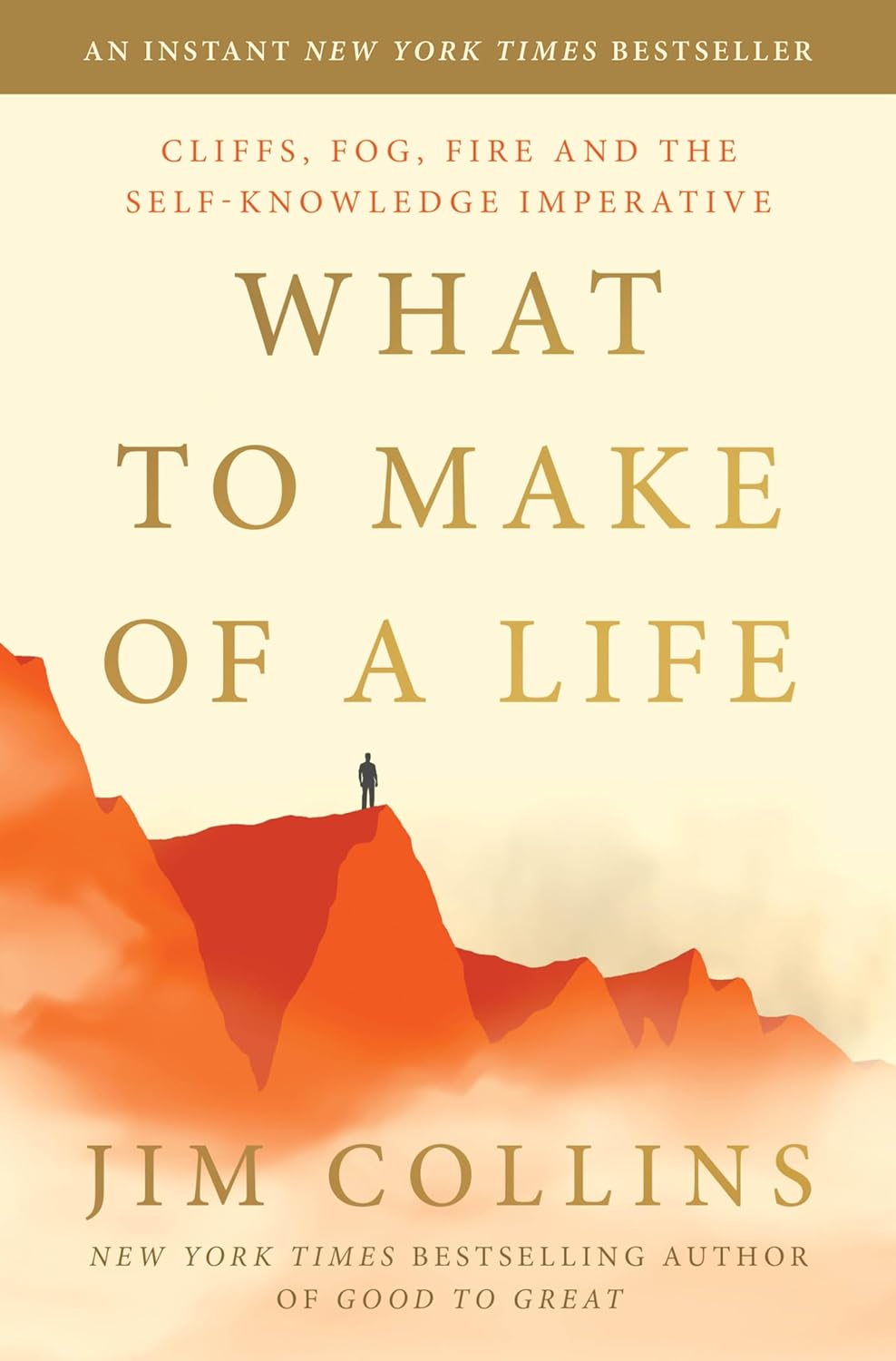
This is a great discussion, mostly focused on Jim's latest book, What to Make of a Life. I'm deeply thankful for his time, and I hope you enjoy our conversation.
Willy Walker:
I want to start, Jim, by thanking you for being such a friend. I will tell you, it is a true honor to call you a friend. And when I first got to meet you through our mutual friend, David Maxwell, who was highlighted in Good to Great, David was one of the heroes of my life, having been a family friend and the CEO of Fannie Mae and the turnaround of Fannie Mae back in the 1980s into the 1990s. And I'll never forget the first time you replied to an email. And I sort of felt like I'd caught the biggest fish I'd ever caught. I was out there kind of just on the sea waiting for that thing to hit. And all of a sudden, this enormous tuna hit it. And I said, oh, my God, I'm in one-to-one contact with Jim Collins. And I will say that not only have I read everything that you've written, including what we're going to talk about today, what makes a great life, but the five-year BHAGs that you outlined and basically made famous have truly been the underpinnings of what has made Walker & Dunlop the successful company that it has been.
And by setting these fantastic five-year growth goals for the company and setting the team to it, what I clearly realized after the first one, and I've told you this before, is that when you take an exceptional team, and you put goals in front of them, they will run through walls to get to them. And interestingly, they, at least our team, have landed not well beyond the mark or well short of the mark, but right on the mark. And I think it says something about business planning and setting goals for people.
And as this book highlights, as it relates to all of our lives, it's not linear. Every one of those five-year plans was a step forward, a step back, a step forward. But at the end of the five years, we got there.
And it has been so fun to have your writing as the backdrop to the success that we've had as a company. And I'm just deeply thankful that you're spending this time today talking about a book that is so much more personal and so much more, well, really, honestly, Jim, about you. The back of this book and where you changed in your framing of the world, the 15 ways that you outline in the back of the book about things you thought about the world previously and how your thinking has evolved while researching this book over 10 years is, to me, knowing you personally, the most fascinating part of it.
Jim Collins:
Well, of course, that was part of the great journey to see my perspectives on life change by doing the research. And one of the things that I really value about going deep in the research is to see my perspectives change. And that happened back in my work on what makes great companies tick. Each research study kind of produced surprises along the way of things that I didn't expect to find. And that was always the really great, joyful thing about it is that if you just kind of ended up in the same place where you began or you do research just to confirm what you believe is true, then I've never understood the point of doing research. I mean, to me, the point of research is ultimately to be surprised, to learn new things, and to come to see the world and how that world works differently than you did before, in ways that you can really rely upon.
And then also in this one, of course, the lens wasn't about what makes great companies tick. I was looking at these questions of what to make of a life. And of course, we all have our own idiosyncratic theories of living. And for many of us, those have worked. But what was fascinating for me was to see how vast the range of approaches that the people I studied took, which made me very skeptical of kind of one-size-fits-all types of recipes. And usually, often, we get one narrative, one person who can tell us something really marvelous that worked for them. But you always have to keep in mind those two words for them and not necessarily for anyone else. And so I would have my own idiosyncratic views. But to see those shaved away was actually joyful. It was a complete antithesis of feeling bad about seeing what I used to think melt away and be replaced by something else. It was really joyful to do that because you get very excited when you go, “Wow, I never really thought it worked like that.”
But it does work like that. I'm glad you like that table at the end. I used to believe; I now believe 15 times.
Willy Walker:
Talk for a moment, Jim, about the sort of genesis of the book. You talk about the loss of your father and having some unanswered questions. You talk about your wife, Joanne, being a world-class athlete and having her career end in the transition from that being defining who she was into the next phase of her life in her career.
And then you talk about John Gardner, a colleague of yours at Stanford Business School, who not only wrote a book that influenced you, but also gave you some personal advice that seemed to have tapped into something that you weren't asking for. But he gave you words of wisdom that you grabbed onto; that you continued on.
Talk for a moment about what was the setup for the book. And then, if you could, lead that into how you defined or decided to study the 34 protagonists inside the book.
Jim Collins:
You're absolutely right. You've actually really nicely, succinctly captured the three seeds of where this book came from. And after 30-plus years of studying what makes great companies tick, you might think that, well, this is kind of now I'm just doing something really new. But in some ways, it's really like going backwards in that I had the seeds of this book in place long before I ever started my great company's research. And as you know, the opening of the book goes to a very painful experience as a boy and realizing that my father would never be a father.
And it was interesting in the writing. I wasn't sure where I was going to start the book when I was actually writing it. You always save the first chapter to write last. I kept thinking, where am I going to start the book as I was writing all the other chapters, and eventually it became clear to me I would actually start with my own story because it's where it began. And some people are really fortunate. They have great parents. They have great fathers that are in their life that provide guidance and frameworks and perspectives. But in my case, I desperately hoped for that from my father. But as you know, as I was in early high school and went down to northern New Mexico, where he was living in an adobe hut with a dirt floor and bringing a turkey with me to bring to him as an offering, kind of at Thanksgiving, with this image that we would somehow share this turkey and have a father and son emerge together. And I would have a father to guide me. And at the end of that weekend, just an absolute shattering experience of realizing that just would never happen.
And I still have the image in my mind of being back on the Greyhound bus heading back north and just all those low November clouds. And it just felt all the world, like I was heading into the fog of life. And I had absolutely no idea how to go about life at all. None, zero, just no idea. And so that was really the first seed. And I had to sort of figure it out along the way.
The second seed. And of course, that gets to the first time we all have to answer that question of what to make of a life when we emerge from the fog of youth. And then there's the kind of the crystalline seed for how I did. The book comes about a decade after the New Mexico experience. And as you know, this story is in the book. But my wife, Joanne, was an elite professional athlete, won the Ironman in 1985, and was the first female athlete in Nike's Just Do It campaign. And she was incredibly exquisitely constructed for that identity and that role in the world. And a hamstring injury took it away from her prematurely. And she was unable to run or race with the running portion at that level ever again.
And she just gasped at me one day as it was becoming clear. I feel like I'm dying. I mean, that moment is just like this. I mean, what do you do if the most important person in your life just looks at you and says, I feel like I'm dying. And I realized that I had no answer. And in a certain sense, that identity, who she was, how she was defined, was dying. And that seed went really deep and really, really deep because I had no answer. And it came out later in this book. How do you look at the question when life bifurcates, or it goes through these what we call cliff events where you have to re-answer the question again because one phase of life has ended and you have to answer the question of what to make of a life.
And the third was John Gardner. I mean, John was just great. I mean, he was just such a wonderful, wise man. And I was so lucky to have him down the hall for me when I was teaching at Stanford. And he had written a book called Self-Renewal back in 1962, I believe. But he always felt it deserved more research.
And one of John's questions that he really wrestled with was: Why do so many people leave some of their best, most spectacular years of potential unused on the table in their 50s, 60s, 70s, 80s, 90s? And why do they not have incredibly renewed lives out there? And why do some people attain them? And he encouraged me to take my desire to do big projects and eventually really look at that question. And so that sat in there and gestated for a long time. And you're absolutely right about one of the key pieces of advice. And this actually, I'll close this out with something, though, I've really learned about pieces of advice. John gave me the advice—I'm sure he gave it to others as well—which is: don't set out in life to try to be interesting, to be an interesting person. Instead, focus on being interested. And he really challenged me on that, because I think I was probably spending a lot of energy trying to be interesting. And that really stuck with me. And I've used it as a guiding frame for lots of things in my life. But I also had other really wise professors that I had as a young person who gave me advice that was really great advice that turned out to be disastrous.
Some of my really well-intentioned professors who I respect tremendously advised me that after I was a student at Stanford Business School, that I should go out and work for an established company and really learn how it works if I ever wanted to do something entrepreneurial. And it was just a complete disaster because I absolutely did not fit working in a large company. Here we have two—I've got two pieces of advice. One I followed and has had a huge positive effect on my life. The other I followed, and then it became a disaster and had to sort of reverse. And what do I draw from that?
What I draw from that is that the reason the John Gardner advice so stuck with me, and I so took it, is because it fits with my encodings. And the other advice did not. And so that's part of one of the big lessons from the book is that I've just become incredibly skeptical of advice because the advice may be coming from a well-meaning place. It may come from somebody who has been incredibly successful at what they did. But that advice worked for them because it fit with their encodings, and they're not necessarily your encodings. And so the critical question is not what advice to follow. The critical question is what are your encodings and then which advice fits with them, which is a very different way of thinking about what advice is. And so to this day, I'm grateful because I have the encoding for curiosity that I follow John Gardner and I wish I wouldn't have listened to the other.
Willy Walker:
Did you discover something, Jim, while researching and writing this book about yourself that genuinely surprised you?
Jim Collins:
Oh, boy. Yeah. That's a nice question. So there's, I guess, a few things that really surprised me. One that jumps out is this is I think it's in Chapter Five that I really started to think about this. You've known me for a long time, and you know that I'd always thought of myself, and a lot of people had thought of me as incredibly disciplined. I mean, if you go back and you look at the work in.
Willy Walker:
Almost, almost, Jim, to a fault in the sense of a discipline you put into your life to those people. I think I'm a reasonably disciplined person. The level of discipline that you and rigor that you put into your life as far as planning meetings, doing what you're going to do. Days of travel, all of that, to some from afar at that time seemed a little bit beyond the pale. But keep going.
Jim Collins:
Well, and just so you know, I still do all those things.
Willy Walker:
I know you do.
Jim Collins:
I mean, at the end of every day, I still fill out a spreadsheet on the day, and I count the number of creative hours I have. And I rank the day on a -2 to +2 scale. And I put in the information, and I run sorts and correlations, and I systematically stay above a thousand creative hours every 365 days. And I have a punch card for the number of things. All that's true. Those are really useful tools. But what all of a sudden became clear to me in writing about this is that while I do have disciplines that I use and they're really helpful to me and they fit me, they fit my encodings. The real thing that's driving is almost an obsessive love of what I'm doing. And if you wake up at four o'clock in the morning, is that when I was working on this book, I would wake up, and this really is true, I would look at my watch, and I would just think, oh, please, oh, please, oh, please, let it be at least 4 a.m. I can justify getting up and going; now, that's not discipline. I'm not like setting my alarm and forcing myself to get up at 4 o'clock and write.
I'm so caught up in the momentum and the energy of what I'm doing and the excitement of the project and the uncovering of what's curious and making the words work. And just the joy of 4 a.m. to 8 a.m. when the day is just starting to kind of go from dark to light. And it sort of corresponds with your brain going from sleep to wake and all of this happening. And it's an absolutely blissful form of complete intense ardor and work. And I began to realize that for all these years, I thought that I sort of willed myself with discipline.
But when I really stripped it away, what I discovered is if you're just so compelled by what you do that you literally can't stop yourself from doing it, and you really do wake up and say, oh, please, oh, please let it be at least 4 a.m. So that I can get up and get going. That's not discipline. Now, that's absolute sheer obsessed inner fire, love of what you're doing, then honed and directed and organized with disciplines that make it highly effective. But the motivating force is that absolute unquenchable inner fire.
Willy Walker:
We'll talk about the inner fire and how you keep the inner fire burning, if you will, on that coal inside of you, which very clearly you have. But one of the things that, as I listen to you talk about that and the excitement and the passion that you have, it made me think about the 34 protagonists that you researched in this book, Jim, are all, in some instances, household names, and others, just people who have achieved great success. And I watched your interview with Oprah, and it was so evident in that interview with Oprah that she said my encoding was to do what I've done. I was a preacher when I was very young, and I have this gift to ask people questions and engage with people in what I do. And I'm encoded to do this. And I sat there, and I looked at the two of you on the screen, and I said, there's this incredible, incredible interviewer, entertainer. And then there's this incredible brain that has gone into the depths of studying business and been a consigliere to so many business leaders as it relates to how I think about this problem and all that. Two people are at the top, top of their game. And I sort of thought, but what about the guy who's tuning bikes at the bike store in Boulder? How does he or she find their encoding or are these encodings just so dramatic in the people that you wrote about that? Yeah, they found their encodings, and they're seeking after them. But for someone who's tuning bikes at the bike shop, they don't know how to find their encodings. How does that guy or woman find their encoding?
Jim Collins:
OK, so first of all, the guys at the bike store do have copies of the book now. Which is kind of exciting. So first of all, I'm going to come at this from, gosh, there are kind of three things that I would go to right away.
But the first is this. One of the things that was marvelous happened in that conversation, and I had known her for some time. And so there was kind of really like two friends reacquainting, becoming reacquainted again in that conversation. But she talked about how even she had cliffs and fog.
Willy Walker:
Oh, yeah.
Jim Collins:
And one of the big things is that I studied these. These were remarkable lives. I had to have remarkable lives because those are the ones where there's a lot of data. That's why I looked to pick them. Another kind of constructs for picking them. But everybody has these cliffs. Everybody has times of fog, and we all have them. I've had them. You've had them. I mean, the people in the book have them. And so I think that's just one thing that aren't these sort of unblemished, perfect lives like you were describing earlier when you kind of are pursuing the BHAGs and how the path, how you get there is highly imperfect. And certainly not linear. And that's the way their lives were. And that's true for everyone, it turns out.
A second thing, though, is that I like to think of it this way. Go back to Good to Great. If I remember the numbers, and I hope I don't get these wrong, it's roughly something like we were looking for companies that were sort of average performance that broke through to attain more than three times cumulative returns relative to the market for a 15-year period. And where it wasn't an industry effect, and we were taking a big publicly traded database of companies to do it. Of 1,435, I think, was the number we found 11. And then we had the direct comparisons to them to see the ones who could have done it, but didn't.
Well, you could look at the findings in Good to Great then, and you could say, well, wait a minute, how's that apply to the rest of the companies? These are 11 really extreme cases that went from Good to Great. And my answer to that is just because there are so few who did that doesn't mean that if we systematically study them, we can't learn from them. And that we could all be kind of elevated, almost like they're a magnet pulling us up. What we learn from them becomes like a magnet. And I think, like the people in this book, I'm not going to be a computer pioneer like Grace Hopper or the exceptional CEO that Katharine Graham became or a scientist and nation builder who Benjamin Franklin was.
But what you learn systematically across them becomes something that you learn from in the templates in a systematic way, and they can help pull us forward, even though I'll never be a Franklin or a Katharine Graham. So that's one piece of it. And then there's another piece. The visibility of the people in this study is challenging just because, I mean, they're almost overwhelming, and what they ended up being and doing with their lives. But I got this wonderful email from a former professor of mine who I had always met. He and I had remained in contact over the years, and he had read an early version of the book. And he sent me the story. He grew up in Europe, in Belgium, I believe. And he described when he was a boy that there was a person in their life, in the neighborhood, who was a cobblestone layer and laying cobblestones in the streets of northern Europe. And this person was incredibly encoded for doing it and had incredible inner fire for doing it and a real dedication to doing it with just this exquisite excellence. And when you would walk around certain cities where this cobblestone layer had done his work, he could point out, and you could see which sections of the street were his cobblestones. They were exquisitely, distinctively beautiful, just like little edges that were perfectly done. And it was a person who really found great meaning in the sheer pursuit of that excellence and what he was doing. And using the terms of the book, he was in frame. He was absolutely in frame doing something he was encoded for, that fed his fire, and the cities or whoever was funding it allowed him to have the economics work. And he was every bit as in frame as John Glenn orbiting the Earth or Jimmy Page playing guitar. It's just not as visible. And so you come to the guy at the bike store; there can be people working at the bike store, somebody who's making just the whole elements of a bike. Bulletproof, and it's working, and the kind of tinkering of it could be just like the cobblestone layer. And you think about it like, if you're on a professional bike team, you want someone in the Tour de France, that's the team mechanic who is as in frame as John Glenn orbiting the Earth. There's that. And so I think you can find this in many ways that are maybe less grand, but equally exquisite.
Willy Walker:
You've worked with some of the world's greatest CEOs, Jim. How many of them do you think are working for their hedgehog that they're right in what they should be doing versus they're really competent at doing what they're doing? And as you talk about the competence doom loop of people who sort of get doing something that they end up just being really good at, and they get kind of caught in the trappings of it, and they're making a certain amount of money, and they're paying for the second home mortgage, and they just kind of keep doing it. Of all the CEOs that you have engaged with, and there have been plenty, is that 85% of them have found their hedgehog and they're perfectly aligned with what they're doing with their lives and careers? Or is it actually more like 50, and 50% of them ought to be off doing something else?
Jim Collins:
I thought a lot about this question in different ways. And so my answer of the ones that at least that I've observed and interacted with, which is quite a large set at this point, and also the ones that I've studied, is that if they are really exceptional at leading their companies to outstanding performances over time. And if they are able to lead those companies to make a distinctive impact on the world that they touch, such that the company would be missed if it disappeared, and they're able to build some sustainability into that so that it can last not just for a few years, but for quite an extended period of time. The odds that that leader is in frame, really encoded for it, really full of fire for doing it, and that at some point it's not about the money is really high, I think.
I think, though, that that leads to, though, a very different, very interesting challenge and question. And maybe we can spend a few minutes on this, because my thought isn't that; I almost think of it as that a lot of the CEOs that I've worked with are not unlike an elite athlete. In that they're executive athletes. That's the kind of athlete that they are. And as an executive athlete, they're like Alan Page playing football or Joanne when she was racing or Tenley Albright skating as an Olympic skater. They're actually, the challenges are so much in frame. And then at some point, unless they own the company outright, unless they're Sam Walton and they can decide when they're done, and Sam did it till the end or Walt Disney and they could run it to the end, or Steve Jobs. And it's basically just what I'm going to do till the end. They're going to face a very interesting cliff, which is very similar to the end of an athletic career. And they're going to go from being kind of the equivalent of an All-Pro player to all of a sudden that identity will be gone, and it'll be gone at a time in their lives when they still have a huge portion of their most creative and potentially effective and impactful years left.
And I've seen executives go over that cliff and into the fog and never really emerge. And what happens is you could end up like with a year gone by, then 5 years gone by, then 10 years gone by, then 15 years gone by. And somehow the incredible renewal that could happen doesn't. And I worry a lot about that. I worry less about CEOs not being in frame as CEOs, the ones who I've met for the most part. What I worry about is what's going to happen when their life as an executive athlete comes to an end. And are they going to make the most of those remaining decades? And we can spend a few minutes on this because I think it's a really important question and topic. I feel very, very passionate about not letting those years get wasted.
Willy Walker:
I want to dive into that in a second. But before we get to that, talk for a moment about the Stress and Drudgery Tax. Talk about—I'm leading Walker & Dunlop right now through a pretty tough time after our stock price has gone down significantly. And you could metaphorically say that we hit a cliff, and we were down, and now we're building back out. And it's hard. It's hard. Every single day, it's hard. And one of the things that I have taken from your book is you put one step in front of the other, and you're going to continue to lead out of it. And you're in a fog for a period of time. I feel extremely good right now that I've got great visibility to where we're going and trying to communicate that visibility to my team. And we will get through this.
But at the same time, it's hard. And there are plenty of days, Jim, where I'm just sort of like, man, this is stressful. And I'm trying to define, like, am I the right person to be doing this right now? Or is there somebody else out there that would actually do a better job of this? Because as you just said, I don't need to do this job. I do this job because I love this job. But there are many people, they don't need to have the cliff that I'm experiencing right now at Walker & Dunlop and walking through the fog and getting the clarity.
But where they sit there and they say it's supposed to be hard. I'm supposed to be slogging away at what I do. And they don't sort of lift their head up to sort of say, I'm done with this chapter of my life. Now it's time for me to not necessarily jump off the cliff, but to shift gears and go do something else. How have you seen leaders do that transition? Have you seen some that do something like you're so disciplined in the way you look at your life that I would think that in your daily notebook, it would come to you sort of like, let's test whether I'm having a good time doing what I'm doing today. And if not, it's time for me to pivot. I think there are very few people who put their own personal life through that kind of rigor. Have you found that to be a helpful tool to executives or leaders in some part of their life to kind of stop and assess whether they should stay on that path or jump off and do something else?
Jim Collins:
Yeah, boy, it's such a rich question, and maybe we can go back and forth a bit with it because there are multiple elements, both from what we learned in this research and then some of my own observations of leaders as well as my own experience, and we can weave this in. So first of all, there's a really—I'll just share a little story, and it ended up as a sentence in the book.
I was having a conversation once with a CEO of a very—it was a publicly traded, very, very successful company, but also going through a time of challenge and also just wearing on the CEO and really, really capable CEO. And what I said to that CEO, which then later became very clear to me as a way to look at the world when I looked at the study in these lives. Don't confuse the need for a break with the need to quit.
And one of the key things when you find yourself in those is just pause and say, OK, do I need a break, or am I really getting signals that I'm ready to be done? And I've seen sometimes that what they really need is a renewing break of some kind because they're really not ready to be done. But they misinterpreted it as needing to be done. And then they prematurely make themselves done. And they realize once the break has kind of renewed them that actually they weren't ready to be done. That's always a key question. Do you need a break? Are you really ready to be done with this phase of your life? May not be obvious what the answer to that is, but I give that to people as a question.
A second thing is this Stress and Drudgery Tax. Tell me a little bit about how you read the Stress and Drudgery Tax. And then let's talk about it, because I think it's actually really important, particularly if you have very significant burdens on you. And if it's a kind of cliffy, foggy time on top of it. But I'm curious how you read the Stress and Drudgery Tax, given that you have your stress and drudgery.
Willy Walker:
Well, I think, I mean, obviously it's time- and circumstance-dependent, Jim. We're going through a challenging time right now. And as a result of that, there's no effort. There's no focus. There's no commitment that seems unnecessary, if you will. And so, as a result of that, first of all, I don't view what I do as work. I really don't. Last weekend, I spent a lot of time working and thinking about work. I don't view that as work. But would I have rather been off doing something else, as I was focused on the work element of it? Sure, in a perfect world. But these times require that of me.
I think the other piece to it, though, is that, at least from what I have seen, those CEOs that I look at and say, man, they have built unbelievable organizations or leaders who have become amazing leaders. I have plenty of friends who are senators and governors who truly seem to enjoy the role, no matter how challenging the decisions are. I'll give you a perfect example. When my friend John Hickenlooper was governor of the state of Colorado, he had to focus on either commuting sentences or allowing people to continue forward with the conviction that they had. And those are hard decisions for anybody.
And so as a result of it, did John struggle with those decisions? Very much so. But at the same time, he was doing a job that I think he found his encoding. He is a leader. He was a natural-born leader and went from being a brewpub owner to being the mayor and then the governor and now U.S. Senator. I think the issue is that at certain times we are called upon to do extraordinary things that require a little bit—not a little bit extra effort. Of course, there's always the extra effort. But you might think that you're being required to do more than feels fair. I'll say that.
I had a call yesterday, just real quick. I had a call yesterday on a number of things that we've done in the last month. And what I walked through with my colleague was the number of times we did this. There was concern that it was going to do that. We got it to do what it was intended to do. And then we did another one. And then it happened, and everyone was concerned about it. We went and did this. And I walked through all these things of the back-and-forth with my senior management team of why are we doing this? It's supposed to get that. It hasn't happened quick enough. Oh, now it's happening.
And I just walked through, and I said, it's very difficult for me as the leader of this organization to be getting these mixed signals as we're trying to do this transformation. And my colleague listened and said that's why you are what you are. That's your job to process all of this and make sure that we continue moving forward. I think that that's very distinct from just saying I'm burned out. I've sort of done it. It's time for me to move on. I don't wake up in the middle of the night and think that. I think, what's the next challenge? Where are we moving forward? I don't view it as a stress or drudgery tax right now.
I just view it as hard work.
Jim Collins:
OK. It's great to have your experience in the middle of this. And it brings to mind a couple of people from the study. And so first of all, just for anybody who's listening to Stress and Drudgery Tax, what that's about.
One of the things, so we found that these lives work at their best when they have got three things that are kind of all coalescing at the same time, that it fits their encodings the way they're really constructed intrinsically. Two, it really does at some level, feed the inner fire for them. I mean, they're able to focus that fire for a long time on doing it. And the “Gosh, I wish I hope it's 4 a.m.” I guess I really want to get going. And then the third is that you're really ultimately would be willing to flip the arrow of money to do it, meaning that money really just becomes, instead of money being like we go through the drudgery of work in order to make money, flipping the arrow of money is money is actually a means and a fuel to be able to do your true work. And sometimes those beautifully correspond together. If you're a leader of a company and you are really in frame doing that, at some point, the money is really not the thing.
But the whole point is that you need fuel to be able to do ever greater things with the company. It's very similar to the sort of the flywheel you put fuel, you make a contribution, you turn it into economic fuel, you put it back into what drives the flywheel around and around again. And that's true for people, too.
But this Stress and Drudgery Tax was the interesting thing to me here. It didn't matter how in frame, which is when you have all these things together. You're in a frame that fits them all really well. How in frame that we have people in the study who were so unbelievably in frame: Jimmy Page playing guitar. I.M. Pei architecting. Toni Morrison writing books. Katharine Graham leading The Washington Post. Barbara McClintock doing her genetics. When they were in it, I mean, they were really, really in it. And yet all of them, while in it, had to pay what I would call a Stress and Drudgery Tax.
And there are times, sometimes the tax rate is high, and sometimes the tax rate is low. But you never get out without the tax. And they can be surprisingly, let's take, for example, Katharine Graham. And Katharine Graham, one form of her. She really hated giving speeches, and she had to learn to do it as a CEO. It wasn't natural for her, but it was part of her responsibilities as a CEO. And she could feel dread for weeks leading up to the office holiday party where she would have to make a few holiday remarks. I mean, you never know what's going to cause us to feel the stress and drudgery. And I have versions of stress and drudgery. You have versions of stress and drudgery. There was always stress and drudgery in the creation of a new project, particularly if it was going to be criticized along the way of making it work, such as when he did the Louvre Pyramid in Paris. And he got all this criticism as he was trying to get the design done and implemented. And that was stressful. And there was a ton of drudgery with just trying to figure out how to make the whole thing work.
But if you zoom way out and said, but would he ever stop architecting? No, I'm so in frame being an architect that I'm willing to pay the tax. I feel so in frame and so dedicated to The Washington Post that I'll pay the tax. And when the really difficult times came, like the Pressmen strike or leading through Watergate, when the stock dropped by more than half, I mean, really stressful times or and stress and drudgery at a huge level when it was the strike that she was leading through. And she described it as feeling like she was pregnant with a rock.
And yet in the big picture, would that cause her to question whether she wanted at that point in her life to continue leading The Washington Post? The answer is no. I'm willing to pay the tax to do it. And that is true. It doesn't matter the walk of life. Test pilots, astronauts, rock musicians, writers, nation builders. It's just reality. You pay the Stress and Drudgery Tax. That's a very different question than if you reach a point where you say, I'm just not willing to pay the tax anymore. You might have your answer to the question of it might be time to be done.
Willy Walker:
Two quick things on that, Jim, that I think are really interesting. One, I think one of the things that's challenging for people who run either publicly traded companies or get up on stage or design a new wing of the Louvre is that they are out there to be judged, and the judging is very public. And there aren't that many people who have either a public company or an addition to the Louvre that are getting public judgment. And one of the things that I would put forth to anyone listening who may be challenged with their own personal cliff of either a private company or their own career is that the public feedback is an early indicator that something is wrong and actually gives those of us who get those early indicators the impetus to move.
And it's very valuable if you can receive it, process it, not let it debilitate you and then actually move towards it, versus if it's a private company that isn't getting that type of public exposure. You can let sometimes the problems kind of fester and then all of a sudden you find yourself sort of deeper off the cliff, and then the climb out may be even that much bigger a challenge. And the only thing I would say on that is that when you're faced with the public input, you do move more quickly. You do make, I think, harder decisions more quickly than letting them fester. And that's one of the reasons why public markets heal so quickly. And I would just put forth to anyone listening to this who may be on their own cliff or their own fog afterwards is to the degree that you can gain the strength to move through it and accept the fact that you've got this journey to go on, likely the better. And clearly to not give up on it, because I talked to lots of friends of mine who say, man, I couldn't imagine having a stock price out there that you watch and it goes up and goes down and you're constantly getting feedback. And one of the reasons I don't look at our stock price is because I look at it once a quarter, and then I go off to run my company. And my day-to-day decisions at Walker & Dunlop should not be focused on the next three months. They should be focused on the next three years. And if I'm doing a good job of that, the stock price is going to follow. But I do think that's an interesting one.
The one other thing that I would say, Jim, it's just you talked about Katharine Graham. Kay Graham was a good friend of my grandmother's, and her granddaughter, Katharine Weymouth, is an old, old friend of mine. And we both lost a dear friend last night to what we believe was a heart attack, but we haven't gotten the autopsy report. But in getting ready for this and what to make of a life and thinking about the lives we're living, we think about people making sure that I remember so distinctly when I was in your office, I don't know, six years ago. And you looked at me, and you said your best days are yet to come, Willy. And I was in my early 50s. I didn't in any way feel like I was over the hill. But I also hadn't sort of thought about it of like I've got a lot more to go and I'm going to get better as I get into my 60s and my 70s and my 80s.
And I heard you say that. And it gave me in that moment, just this incredible sense of there's so much more for me to do with my life and what have you. And I just want to for a second pause, because Katharine and I lost a dear friend of a sudden heart attack. And this life is so precious, and it can go so quickly. And obviously, I'm thinking about my friend and his former wife and their kids today. But it's just reading something like this does say sort of carpe diem, go out and seize every moment of it. And then also that hopefully all of us have many more chapters to play in our lives, even if we're sort of at the end of one career.
And I'd use that as a quick segue, Jim, to talk for a moment about—I listened to your conversation with Tim Ferriss. And you and Tim had this great debate about Tim sort of over-indexing on young people with these great ideas. And they're founding these companies, and they've got all this energy around them.
And he was sort of like, you've got to go all in on these young people. And you sat there and made a great case for sort of the older cohort. You're like, oh, no, no, no. People get into their really great work when they get into their 50s and their 60s and their 70s. And obviously, as someone who's right at the precipice of my 60s, I was going, go, Jim, go, Jim. And totally getting excited about what you were saying.
Talk for a moment about what this research did to you to give you such great data points to go kind of toe-to-toe with Tim on that people's best and most creative work actually can happen much later in life. And not just all these tech people that Tim happens to hang out with who form these great companies and come up with these amazing ideas.
Jim Collins:
First, I just want to just pause for a moment and I'm sorry you lost your friend. And especially dear friends are a currency of life for me that are so much of the context and the fabric of my life. And so to lose a friend is an unfillable hole.
And life is the ultimate punch card. The notion of investing punches. The problem with the punch card. I love the punch card model. Only so many punches. The problem is you never actually know how many punches there are. And one day you may actually find that the punch card is shorter than you think it was. And we never know the great wild card in life is health. There are many great wild cards, but that's one.
Willy Walker:
And Jim, one thing I would say on that, my ex-wife, Sheila, and she this morning when we got the news about our friend's death, she wrote me the nicest text, just saying if for whatever reason, one of us goes quickly. Thank you for everything that we've done in the family we've built. And so if there's anything that people listening today take away from this, what I consider to be a great conversation with you, it's that if there is someone who's special to you in your life to reach out to them and just say thank you, because hopefully it isn't, but it could be the last time that happens.
Jim Collins:
I'm not universal on this. I mean, I am not perfect across my life on this. But one little practice that I started quite a number of years ago is I really try to acknowledge a lot of people's birthdays on their birthday. And in particular, on their birthday, to think of something wonderful about them that makes me grateful that they're in my life. And to share that with them.
And I gradually add more people to that. And interestingly, I now have on my reminder list of birthdays, birthdays of people that we've lost, who have passed away. And I keep them on the list. And I keep them on the list because I still pause on their birthday and reflect upon the wonderful aspect of them having been in my life, and I pause. They may have been gone 10 years, 15 years. And I'll pause, but the birthdays become a way of, like, it's kind of like a natural prompt of, it's your birthday today. And I just want to celebrate you or something about you or something in about whatever you say. Doesn't have to be long or elaborate. And so that's been—and I could even do that more, but I, it's been a pretty consistent thing I've been adding and adding and adding. And that means if I hit the birthdays, at least a year doesn't go by. Before I pause to acknowledge someone in my life. That's a note to me to still continue to even get better at that.
Willy Walker:
I would say one quick thing on that, which is that Jesse Itzler, who you probably know, started Marquis Jets and a number of other companies. I saw something last week about only one of his friends remembered the one-year anniversary of his father's death. And that friend wrote him on the one-year anniversary of his father's death. And it meant so much to him. And I think about those small things that make such a big difference in the lives of the people that we care about, and we love. And I just—that was one of them. And so to your point about birthdays, as you and I've discussed, I write a birthday card to everyone at Walker & Dunlop. And as that cohort went from 200 employees to 500 employees to 1,500 employees, one of my board members turned to me at one of our board meetings. And I think we were about 400 employees. And he said I think you probably have more important things to be doing with your time than writing 400 birthday cards. Maybe you ought to give that habit up. And I looked at him.
And I said to him, the day that I don't have time to touch base with one of our employees on the one special day of the year that they have. They can have all sorts of other things going on. And they've got plenty of anniversaries that are important to them. But the one day that I know every single year is their one special day to say thanks for all you do for Walker & Dunlop is the day I shouldn't be CEO of this company. And the one thing that I would put as a caveat there is if all of a sudden we get to 10,000 employees or 20,000 employees, I may have to put an asterisk next to that one. But it is one of those things that as people sometimes exit the company and go to other companies, they say that connectivity to the company and the sort of the culture that you create by doing that has so many broader ramifications to the overall culture in the company about why people want to stay here and work here. You writing your friends is incredible. And I have found that writing all the employees at Walker & Dunlop has been a really important part of the culture of this company.
Jim Collins:
By the way, you'll have to let me know how you solve the 10,000-person problem. But on your question, there was this very much this back and forth that Tim and I have, but it really captures sort of a larger, larger frame. And for anybody who is listening to this, that is within a decade of 50 on either side and then maybe further out or whatever. I really hope that this sparks something for you. There's kind of one view of the world sort of says we peak somewhere before age 50. And with our real creative work, our real breakthrough work, our real impact work or what the kind of big stuff happens before 50. And then there's a lot of different views about what could happen after that. If you will. And there are different models and frames and ways that people think about that.
But what happened in this study for me was just really kind of inverted because what I was so struck by is the remarkable, amazing things that many of these people did well past the midpoint of their life, even in the creative or scientific breakthrough areas.
There's this little detail that's in the book. But I love the detail. If you take all the major biographies on Benjamin Franklin, there's sort of three really big ones. And you go to page 60 or when you hit age 60 and you simply ask what percent of the book remains on average, the answer is 53%. Just flip life around and think about it as: imagine how it's different if you come at life with the idea that when you hit 60, more than half of what might be most impactful, interesting, creative, whatever you do with your life is yet to be written like that, that's a different way to come at it. And then if you start just even looking at I.M. Pei doing the Louvre Pyramid in his 70s, Toni Morrison, the great novelist, published Beloved at 56. She did Jazz, which is mind-blowing at 61, and she did half of her life's work after the age of 60.
If you go and you look at Robert Plant from Led Zeppelin, 86 percent of his 21 Grammy nominations. They don't happen in Zeppelin. They happen years later when he's partnering with Alison Krauss, and they do this mind-blowing duo of the two of them coming together to do this bluegrass album called Raising Sand. We were just talking about Katharine Graham. She didn't even come into frame as a great one of the great CEOs of all time until well past the midpoint of her life, and then discovered this amazing capacity later in life. And I could go through sort of case after case after case of this happening and kind of what happened. Even Barbara McClintock, who was this great geneticist and the burst of intellectual activity. When the theory of transpositional genetic elements all crystallized for her happened after the midpoint of a quite long life.
I look at all that, and I say, my goodness. If we accept the idea, if we walk around the idea that somehow what was happening was before 50 is kind of going to be somewhere in there is going to be our peak. And then we've got to sort of figure out this other part over here; accepting that premise, you make very different choices out here if you accept that premise. But if you reject that premise, and you say, those are warm-ups. That's all they are is warm-ups. For what can be out and up from there, you make a whole different set of choices. When I was 30, I started teaching at Stanford Business School. And I had all these young MBA students in my classes. And I had this; I changed my course syllabus. I was going to teach entrepreneurship and small business. I did teach that class. But the original syllabus—the opening line of the syllabus was something about this will be a course on the mechanics and challenges of the new business entrepreneur and small business manager, something like that. But anyways, I crossed out before I taught my first section of the course and replaced it with this will be a course on how to start and build an enduring great company. And I just sort of took the whole thing and elevated the lens. And I had this image that I had all these mostly 20-somethings, a few 30-somethings in my class.
And what I was trying to do was I thought of them all as sort of vectors going out in time and space. And I thought, if I can just elevate their standards of what they could do, if I could get them, I don't want you to just do some little little company to flip or something like that. Why don't you go out and build the next Disney. Go out, and if you're going to start a retail company, build the next Walmart. I mean, do bring things to the world that were never there before. Don't capitulate to something smaller. Make the vectors go like this. And if I could get a bunch of my students to elevate their vectors like this over the long course of a life, it would be a big sweep.
What I didn't anticipate is I would get to this stage of my life at age 70, coming up on 70. I'm 68, almost 69. Now with a whole cohort of people who grew up with like, Good to Great and Built to Last and so forth. And I feel like I'm doing the same thing again. I'm basically looking at a bunch of folks. And instead of my young sort of students at Stanford Business School, I'm looking at folks and saying, I want to elevate the vectors again. I want you coming at base in this study, and these people and what they do with their lives provide the empirical foundation for thinking this way. I want to raise the vectors again. I want all those leaders who've grown up with my prior work and maybe people who haven't found it yet to kind of come at it with the very question I gave you.
Willy, the best is not behind you. It's out here. And whether it's with Walker & Dunlop or whether it's with something else that you do, which we could talk about different models of doing that. I want the vectors. I want to raise the vectors again. And I want to have them be, for the next phase, be the same kind of elevation. And that I think the empirical foundation that shows that that's entirely plausible. And then I think about this very simple thing. Think of all the capacity of executives and leaders. And what a tragic loss it would be if they capitulated to the idea that their best is early. And as a result, they actually didn't capture what they could in those decades. Think of the lost potential to the world. Think of what wouldn't be created. Think about the impacts that won't happen. It's vastly larger even than my young MBA students. I didn't really realize that that's what I was kind of doing with this, with that part of the book, that third part of the book. But that's exactly what I'm doing.
Willy Walker:
On that, Jim, the examples you use are people who continue to move forward on the things that they were already excellent in. And it just happens to be that they're the models, and you've gone through actors. I mean, Meryl Streep was one of the other ones that you talk about in the book.
Jim Collins:
I mean, just like most people think you did. It was all her great work when she was young, except when you look at the data.
Willy Walker:
Exactly. Exactly.
Jim Collins:
Of her life.
Willy Walker:
But do these people succeed because they keep doing what they knew or because they deliberately push themselves into unfamiliar territory?
Jim Collins:
I'd like to do two things with this. Maybe you can help hold me accountable to make sure we do both of them. First, I want to talk about this extend out circle back part, which is actually sort of a surprising answer for how they do this.
Willy Walker:
And that's a great part of this. It's just so good.
Jim Collins:
Yeah, exactly. And then a second part is, since writing the book, I've kind of stepped back to really crystallize for people who are these executive athletes and people who have had really successful careers, kind of looking at what are the different kinds of models for how they might think about elevating the vector out beyond. And there are three basic patterns. And what I'd love to do is kind of challenge everybody to think about which of those three patterns they might end up being. Let's make sure we don't forget that.
On the first part, the extend out circle back. One view of continuous self-renewal would be that what you have to do is like totally reinvent yourself or that you just keep doing what you did before. And just make that more and more successful. Well, what we found was a really wonderful pattern of, we just simply called it, extend out circle back. And the idea being that it isn't sort of this like I'm just going to blow up my life and reinvent. And it isn't like I'm just going to keep doing what I've been really successful at.
Rather, it's like you're always kind of pushing out the edges and extending out to try new things. You were talking about Meryl Streep. She starts out with doing real drama. And Sophie's Choice and Kramer vs. Kramer, but then she extends out into doing comedy. And then at some point she extends out and doing the histories and musicals. But all the way along, she would also circle back and do really intense drama. She never abandoned that, but she also just kept pushing out. And so it was extend out and circle back.
Robert Plant, who we're talking about earlier, is just wonderful at this. After Led Zeppelin ended, which was the cliff, he extended out. He goes off, and he does plays with trance musicians in Marrakesh; he goes off to the festival in the desert with all these camels and goatskin tents. And north of Timbuktu in the Sahara Desert. I mean, it is literally thousands of miles away from a big stage stadium rock concert. He's just way extended out. And then he does this, extends out to learn how to be a duo, to blend his voice with a voice that sounds like an angel, which is Alison Krauss. He'd never done that before. And then move into the new genre of bluegrass. But then if you look closely, he also circles back to Zeppelin stuff. And you'll notice that even though he's extending out, he and Alison Krauss would come back, and they would do a Zeppelin song in bluegrass. You take that song, Black Dog, classic hard rock blues rock song. Hey, hey, mama. You just start right off. Bam. You've got John Bonham and Jimmy Page and John Paul Jones and Robert Plant hitting the high notes and wham, it just hit you Led Zeppelin for Black Dog track. You got to hear it.
But then, you come to him and Alison Krauss, Plant and Krauss doing a bluegrass version at a country music festival gathering. And they do it slow and mature. Quiet, seductive, melodic duo of Black Dog. And here's what he's doing is he's going back to a Zeppelin song reimagined as a duo in quiet, beautiful bluegrass. And so when you look at this, and you realize this, the image I have is that extending out renews you, trying new things, learning new things, pushing out the edges. I've never blended my voice with another. But then you circle back, and it's like a rocket ship with a planet. You use the planet coming back to the planet, not to decelerate. But to sort of refuel to resell, accelerate out further. Then back. Accelerate out even further. And that beautiful process of extending out and circling back and extending, that seem to be an enormously powerful mechanism for continuous creative ferment and renewal. I think it can happen for leaders. I think it can happen for creative people, artist types, all different walks of life. And I see it happening for me. And this project is an extend out and a circle back; circle back to research.
Willy Walker:
As you know, I could keep talking to you all day and I got about nine pages more of questions I want to ask. But I want to be mindful of your time. One of the things that you talk about, Jim, in the book is that most of us spend our careers trying to create freedom. We try and create financial freedom. We try and create freedom from a boss. We try and create at the end of once our kids go off to college, we're free to not have the responsibility of taking the kids coming home to them and going to soccer games and things of that nature.
And yet your conclusion after studying these 34 amazing people and doing all the personal work that you did, that really that freedom ultimately comes from choosing responsibility. Talk about that shift, because I'm at that stage where I have lots of friends right now who are deciding that if you will, the golf course is their choice for freedom, if you will. Now they don't have any of the responsibilities of life. They've got the money to be able to go do what they want, and their freedom is having no responsibility. And it's the complete inverse of where you came to as a conclusion out of this book.
And I loved it. I just love to hear you talk about it for a moment, because I do find it to be so inspiring as it relates to what many people that I see in their 60s, 70s and 80s going towards, which is to do more, to take more responsibility and not actually go the other way, which is to shed responsibility. And go after that perception of freedom.
Jim Collins:
The perception of freedom was crystallized in a by Toni Morrison was one of the people I studied in this marvelous quote and buried in a 1985 interview with her, where she essentially says “Freedom is not the absence of responsibility.” Freedom really means you get to choose your responsibilities. And it really just when I look back across the whole rest of the study, all of a sudden I realized it shows up in a lot of different ways, but this was a big part of how they remained incredibly renewed for over the long arc of a life was, I think, your renewal stops and the fire goes out when you stop choosing responsibilities. And choosing responsibility isn't about externally imposed obligations or expectations. Choosing responsibilities is ultimately about choosing to take something on whether anybody knows about it or not is really not the relevant question. It's taking something on that still meets the tests of it, it fits your encodings, it lights up your fire, but it might be something that might not happen if you don't do it right. That's really choosing responsibility. If I don't do this, it may never happen. It doesn't matter if anybody ever knows about it. It doesn't matter to me whether I get credit; what matters is that it happens. And I freely assign this to myself. And there are lots of permutations of the way that this could unfold. And they don't have to be super visible.
One of my favorite little stories in the book. There are two that really illustrate this on a, I mean, obviously someone like Franklin chose the responsibility to help give birth to the United States he and Roger Sherman, about that was a big visible one. And they knew when they signed the Declaration of Independence, if we lose, we all die. I mean, that's choosing responsibility.
But in a more private way, it could be even just the way you do things. Tenley Albright, who was a little bit of a gold-medal skater, then became a surgeon. When she was a little girl, she had polio. And there was this moment where they were going to put a big needle in her spine, and she was really terrified as a little girl 10, 11 years old. And she said, “Would somebody please hold my hand,” and everybody in the room hesitated, because they weren't sure how the disease was transmitted at that time, as far as I understand it. And then finally somebody stepped forth and held her hand. As this very painful needle went into her spine. And she never forgot that. And when she became a practicing surgeon, she took the idea of surgical conscience as a deeply held sacred responsibility, going all the way back to when she was a little girl, and when she would perform surgeries, she would ensure that somebody would hold the patient's hand.
And only the people in the operating room could see that. But that's the choosing of the responsibility. How did Joanne get on the other side of the fog from her cliff of losing her athletic identity was a luck event that led to her having a chance to coach boys' and girls' high school cross-country teams, but she didn't just sort of step into a vacant role. She chose the responsibility to develop young people to help them feel what it's like to feel the love of running, the love of using their bodies, the love of feeling fit to carry for the rest of their lives, and the love of being on a team where you're racing not for yourself but you're racing for each other and carrying with the highest standards it means something to be part of this team. And she still gets you just got one the other day, like a four-page letter from somebody that was on one of her teams 25 years ago, of the impact that being on that team had on shaping the framework for this person's subsequent 25 years of life. That's not visible like winning a world championship. But it was the renewing step to do that, and hugely, hugely meaningful in her life, so I think this question of where do we have chances to choose responsibilities, and I really do believe the moment we stop choosing responsibilities. The fire is going to get dimmer and dimmer, and we're going to feel older and older. When it doesn't have to be that way.
Willy Walker:
One final question for you, Jim. When you and Joanne sit around and talk about reflecting on your life, and you're sitting there saying, what do you hope you've gotten. You've been such a prolific writer; you've been such an incredible counselor, teacher, professor, all that stuff is out there that's done but what's the thing to Jim Collins: is you sit there and say, when I look back, what I want to have gotten right is this. What is that?
Jim Collins:
It's a great question. Well, there are, I think, two basic elements to that for me. One happens in iterative slices. And the iterative slices are that whatever I commit to. I'm very choosy about what I commit to, but whatever I commit to that, whatever the outcome of what I do. The integrity of the input is the highest I could possibly give it. Only I know how much care I put into preparing for something, and only I know whether every sentence is the best at that moment I could make it only I know what the things I do was the integrity of input, never cutting a corner, and always being like if you're going to go you contribute to the best, best of your ability you may come up short but it doesn't change the integrity of input and each piece slice, and if you then up, add up all those slices over a life is like an integral under the curve, you add up all those slices over the course of a life, it has been a life of upgrade intention and each commitment fulfilled to the best you possibly could, even if at times it comes up short of what you would have hoped. That is just every day you're coming at that with your best. It could be a nine-year project, it could be whatever, a single teaching commitment.
The second is really has to do with me and Joanne, and I still look back to a sentence I wrote in Good to Great, it was in the acknowledgments one, and it's still true today, which is that I wrote in there that those acknowledging Joanne, we've been great intellectual partners, she's the strategic genius on the creative propulsion machine. And she keeps me from crashing into things with all my energy. She, but for me, the ultimate definition of success is that Joanne would like and respect me ever more as the years go by. And that I would hope to be as successful in life. By that measure, as she is.
And the turning point in my life, which still is activated and today was when Joanne and I got engaged, and then we got married quickly was I wanted to become a person worthy of being married to her. And that has never stopped.
It's been now 46 years this year. And that’s still there. And when we get to however many more years we're gifted from here, I would still want that to be true. I would, and you can choose what you want to do with this. I want to actually just come back to the one thing I left hanging out there, which is these three models. Can we do that?
Willy Walker:
Yeah, of course.
Jim Collins:
I think about your friends, my friends, colleagues, so forth, really successful, a lot of them really successful business people who are looking at these later phases, and it ties into the choosing responsibilities. And I just would offer that there's kind of these three crystalline ways I'd have you think which model might you be.
Model one is burrowing ever deeper into a single, narrowly defined hedgehog until the very end. That was Barbara McClintock doing her genetics, but it also applies for some business people. That was Steve Jobs.
Willy Walker:
Warren Buffett.
Jim Collins:
It was Warren Buffett. It was Sam Walton. It was Walt Disney, that the definition, they found their hedgehog, which was building their company doing their thing and they just did it right to the end and that that is a legitimate renewed choice, and that's the responsibility I chose. I want to leave Walmart the best I can. I want to make Apple set up so that it will be a great company beyond me. But until that point, and Warren never stopped. He'll run out of time at some point, but he narrowly missed one big thing. That's model one. You found the big thing and just go deeper, deeper, deeper to the end.
Two is what I would call a hedgehog theme that has multiple platforms and multiple careers within that theme. That would be like the computer scientist Grace Hopper, who was about making computers more useful and these incredible useful gadgets in the world through software, which she was on the first computer, the Mark I project at Harvard. But she did it through multiple platforms. She was in university. She ran big teams in industry, and she was in the Navy and she retired as a rear admiral at age 79 from that, and then she did consulting for Digital Equipment Corporation. The theme was making computers useful, but there were all these careers and platforms. It could be somebody sitting there saying my theme is strategic leadership and team building. This just happens to be the current permutation of that. But once this is done, I'll never be done with that. I'll just move on to the next responsibility that uses that and the next responsibility that uses that. A hedgehog theme with multiple careers and platforms, that's model two.
Model three is radically different: distinct hedgehogs across a life. This is Benjamin Franklin, built his printing empire, scientist, and co-founded a nation. Three really different, distinct ones. And all three models show up in our work.
The one thing they all share in common, though, is that none of them stopped. None of them bought into the idea that their later years would have to be a diminishment compared to their earlier years. There were just different ways of doing it.
And so for anybody who is listening and thinking about those years, I would encourage them, maybe through the lives in this study in this book to ask, which of those three models am I? I mean, it's interesting to think about for you. I mean, are you model one, and Walker & Dunlop will be it? And you're just going to be to this world what Steve Jobs was to his world. Or is it going to be actually, this is just part of a broader theme and just happens to be a really big thing you did within it? Or is it actually going to be: I'm going to do something radically different. I'll co-found a nation or something.
Willy Walker:
And as you and I have discussed, one of the things that you underscore is that the switching from an industry to something else, John Glenn, as you outline in the book, John Glenn, for all of his fame and success from being a pilot into being an astronaut, actually had a hard time getting going on his political career. And that shifting industries and you and I've talked about this shifting industries is very challenging. And so you use the Barbara McClintock example, where she took her hedgehog and took it all the way through and others who iterated off of it.
But back to your going out and then looping back. Oprah, who you met with. Oprah didn't all of a sudden say, I'm going to give up on being an interviewer and being in the entertainment industry and try and go, I don't know, create beauty products just as kind of a—she may have already done that. I don't know, but I'm just trying to say she didn't completely shift industries. Whereas you have been very straightforward with me in past discussions of don't underestimate the challenge of moving from one profession, business, to being a coach, to being a writer, to being a politician, that all of those other industries are very distinct and that very few people like Benjamin Franklin are capable of shifting from one to the next.
Jim Collins:
And I guess I would just come back with this is one of the ways in which my thinking changed from our early conversations.
Willy Walker:
Oh, that's neat. I love that. That's great.
Jim Collins:
Yeah, what's really changed for me is I challenged you on that. But in the intervening years I completed all the research. And what I concluded is that the constellation of encodings that you have and that I have, they're different encodings, but are really vast. And you might find a set of those encodings that you follow, really, and you stay pretty much within it all the way through the duration.
But in that constellation, there are undiscovered sets of encodings. And I think what we found in the study was half the people basically stayed with one big thing once they found it. Half the people moved across radically different things in the course of their lives; changed the frame. And so one of the ways my thinking evolved is I believe that while it might actually be a bumpy transition, not discounting that at all, but you can have the encodings for being an astronaut and test pilot and the encodings for being a senator in the same person, the encodings for being an NFL defensive lineman and a Supreme Court justice in the state of Minnesota.
Willy Walker:
Another example.
Jim Collins:
That's, I think, the thing is that it's just the journey might be very foggy to get there. But that's a huge change for me. There are many possibilities in any single person.
Willy Walker:
I'm going to leave it there. You've been so generous with your time and so generous with your friendship, Jim. I just can't thank you enough. Thank you for spending the time. Thank you for really diving in and talking about so many things that were both in the book, but then also between the lines, if you will. And I'm forever grateful. And I look forward to seeing you in Boulder sometime soon.
Jim Collins:
Yes. And thank you for the chance for, as I said at the beginning, this is going to be reconnecting with a longtime friend for a conversation. I feel that's exactly what we did.
Willy Walker:
Thanks, Jim. Have a great day.
Jim Collins:
All right. You too.