
Paul Cheek
MIT Senior Lecturer, AI Strategist, Entrepreneur & Author
On the latest Walker Webcast, Willy sat down with Paul Cheek, Senior Lecturer at the MIT Sloan School of Management, serial entrepreneur, AI strategist, and author of the new book, No One Works Here, for a conversation about AI, the future of work, and what it takes to build an AI-driven enterprise.
They explored why AI is advancing faster than organizations can adapt, why leaders may be looking at AI ROI through the wrong lens, and why adopting AI tools and training alone isn’t enough to drive meaningful transformation. They also dove into Paul’s framework for deciding when AI should-and shouldn’t-do the work, why organizational redesign is essential to realizing AI’s potential, and how leaders can prepare their people and businesses for a future where humans and AI agents increasingly work together.
Watch or listen to the replay.
At a glance
1. Who is Paul Cheek?
Paul Cheek is a global expert on AI-driven enterprises and enterprise innovation. He is a Senior Lecturer at the MIT Sloan School of Management, Senior Advisor for Entrepreneurship & Artificial Intelligence at the Martin Trust Center for MIT Entrepreneurship, and founder of the AI-Driven Enterprise Institute and Entonomy.
2. What are the top reasons to watch this webcast?
- Learn why Cheek believes AI transformation requires more than giving employees new tools and training.
- Understand how businesses can redesign their organizations to bring humans and AI agents together effectively.
- Get insight into why companies should take a long-term view of AI investments rather than expecting immediate returns.
- Learn why human judgment still matters and how leaders can decide when AI should assist with work rather than take it over entirely.
3. What does it actually mean to become an AI-driven enterprise?
An AI-driven enterprise deeply embeds AI across functions like marketing, sales, operations, HR, finance, and engineering. Cheek argues that transformation requires companies to rethink their operating models, workflows, roles, and even organizational structures so humans and AI agents can work together toward shared goals.
4. Why aren't AI tools and employee training enough to transform a business?
Technology alone does not change how an organization operates. Employees need opportunities to experiment, develop new habits, share what works, and learn from one another, while leaders must redesign workflows and roles around the new capabilities AI creates.
5. How should companies think about the return on their AI investments?
Cheek cautions against judging a transformative technology solely by its immediate impact on the P&L. He views AI adoption as a long-term investment in organizational capability, where employees learn faster, solve problems more effectively, and position the company to remain competitive as the technology matures.
6. What role should CEOs and senior leaders play in AI transformation?
Leadership needs enough AI literacy to understand both the opportunities and the risks. Cheek believes transformation requires full commitment from the CEO, including personally investing time in learning, because employees are more likely to make AI experimentation and upskilling a priority when senior leaders do the same.
7. How should leaders decide where to use AI?
Cheek recommends evaluating four questions: Is the use case feasible? What is the potential business impact? What risks does it create? And should AI do the work at all, or is a human better suited for it? The final question is particularly important when customers, regulators, investors, or other stakeholders expect human judgment and interaction.
8. What advantages do established companies have over AI-native startups?
New technology has dramatically lowered the cost of building products, but finding customers and creating distribution remains difficult. Cheek sees existing customer relationships, distribution, proprietary knowledge, and other durable competitive advantages as powerful assets that established companies can combine with AI to innovate faster.
9. How can companies build a culture that embraces AI?
AI adoption requires changing habits, not simply introducing technology. Cheek recommends creating dedicated time for experimentation, encouraging employees to demonstrate what works and what fails, and making AI learning part of the organization's regular way of working rather than a one-time training exercise.
10. Where should companies draw the line between human judgment and AI?
Just because AI can perform a task does not mean it should. Cheek keeps humans involved when authenticity, accountability, relationships, or stakeholder expectations matter, and he applies the same principle to business decisions. The goal is to use AI where it improves the outcome without unnecessarily removing the human value that customers and organizations still rely on.
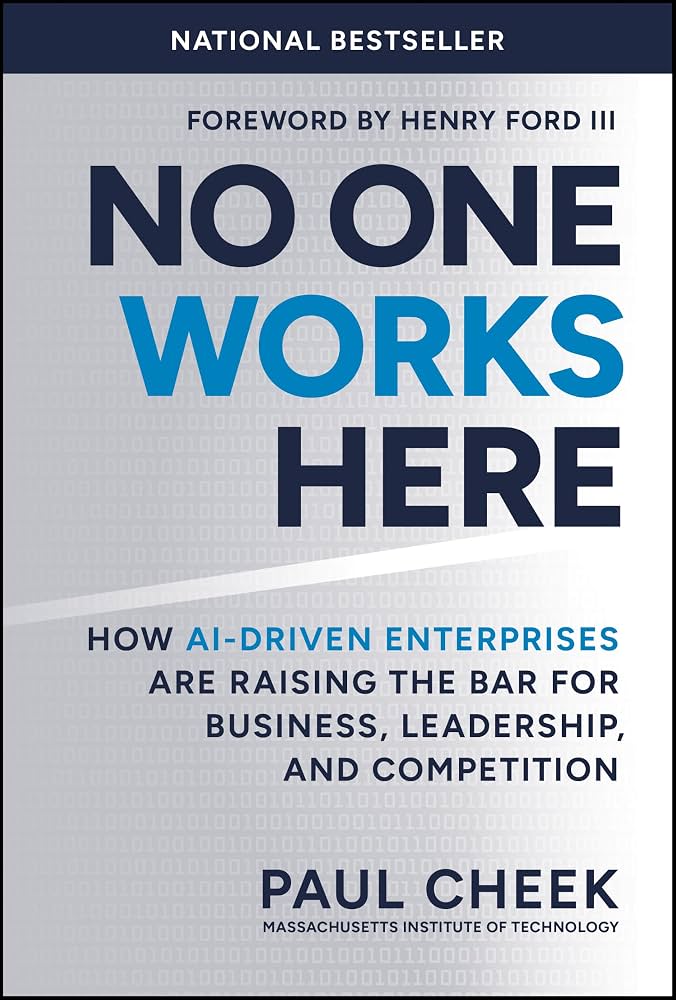
No One Works Here
Lorem ipsum dolor sit amet, consectetur adipiscing elit. Suspendisse varius enim in eros elementum tristique. Duis cursus, mi quis viverra ornare, eros dolor interdum nulla, ut commodo diam libero vitae erat. Aenean faucibus nibh et justo cursus id rutrum lorem imperdiet. Nunc ut sem vitae risus tristique posuere.
Lorem ipsum dolor sit amet, consectetur adipiscing elit. Suspendisse varius enim in eros elementum tristique. Duis cursus, mi quis viverra ornare, eros dolor interdum nulla, ut commodo diam libero vitae erat. Aenean faucibus nibh et justo cursus id rutrum lorem imperdiet. Nunc ut sem vitae risus tristique posuere.
Paul Cheek challenges you to rethink what a company can look like in the age of AI. No One Works Here is provocative, practical, and full of ideas that will change the way you think about building teams, scaling businesses, and the future of work.
Related Walker Webcasts
The Alpha Trap with Steve Hills
Learn More
September 9, 2026
Technology
The Data Center Boom with Chris Crosby
Learn More
July 1, 2026
Technology
The Human Advantage with Angus Fletcher
Learn More
April 22, 2026
Technology
Insights
Check out the latest relevant content from W&D
News & Events
Find out what we're doing by regulary visiting our News & Events pages
