Willy Walker:
Good morning, David.
David Gelles:
Good morning.
Willy Walker:
Great crowd.
David Gelles:
Hi, everyone. Thanks for coming.
Willy Walker:
I'm given the competitive set this morning. This is a really great crowd for you. I would say I think we're both fortunate that we're not going up against Lionel Messi at the one o'clock time slot this afternoon.
David, I want to start here. If Yvon Chouinard were with us this morning, I want to get from you what I am going to interpret his emotions would be listening to our conversation. First, Chouinard would want to be sitting right next to me and not down in the audience. Second of all, he would look at what I am wearing, and he would say, pretty nice that Willy's wearing a Patagonia shirt. He's wearing a Patagonia vest from 1999. He would probably have an issue with my Patagonia bag that has a corporate logo on it. He would be a little bit upset that you were being interviewed by a public company CEO and not a writer or one of the writer conference fellows who is toiling away at his or her craft. He would be very upset at the fire that broke out last night just south of here, reminding him of the 1988 Yellowstone fires that really amped up his activism for our planet. He'd be grateful for the book that you wrote about his career. And he would probably do a little bit of background on me and my company. And he would first see that I have an MBA, and he would say, the only MBA I know about is management by absence. Second, he would look at all the things that we do to try and give back to the communities where we operate and probably look down his nose and say, it's not enough. And then he would also look at our financial performance and say, Willy's a little bit too focused on the bottom line and not enough on the broader impact that his company is having.
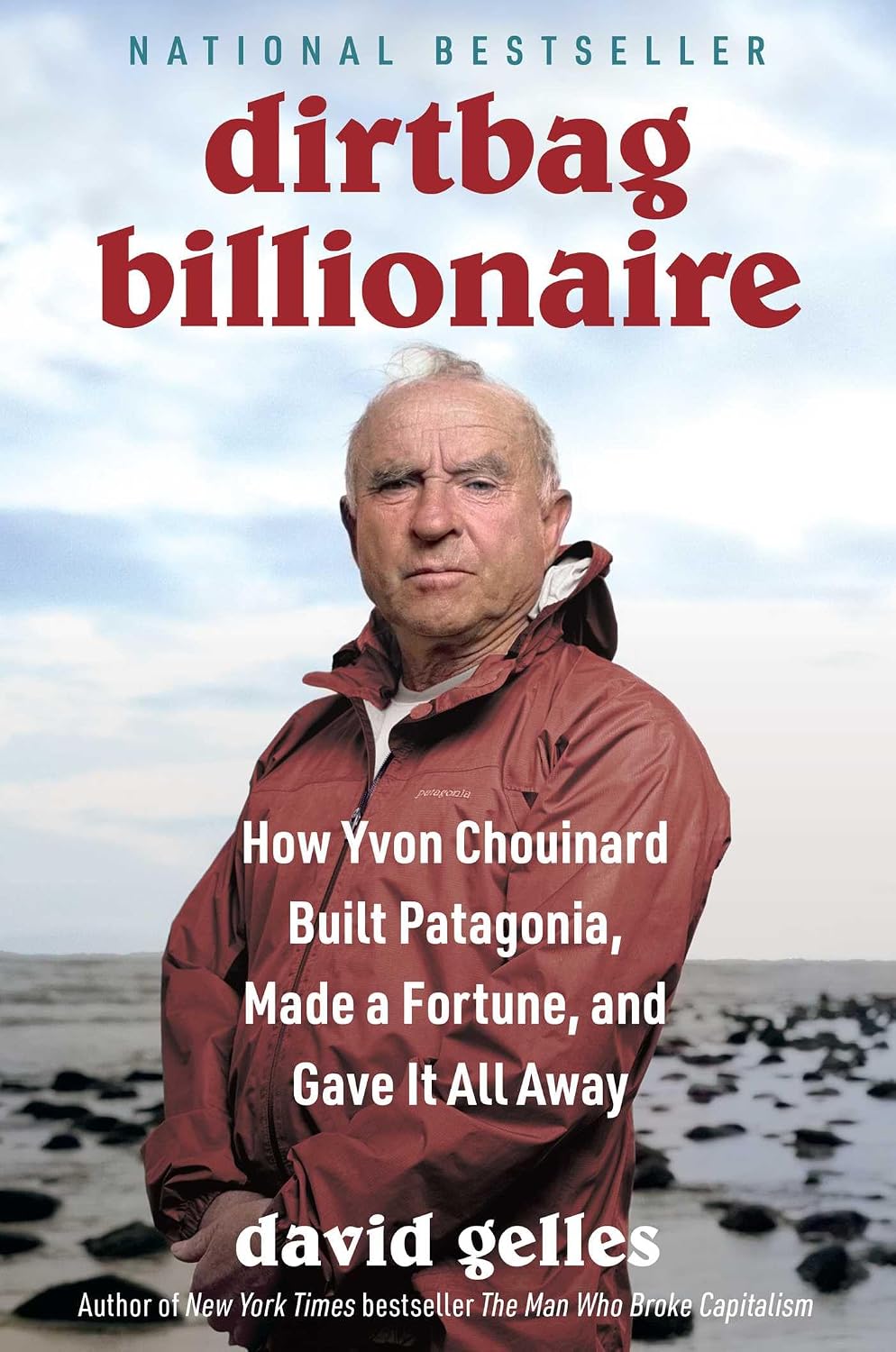
If we can go to the cover of the book, with all of that as the background, first of all, what I get right, what I get wrong, but second of all, and more importantly, why did you pick that image of Yvon Chouinard for the cover of this book? And what does that tell us about him as a person?
David Gelles:
Thanks everyone for being here. Willy, thanks so much for this conversation.
The first thing I would say is, given his choice, Yvon Chouinard wouldn't be anywhere near this stage right now, because the last thing this man wants is for other people to be talking about him. He has been a recluse from the time he was a young man. And this was one of the central paradoxes that I had to wrestle with in reporting this book and telling this story, which is that unlike so many public figures, unlike so many entrepreneurs and businessmen, he really had no interest in making it about himself or building a name or being on magazine covers, let alone book covers.
I mean, in fact, when I went to the company and said, I'm planning to write a book about Patagonia, the answer I got back was, "We would rather you not.” And I said, well, let me rephrase. I am writing a book about Patagonia. And thank you to our First Amendment rights for making that possible. And I hope you participate. And they said, “Thanks, good luck.” I didn't hear anything for a long time. And what I did was start reporting. And so I tracked down employee number two at the company. I tracked down his childhood friends and his cousins. And I said, I'd like to interview you about the company. They then started to tell the company that there were some reporters sniffing around.
And it was only after more than a year of this that I one day got a call, a year into my reporting project and said, what are you doing this weekend? And I said, I don't know. What am I doing this weekend? And they said, Yvon wants to see you. Come to Wyoming. And that began years of our dialogue that ultimately informed this book.
And so that picture, there are a lot of pictures of Yvon Chouinard out there. But it really captures many of what I came to understand as some of the defining personality traits of him and his life.
Number one, and perhaps most importantly, he's in nature. This is a man who from the time he was a young boy was driven to the outdoors. And it was his time in nature that was really the crucible that formed the foundation of his identity, his worldview that would go on to shape everything that he would do. Number one, he had to be in nature.
Number two, he's wearing Patagonia gear. That Patagonia shell, it represents that hardcore technical gear that ultimately was the type of clothing that made the company so successful and allowed him to do the conservation work that has become so impactful. And then, as for his expression, there are pictures of Yvon Chouinard smiling. But if you spend time with him, the overall tenor of his demeanor these days is much more taciturn. He's not optimistic about the state of the world. He's not optimistic about what climate change is doing to this planet right now. And so I felt it would be disingenuous to put a picture of him smiling on the cover when that's not ultimately where you find him when you spend time with him today.
Willy Walker:
Well, talking about spending time with him, there's a picture of the two of you fishing, which I think encapsulates what you just talked about as his true essence. He's a pretty happy guy right there. What was it like going out into Patagonia fishing with him, exploring with him? What did you see when you were actually out there with him that we missed by just reading a book about him?
David Gelles:
He's happy when he's catching fish, as we all are. Yvon Chouinard today spends most of his time on the road just looking for trout and salmon. And he has earned that right over the years.
What I found in spending personal time with him, and so let me just slow down here. I got that call in 2023, after I had been working on the book project for about a year, essentially reporting around my target. And that's something they teach you in journalism school at the Times. Sometimes the source, the subject, is not going to cooperate. You report around the story. And so I was doing that. I had made a list of hundreds of people I wanted to talk to.
I was methodically going through it. Finally, I get the call. The man himself wants to see you.
I get on a plane. I fly to Wyoming. And I spent the better part of a week with him and his wife, Melinda, at their home outside Jackson, Wyoming. And I didn't know what to encounter. I mean, here was a man who at one point was worth billions of dollars, had essentially unlimited capital to live whatever type of life he wanted. And when I pull into the driveway, what I find is an old Toyota hatchback with a bumper sticker that says, "Every billionaire is a policy failure.” The house itself is a sort of rundown two-story log cabin. The doors are cracked open. I walk inside, and the house is cluttered with secondhand furniture, which I later discover is the same furniture they purchased in the 1970s, secondhand from the National Park Service.
We settled in. We make small talk. It's dinnertime. There's no staff coming to help. We head to the kitchen, and we start chopping our vegetables using a knife, I later learned, he's had for 50 years. It's a Japanese blade that he's continued to sharpen, and a cast iron pan that he's also had for almost 50 years that's still well seasoned.
And over the next several days, we cook for ourselves. He smokes the trout that he catches on the river. We do our own dishes. And that was the purest distillation of who this man is. And here, maybe it's important to acknowledge the title of the book is Dirtbag Billionaire. Some people hear that title, and they're like, oh, you must not have liked the guy. And I say, no, to the contrary. I have a lot of respect for him. He calls himself a dirtbag.
In the climbing community, in the outdoor world, a dirtbag is someone who is so unenamored with materialism, so unconcerned with living comfortably, that they are content to sleep in the dirt if it means they are that much closer to nature. And so the great paradox of him and his life in this company is that he still calls himself a dirtbag, even though he became a billionaire.
Willy Walker:
Let's go to that. This picture is of him climbing in the early years. And you're talking, David, about him being the true dirtbag, living out of the back of his car. He grew up from an immigrant family from Canada into the United States, in Maine. They had a farm. They were not poor, but certainly, I mean…
David Gelles:
There were hard years.
Willy Walker:
There were hard years. The family moved to California. He begins to learn his love for the outdoors, hiking around Los Angeles. They lived in Burbank. He went over to the observatory and started to explore around the observatory, and then was shown the ocean and all of a sudden saw what you could do about surfing and getting involved in those types of sports. And then he started to go to Yosemite.
And he would go up to Yosemite and stay at Camp 4. And that picture that we just put up there is of him climbing at Yosemite. And he then started to make his own tools for climbing. Get us into, if you will, what it was that got him to start to be the entrepreneur he was, and that conflict of just literally wanting to be in the outdoors and not really have a job and not do anything else. And yet, at the same time, started to make those things to subsist.
David Gelles:
Well, you bring us right to sort of a crucial juncture in the narrative. The one thing I would add to a really concise summation of his early years is that he ultimately started rock climbing because he was learning how to capture and train birds of prey.
He fell into this really eccentric group of falconers in the late 1950s in Southern California who were sort of doing just that. Actually going out, capturing peregrine falcons, training them. What he ultimately discovered was that in order to reach the aeries, these nests which were nestled against these cliffs in Southern California, you had to rappel down the rock face. And he was one of the few adventurous people who was willing to do that and actually go capture the baby raptors and bring them back so they could train them.
And what he learned was that he loved being on the wall. He loved rappelling down. And there was one day when he was rappelling down where he thought, what would it be like to climb up? What would it be like to start from the bottom and get to the top? And that led him to this really nascent scene of big wall rock climbing. He started climbing, as you said, the walls of Yosemite ultimately. But what he found very quickly was that the gear that you could buy was simply insufficient. They were starting to do more ambitious, more technical climbs of rock faces that have literally never been climbed before at this point. He puts up all sorts of first descents across North America.
But he says the gear that you could buy, most of it was imported from Europe at that time, was simply not designed for these kinds of climbs. It was sometimes too weak. It was sometimes too heavy. And so what he does is borrows a couple hundred bucks from his parents, goes to a junkyard, buys an anvil, a coal-fired forge, and some tools, and starts making his own equipment, hammering out those pitons that you see there on his own anvil. He does them initially just for himself and his friends so they can do these climbs. But very quickly, other climbers discover that, oh, Yvon Chouinard is making the best gear that's out there. And they start asking for it. And very quickly, before you know it, before he even understands what's happening, he's a businessman.
He's selling this gear out of the back trunk of his car to other climbers. He's got inventory. He's got a price list. He's got overhead. He suddenly has a few employees. And even though he hated business people at the time, he loathed them, he called them greaseballs, and that was an insult, he himself became a budding entrepreneur. And there again is this tension right at the very early days of his narrative between the capitalist and the climber, between the conventional businessperson and the consummate outdoorsman.
Willy Walker:
You mentioned he started to employ people. And here's a photograph of the early Pacific Ironworks workers.
David Gelles:
This is what your employees look like, by the way, Willy.
Willy Walker:
Right, exactly. That's an interesting one that you throw that out there, only in that I would say one of these conflicts that comes up is that the way they ran Patagonia, they were cutting edge as it relates to employee benefits. They were one of the first corporations in America to put daycare inside of the office.
And yet if you look at the history of Patagonia as it relates to an employee-centered company, they're not really an employee-centered company. He's much more focused on the environment and giving back to the planet than he is on either making his employees wealthy or, to some degree, there seems to be a little bit of disdain in there between him and his employees. Expand upon that, given that original picture of the first people who helped him launch the company.
David Gelles:
Let's start at this moment and come back to some of the dynamics you described because I really think those develop a little later in the narrative and they're super important, and I want to get there. But let's sort of give him the benefit of the doubt and look at that picture and imagine what it would be like to be a part of this culture in the 1960s. Once the business gets going, the climbing gear business gets going, he's got a little overhead. He's got some money. They moved to Burbank. Why? Because he wanted to be closer to the waves. And what does this motley crew of workers do? Well, he says, I want you to work. You can work on your own hours. But here's the rule. Anytime the waves are breaking in Ventura, everyone has to put down their gear and go surfing.
And this is the culture. And he means it. He does it. And that becomes the nexus of this really beautiful and weird and sometimes disgusting sort of outdoor surfer-climber hybrid community that takes root in Ventura, California. And what he starts doing once there's enough of a rhythm to the production is he starts going away for weeks and then months at a time. And he invents this phrase, which you invoked in the opening. He says he didn't graduate from college. He certainly never went to graduate school, never got a business degree. But he says, I have an MBA. And that's called management by absence, which is to say the company can do whatever it wants, but I'm going fishing. I'm going surfing. I'm going climbing.
And against all odds, the company keeps growing and growing and growing. And they start making not just thousands and tens of thousands of dollars in revenue from climbing gear, but they start making millions of dollars because this is a moment in the 60s now where there's a big appetite for this kind of gear and rock climbing is becoming more popular. And then during that period in the late 1960s, they expanded into clothing. They start making their first pieces of clothing. And a good friend of his says you're going to make a lot more money selling T-shirts and vests than you're ever going to make selling climbing gear and pitons and carabiners. And so in 1973, Chouinard Equipment essentially set up its own clothing division. And that becomes the company known as Patagonia.
Willy Walker:
Talk about that friend for a second. Doug Tompkins. There's Chouinard and Tompkins on the top of a mountain together. Talk about the importance of Tompkins in both their friendship of exploring the outdoors together, and then to exactly what you just talked about, about Tompkins saying to him, the tangible addressable market in the climbing community is back in the 1960s. I think you put in the book, there were about a thousand rock climbers in the United States, and thinking about going into the clothing business, which was a much, much larger tangible addressable market.
David Gelles:
Yvon Chouinard developed tons of deep and meaningful friendships over the years. And I include many of those in the book. And I think there's just an important footnote. The creation of Patagonia and everything that it did was not the work of one man. It was the work of a community and a group of friends. And I really try in the book to show how many people, in so many different ways, played a role in creating this culture and ultimately delivering the philanthropic outcomes that have really reshaped parts of the world now.
None of those men and women, however, was more influential and more impactful than Doug Tompkins. Doug Tompkins and Yvon Chouinard connected early; they were in their 20s, and they were just kindred spirits. They were alike in many ways in that they were daring, iconoclastic outdoorsmen, but they couldn't be more different in some ways. Whereas Yvon Chouinard grew up in near poverty, as you said, at times. Doug grew up from an incredibly wealthy family in New York City. They had very different perspectives. And yet they both also had real sharp business acumen. And just to pause here, Chouinard Equipment, the climbing business, goes on and becomes Black Diamond, a company that is still extant today. Many of you may know it. Patagonia, of course, is also a big company still out there today. Yvon Chouinard founded two companies that lasted a half century or more. Doug Tompkins, his best friend, also founded two companies, both of which have lasted 50 years or more.
Doug Tompkins is the founder of both The North Face and Esprit. These two men found these four companies that go on and reshape not only the outdoors business, but, through their charitable work, start to push and pull one another. And they take very divergent paths at times, both from their corporate governance and how they spend their money, and then also to their charitable work. And they're in dialogue, on the road, in nature, until the very end. And I won't tell you what the very end is. You got to read the book for that.
Willy Walker:
We'll get to the very end. Here's when they went into the Pacific Iron Works turned into Patagonia. Talk about the entry into the clothing business, and how both what the opportunity was there, and then also what the challenges were for Chouinard, who was this gentleman who was so focused on being true to what he wanted to do. I mean, making the pitons and selling them out of the back of his car was his way to a) subsist, honestly. And then second of all, it was something that he was very passionate about.
And you mentioned previously, David, that he didn't have the equipment or the clothing to be able to do the things he wanted to do. And so it seemed from the book that it was actually that need to be able to have a jacket like this, that he could take into the out-of-doors and not freeze to death. There was sort of the need for him to expand into the clothing business versus Doug Tompkins saying, as I used in a business term, the tangible addressable market is so much bigger.
David Gelles:
The Patagonia company stood up as its own formal entity in 1973. And they started selling and making shorts, rain shells, ultimately vests. And Chouinard is absent for a lot of this. He's not the CEO even at the time. A woman named Kris Tompkins, who we may discuss later, becomes the CEO and really is the one who scales this business. And yet along the way, it's still Yvon Chouinard who is coming up with the signature product developments that allow Patagonia to be the success that it is.
And where does he have those insights? Well, he has them during his management-by-absence trips. He goes out into the woods. He puts himself through absolute grueling torture on multi-week treks through the cold Patagonia winters, deep into the backcountry. And he's taking note of the ways in which his clothing fails him. And he comes back, and he shows his team, here's where the jacket ripped. Here's what's not working. The fabric didn't dry. And it's that first-hand, first-person research that only someone like Chouinard could do that informs the product team and gives them the roadmap for what kind of clothes they need to be developing.
And guess what? No one else in the country, no one else in the industry is doing that. And so, year by year, Patagonia becomes the leader in the outdoor apparel business. And so, I mean, any of us who go skiing, we're familiar with this layering system. You have a base layer, a mid-layer, and then a waterproof shell. Guess who came up with that system, effectually?
It was Chouinard and the Patagonia team, as they understood what it meant to really protect the body in the elements. And guess what? The company grows.
And it gets bigger and bigger and bigger. And here we sort of shift from the narrative just about Yvon Chouinard the man to Patagonia the company. And it now takes on sort of a life of its own. And I chart in the book many of the ups and downs and mistakes that were made. And Chouinard himself, of course, had a deep understanding of the natural world and a deep love and appreciation of the wild places on Earth. But I would posit that it was only through his work at the company that he really began to understand the environmental degradation that was happening on Earth because he started to see it through his own work. He began to understand, as Patagonia scaled, that the company he had created was actually extracting a negative toll on the planet he loved so much.
Willy Walker:
And that's one of the contradictions here. And so this photograph, the cover of Patagonia catalog, a couple of things, David, for you to comment on. First of all, in his relationship with Tompkins, the two of them seem to want to protect these beautiful places that the two of them had access to. And yet, at the same time, as we see in this picture, he's showing the world what it's like to stand on that peak wearing Patagonia clothing. And to some degree is inviting all of us to go visit these places that it seemed like he and Tompkins wanted to just say, don't go there. There's this constant conflict as it relates to, I'm going to show the world how to use my clothing and my equipment to go explore these places, but I don't really want them to go there.
And then there's also the, but the gear that I'm making also needs to innovate. And therefore this jacket is, if I put a match to this thing, it's going to melt, not burn. It's made out of oil-based products. And so, as he's constantly innovating to try and grow and create things that we would want to take into the outdoors, he's also using materials that are against his environmental ethos.
Talk about that conflict during the 1990s, as this company is going sort of up into the right and his own personal struggles of having to innovate. And then also show all of us these places that he seemingly wants to keep to himself.
David Gelles:
You can go to conflict, you go to contradiction, you go to paradox, you'd call it hypocrisy. But this became the animating tension at the heart of the company and the man. And you said it very clearly with the synthetic materials.
Patagonia popularized the use of synthetic materials, which, let's be clear, are made from oil. And it took them a while to realize that, and they're not entirely comfortable with it. And yet, in the service of making these products, that was the best material, so they used it. There weren't a lot of great solutions. They ultimately really embraced and began pioneering the use of recycled petroleum products. But that only gets you so far. What did that look like in other areas with other fabrics? Well, take cotton. They were using a ton of cotton products in the 1980s. And at the time, conventional cotton was all you could buy. There was no big market for organic cotton.
Well, they had a rude awakening one day when the workers in one of their stores began getting really violently ill. And they were getting sick because of the new cotton material that was in inventory, all these new T-shirts that had just come into the store, they were off-gassing formaldehyde because the cotton had been treated with formaldehyde. And it was when they understood, oh my gosh, conventional cotton is toxic. Guess what? Chouinard went out to the fields in Central California to see what conventional cotton fields look like. And what he found was sort of an industrial wasteland. And he was appalled by it. He said, all right, we're shifting to organic cotton. His team said, there's not nearly enough organic cotton to satisfy our requirements. We would lose up to 30%, perhaps more, of our business next year. He said, make the change.
And here, very critically, he was willing to sacrifice in order to pursue something he believed in. He was willing to make a sacrifice of revenues in pursuit of his values. And this is a pattern that we'll see repeated. But the tension is still there. They phase out conventional cotton. They start promoting organic cotton. But as soon as they do that, they encounter new supply chain issues. They realize that some of their workers in overseas countries are being mistreated. They realize that the rivers behind the factories that are making some of the dyes that go into their vests are polluting, being polluted by the factories. And it becomes this moment, this is really in the 90s now, where Chouinard and his team began to have a much more holistic understanding of all the complications and, frankly, like the deleterious impacts of industry and their role in it.
And at that moment, you could imagine someone with such rigorous beliefs as Chouinard saying, well, enough, walk away from it all. And yet he doesn't. Patagonia continues to grow. And with it, so does their environmental impact. And the next several decades, which brings us right up to today, is a process of him and the executive team and the company wrestling with their negative impacts on the world and trying to find the ways to minimize it when possible, but also to counteract it and address it where possible.
Willy Walker:
During that period of time, Doug Tompkins had A) sold the North Face for not very much money, but then he and Susie Tompkins sold Esprit and made a huge amount of money. And so Tompkins was sitting there in his ear throughout that period of time saying, just sell it, take the money, and give it away. Let's go buy land in Latin America, and we're gonna save the world. And Tompkins actually bought almost a million acres of land to create the Patagonia National Forest, not without its own question marks by Latin Americans and Chileans in particular about what were Tompkins' real intentions there, because nobody in Latin America was out buying great swaths of land to be an environmentalist and turn them over. They thought he was trying to buy the land to take over the place. And he brought in Chouinard to participate in that.
But he struggled throughout, and I don't wanna get to the very end yet about what to do with the company. And as you look back on all of his efforts to, first of all, give away 10% of profits on an annual basis, then he started a number of coalitions to try and get other retailers to join him. And you talked about organic cotton.
Talk for a moment about the impact that Patagonia had on Walmart, because as you sit there and kind of count up how Patagonia started to make an impact on the economy, there's one stat you give that they pulled together a bunch of retailers to do this coalition, and they gave away $36 million. And I looked at $36 million, and I say, it's nice, but it's not gonna move the needle. But then he went to Bentonville, and he got Walmart to focus on using organic cotton. Talk about that, because I think it represents the broader impact that this company that stood true to its values had on the broader economy and today still has.
David Gelles:
One of the things that really surprised me in reporting this book was finding the fingerprints of Patagonia and Yvon Chouinard all over the rest of the business world and our modern economy. I think I was tempted when I began the reporting to believe that this was a unique case study and a great narrative, but their impact could only be so large given that it was a relatively small private company based in Southern California. But Walmart is perhaps one of the greatest examples of their much broader influence.
You talk about strange bedfellows; Yvon Chouinard and the CEO of Walmart couldn't have more distinct, different executives. And yet the invitation came to Patagonia to help Walmart think through some of its own sustainability goals. And they go there, and Chouinard addresses the team, and there's some comical scenes in there about what it's like when a dirtbag shows up in Bentonville, Arkansas.
At the end of the day, though, Walmart takes some of these recommendations seriously, starts implementing some of the practices that Patagonia has suggested might be beneficial both to sustainability and the bottom line. And in the blink of an eye, you could contend that what Walmart did in a quarter was perhaps more influential and impactful than what Patagonia could do in a decade simply by sheer virtue of Walmart's size. Patagonia pioneered the organic cotton market, but when Walmart decided to start using organic cotton, guess who became the largest buyer of organic cotton practically overnight?
And time and again you see, oh, scale can really make a difference here. The asterisk, of course, is how many businesses of scale possess the kind of values that animate a company like Patagonia? And the answer is not nearly enough.
Willy Walker:
And so when you think about the focus on the environment, I mentioned previously sort of the tension between the focus on the environment versus the focus on the employees. I've got a picture here, you talked previously about Kris, who ran the company for a good period of time. He had a lot of—you said he wasn't really CEO, he would do management by absence very often and yet the company churned through leaders. I think in, I mean, almost as many as the UK has turned through prime ministers in the last decade.
The question I have for you is why was it so hard for Yvon to get leadership in the company on a day-to-day basis, given both his image, his brilliance, I mean was there something to him that was very hard to work for?
David Gelles:
Yes, yes, and yes. It's important first to note that Kris McDivitt-Tompkins, pictured here, ran and scaled the company for more than two decades. And so she was his most consistent and trusted executive, and she remains on the board of the company. And she, along with Doug, so she started as an intern at Patagonia, became the CEO of Patagonia, and ultimately married Doug Tompkins, Chouinard's best friend.
They then go and spend the money that Doug made from selling Esprit, buying up land in South America. One thing that's not particularly well known but that I document in the book is that a lot of that money also came from the Chouinard’s and from Patagonia. But just as I said at the beginning, guess who didn't want his name anywhere near it? Yvon Chouinard. Their name is not associated with a lot of those land purchases, even though it was their capital that made many of them possible. Kris steps down as CEO of the company and indeed, following her departure, Yvon churns through CEOs.
And I think there were a couple of things that led to that revolving door, if you will. The first is, he could be very difficult to work for. I don't wanna undersell it. Patagonia is a great place to work for many employees. The benefits are quite good. You have a lot of flexibility. There are opportunities for volunteering. You can still go surfing, maybe a little less flexible than it was in the 1960s. But that culture still exists.
I think where Patagonia, as you rightly point out, has not been as progressive as some other companies is with sharing the wealth created by the company with its employees. That was a dynamic that frustrated many longtime executives there. They saw themselves producing enormous wealth for this company. They saw the Chouinard’s giving all this money away and living pretty nice lives themselves. Why couldn't they get some of it? That was a tension that exists through to this day.
The other thing that I think made it extremely hard for many CEOs was that Chouinard was a micromanager. He could change his mind very quickly. He had a temper that could flare. I document this in the book. This is not a hagiography. Yes, he could be a brilliant executive. Yes, he could be an incredible product designer. But he was a very complicated man, and he could be extraordinarily difficult to work for.
Willy Walker:
This picture of him at his desk reading and writing, given that we're at the Sun Valley Writers’ Conference, as I said in my opening, where he's sitting here, he would love the fact that we're at a writers' conference of people who really enjoy reading. Talk a little bit about his intellect and how much of that came from his reading. Was there anything, as you studied him and talked to him, of seminal books or seminal things that he had read that really influenced either his management style or who he was as a person?
David Gelles:
Yes, this is another delightful surprise that I encountered in the reporting. He never went to college, and he, by his own admission, was sort of a D student in school. He had an incredible love affair with literature.
He was a deep reader from the time he was a young man, and that continues to this day. And of course, guess what? If you are a great reader, you have the potential, the voice, the aptitude to be a really successful writer yourself. And he did that in essays in the catalog, in his own books. And it was the transcendentalists who were some of the writers that first captured his imagination. He read widely. He read Joseph Campbell as well, and was an incredible influence early on. And he continues reading to this day. Nature writing is deeply important to him.
And now, as I mentioned at the start, he's most often found on a river fishing somewhere. He writes deeply about fishing. And he is a celebrated author among the many anglers here in Sun Valley as well.
Willy Walker:
And celebrated author of the book entitled Let My People Go Surfing, correct?
David Gelles:
Let My People Go Surfing was the first and probably most famous book he's written. And that was a nod to the way he tried to run his company. And again, a lot of truth to it, but I've spoken with hundreds of Patagonia employees over the day. It's a more complicated picture to actually work for them full-time.
Willy Walker:
And we've talked about his focus on product engineering and innovating and continuously innovating. Talk for a moment about his marketing because Patagonia, as it relates to marketing, just set all new, if you will, standards as it relates to both that photograph that I showed, Rick Ridgeway, who was one of his best friends, became sort of the photographer for Patagonia Magazine. When I was living in Latin America in the late 1980s and in the early 1990s, I was one of those people who would wear a jacket like this, go out and take pictures in Latin America, and try and get into the Patagonia catalog. And I'm one of those people who has, Rick Ridgeway’s wife ran the catalog at Patagonia. And she's one of those people who literally wrote me a note saying, thanks, Willy, nice try, keep trying.
But the concept that you'd have people like me living in Latin America doing their work for them, they didn't have to pay fancy photographers to go out and take these pictures. And they built this incredible, what I would call cult around A) wanting to be in the catalog and then B) setting the proper brand image that Chouinard has always been extremely sensitive to. Talk about that.
David Gelles:
Well, the way they did marketing was by not marketing. To this day, Patagonia spends disproportionately small sums on advertising. And especially in the early days, if we're talking about the 80s and 90s and even early 2000s, they did almost no paid marketing. It really was not only a reflection of Chouinard's sort of distaste for the broader culture of capitalism, but it was, I think, more deeply a reflection of their conflicted feelings about trying to get people to buy things that they might not need. And this is, again, one of those paradoxes.
Here, Patagonia is making new vests every year, slight changes, new colorways. And yet most of the people buying those really don't need them. They just wanted them. And he was always deeply uncomfortable with that. And yet, how else was he going to grow his business? How else was he gonna pay his employees? How else was he gonna have money to spend on conservation and supporting grassroots environmental activists?
There's that paradox again.
How did they do the marketing? Well, they tried to make the marketing about the customers rather than the products. Jennifer Ridgeway, who's now passed, but she was the wife of Rick Ridgeway, and she essentially reimagined Patagonia catalogs, not as just images of the latest SKUs with the prices below, but as almost more akin to the Whole Earth Catalog, if you recall that. Beautiful pictures submitted by customers. And so I contend in the book that Patagonia really invented user-generated content, if you will, and then accompanied not by a lineup of what's different about that vest, really, but by meditative essays, discursive musings on some of these wild places and what makes nature so worth protecting. And that becomes the Patagonia catalogs, which are beautiful artifacts, if you can still find them.
Willy Walker:
I have a friend of mine who last night, I was telling him I was doing this this morning, and he said, God, I remember, I bought this big box of Patagonia clothing, and then he paused, and he said, did I buy it online? He goes, no, there was no way I bought it online. It was like 2003, he goes, I wonder how I got it. And I looked at him, I said, mail order? And of course, he'd completely forgotten that the Patagonia catalog, you used to be able to go call an 800 number, actually fill out the form, and send it in. And the one other thing that I would say is I went to pull this vest off of my shelf out of my closet this morning, and I thought Yvon Chouinard would be really happy that I'm wearing a 26- or 27-year-old vest and still have it. There were about eight other Patagonia vests that lined up in there that he would not be very happy about, except for the fact that I've driven his sales over all that period of time.
Talk about the conflict as it relates. I talked about the branding on the bag, the branding on this. What I am wearing is called the Midtown uniform, which Chouinard hated because there was a period of time where all Wall Street firms would buy these vests, put on them Goldman Sachs, and this was the Midtown, even though Goldman Sachs is downtown; this was the Midtown uniform. That's another one of his big struggles . I love seeing my brand out there. I love seeing people like Willy Walker wear it, but I don't really like the fact that corporate America is somehow using my brand to promote them or promote what they're doing.
David Gelles:
Well, that's exactly right. Even more specifically, what they realized is that a lot of the summer interns were getting issued Patagonia vests when they started their couple of months at KKR or wherever it was. Upon finishing their summer internship, they would throw the vests away.
That sense of disposability, coupled with being used as a vehicle for the branding of some of the financial firms that Chouinard would contend were making the world a much more corrupted place, it was enough to say, to hell with it. They stopped doing that work.
Willy Walker:
This final image I want to talk about, and then after we talk about the end of the story, I'm going to open it up for some questions before we finish on our time. David, this is the two of them, Melinda and Yvon.
David Gelles:
That's Jane Goodall.
Willy Walker:
Oh, that is Jane Goodall? It is Jane Goodall. I should have noticed that when I pulled this picture out. Pardon me for my—I sent you these pictures before we used them. I wish you'd written it.
David Gelles:
You didn't say that you thought that was Melinda.
Willy Walker:
I know, I'm sorry. It's true, true you are.
David Gelles:
You said these two people. That's Jane and Melinda.
Willy Walker:
These two people, Jane Goodall and Yvon Chouinard, actually did talk about the future of the planet. Let's just suppose for a second that that's his wife Melinda on the left and not Jane Goodall.
The two of them sit around and they're trying to figure out what to do with Patagonia. And in their deliberation, do we sell it to a private equity firm? Gosh, no, we've just talked about why they don't wanna sell it to a private equity firm. Do we sell it to VF Corporation, which now owns the North Face and a bunch of other brands? Gosh, VF Corporation, we don't know whether our employees will still be here and they certainly won't be the great stewards of this brand and this company that we have been. And they set up a group of close advisors, estate planners, people inside of Patagonia to sort of wrestle with what to do with this?
Talk us through sort of the ups and downs of that process and how they ended up deciding to do what they did with the company.
David Gelles:
Well, first he said, so Jane.
Willy Walker:
Yes, there you go.
David Gelles:
It was something that gnawed at him for decades. What happens to Patagonia when I die? They would talk about it because they knew that he was integral to the brand. And to get a little wonky here, Chouinard, his wife, Melinda, and their two children were the sole owners of the stock in Patagonia. Something had to happen. There was going to have to be some transaction either after his death or potentially before. As you say, they went through every permutation. Do we go public? Do we go private? Do we sell to a benevolent billionaire? And none of the options satisfied what they had identified as their couple's main criteria.
And those were these. They wanted, number one, for Patagonia to have the opportunity to last another 50 years and sort of be the company that it was. Number two, they wanted to continue to give away as much money as possible to the causes that they cared about, grassroots environmental activism and conservation. And number three, and this was really important to Chouinard, they didn't want to be billionaires anymore. There was a moment in 2018 or so where for the first time Forbes magazine put Chouinard on their list of billionaires. And he said it was one of the worst days of his life.
He stomped around the office, fuming mad, screaming at people saying, get me off that list. And of course, not so easy. He was effectively a billionaire on paper. And so that agitation led to this succession planning process and ultimately led to this very unusual structure that in 2022 saw the Chouinard family donate all of their stock to a new series of trusts and nonprofit entities. And now here's how it works. There's a trust which owns the voting stock for the corporation. It instructs the corporation to give away all the profits not reinvested in the company, which amounts to somewhere between 50 and $100 million a year. All that money every year goes to a new group of nonprofit organizations called the Holdfast Collective. And the Holdfast Collective distributes those monies on an ongoing basis to the very causes that Chouinard and his family have always cared about, conservation and grassroots environmental activism.
And in fact, I know we have some of the beneficiaries of those monies in the audience right now in the form of Amy Bowers Cordalis, who I'll be speaking with tomorrow. More on that later.
Willy Walker:
A couple of things on that. First of all, does the company continue to generate the types of profits it's been able to going forward without Chouinard's brilliance in leading it? These are the big questions.
David Gelles:
And he doesn't know the answer to them right now. Patagonia is now roughly a billion dollar revenue, maybe a little higher, a little lower. But Chouinard knows as well as anyone, and I see it clearly as a business reporter for the New York Times, the market has never been more competitive.
You've got not only pressure from the top in the forms of brands like Arc'teryx and Norrøna and all these super high-end outdoor brands, but you've got pressure from the bottom with whatever you can buy on Amazon or Temu for a couple bucks. You've got a wildly fragmented media landscape that makes it harder than ever for even a brand with a message to punch through. You've got a founder who's now 88; I believe he's turning years old. And while he's as vigorous as any 88-year-old I've ever met, he's only gonna be around for so much longer. And you've got a company that is now still staffed with highly motivated, idealistic employees, but not employees that can expect any financial upside for the work that they're contributing to. And so in an environment where the competition for talent is extraordinary, Patagonia is not able to offer them the potential or the opportunity or the promise of a big return at the end of the day.
Is that a recipe for innovation and continued growth in this market? I don't think anyone knows. I don't think Patagonia is going anywhere in the next decade, but what exactly Patagonia looks like two decades from now and what its impact is going to be, we'll have to see.
Willy Walker:
Two final things before I open it up to any questions. If we have mics here, we have time for two quick things. One is that David is very clear in the book that by donating the company to 501(c)(4), which allows it to make political contributions, and not a 501(c)(3), which is just purely a nonprofit, they lost the ability to use the donation as a tax shield for the rest of their estate.
Lots of people sort of threw darts, saying, oh, they're giving it away to protect the rest of their estate. And when Fletcher and Claire, their two kids who work in the company get it, they will have this huge tax shield. They lost that by donating it to a 501(c)(4) rather than a 501(c)(3).
This final picture that I pulled out, and I do know that that's you on the left and Yvon Chouinard on the right. As I looked at this picture, David, and the two of you, one of the things that you talk about Jim Collins in the book, and Jim Collins talking about how unique the donation to the 501(c)(4) was, and Jim Collins wrote a great book called Built to Last. And I thought that if you hadn't called this the name that you actually called it, Dirtbag Billionaire, you might call it Built to Last. That title probably would have really pleased Yvon Chouinard.
David Gelles:
Probably.
Willy Walker:
With that, David Gelles, let's go to any questions.
Speaker 1:
Why do you think he didn't consider his employees much more important to the success than he did by giving opportunities while he was there to earn a part of the company or something? But why was he so generous in other ways, but not with his employees?
David Gelles:
I think there are a handful of factors, but the first and maybe most fundamental is that I described to you that he considers himself a dirtbag. He still lives a very modest life in many ways. And I think he sort of assumed that if that was enough for him, it ought to be enough for other people. Now, that's easy for him to say when he has a house in Jackson and a house on the water in Ventura and can do whatever he wants. And so there was a disconnect there.
The second part, and this is just a difficult one to talk about, but I acknowledge in the book, he sort of had contempt for his own employees. And this is a dynamic I think I've seen occur with other founders, is that they never feel like people are working hard enough for them. They always feel like people are sort of taking from them or mooching off them or milking their resources. And that was just a complicated part of the story that, again, doesn't fit into the hero narrative, but it is very much a part of this story.
Speaker 2:
Good morning. Thank you so much, gentlemen, for your previous conversation. And I'm also pleased, David, that you included Dick Dorworth in the opening chapter of this wonderful book. Dick is a living legend here in this county. Which is also, of course, Patagonia County, but that was before Patagonia. And Dick lasted here a long time and we miss him. He's still around and fit, and I'm sure in touch with him.
I recommend this book to anybody that loves Ketchum or I should say Blaine County. And I would urge you to go home and count the number of Patagonia items you have in your closet. I know you have, because as you pointed out, Willy, they're everywhere.
But my question goes to something you've talked about in depth in this book, and that is sustainability and the duty of private corporations to sustain themselves. Presently in this county, we have a fight or struggle going on that our local governments think they are responsible for sustaining the growth of this county rather than individuals. Thank you.
Willy Walker:
Is Dick the one who, with Tompkins, drove on LSD to Reno? He is.
David Gelles:
There's a great story in there. I think you raised the issue of sustainability, both at the corporate and perhaps the community level. The paradox is here too. Chouinard's first foray into environmental activism came when there was a plan to dam and divert the Ventura River, which ran behind the office.
He didn't like the sound of that because it might have messed up the surf break that they all used to surf on. He went about and started funding grassroots activists who were working against that plan. It worked.
That is the origin of the story. He was trying to protect his community.
At the same time, Chouinard used the money he was generating to fund a campaign to block the construction of a new college campus in Ventura, which would have meant jobs and development and opportunity for other people in his community. That campus never got built. I go to Ventura a couple of times a year for various reasons. I have family in the area. That community would have benefited from a Cal State campus in a massive way. And this gets back to the notion of who's allowed to participate in these stories? Who's allowed to go to these places?
And yes, Chouinard tried to invite the world into these wild places. And he did that because he had his own personal and deep relationship with nature. And yet even as he did that, he couldn't help but try to keep other people at times at arm's length.
And there again from the earliest moments through the company's founding to his most recent conservation work, these paradoxes exist. It's a complicated story. But at the end of the day, I found a really inspirational one.
Willy Walker:
Ladies and gentlemen, David Gelles. Thank you.