
.png)


Executive summary
Commercial real estate is moving through 2026 with more available capital, fewer new starts, and a growing wave of refinancing opportunities, but the recovery remains anything but simple. Performance is increasingly property-specific, shaped by local supply, operating costs, disciplined underwriting, and shifting assumptions around income, expenses, capitalization rates, and long-term value. In this environment, appraisal is no longer just a transaction requirement. It is becoming an earlier source of strategic insight for understanding risk, evaluating options, and making more confident capital decisions.
Valuation moves upstream
Historically, appraisals have been commissioned after a transaction is underway. Today, owners, developers, lenders, and investors are engaging valuation professionals much earlier in the investment lifecycle to evaluate refinancing options, assess development feasibility, monitor portfolio performance, support financial reporting, and better understand risk before making significant capital decisions.
Property-specific insights matter more
Several trends are driving this shift. Improving capital availability, significant refinancing activity, and continued discipline in underwriting are increasing the need for earlier, property-specific valuation insight. Financing outcomes continue to depend on local conditions, property performance, sponsorship, and the assumptions supporting income, expenses, capitalization rates, and long-term value. As a result, valuation insight helps clients navigate a complex market with more clarity.
Local conditions matter more
National market averages are now less useful as a proxy for individual property performance. Uneven supply, rising operating costs, regulatory differences, insurance, property taxes, and neighborhood-level demand are making current, property-specific analysis grounded in regional expertise more important than ever.
Technology connects the dots
Technology helps make earlier engagement more valuable. Connected workflows, integrated market intelligence, and artificial intelligence (AI) are improving quality, increasing transparency, and identifying potential issues more quickly in the appraisal process. By streamlining routine work, these tools give appraisers more time to analyze markets, test assumptions, and provide clients with more meaningful insights.


What this outlook covers
How demand for appraisals is evolving
How market fundamentals influence property performance, valuation assumptions, and investment strategy
How technology, data, and artificial intelligence are reshaping workflows and client expectations
How development activity and supply trends are driving localized conditions
How capital markets and refinancing activity affect lending and demand for valuation services
How policy, regulation, and operating risks are shaping underwriting inputs and property-level decision-making
How key headwinds, tailwinds, and strategic opportunities are expected to influence commercial real estate valuation this year and in the future

Market fundamentals
Appraisers enter the decision earlier
Historically, appraisals often followed a decision: a property was under contract, financing was underway, or a regulatory requirement triggered the need.
That’s changing.
In today’s market, clients are engaging appraisers earlier to test assumptions, evaluate opportunities, and understand risk before capital is committed. The appraisal is no longer just supporting a transaction. The expertise and data behind it are increasingly helping inform the decisions that lead to one.
Clients are asking different questions. They want to know:
- What has changed since the last valuation?
- Which assumptions have the greatest influence on value?
- How is the new supply affecting property performance?
- Which risks should we be monitoring over the next six to twelve months?
These questions reflect a broader shift in the role of appraisal expertise. Small changes in rents, expenses, capitalization rates, or absorption can materially affect financing and investment outcomes. Bringing that expertise into the process earlier helps lenders and investors pressure-test assumptions, understand what is driving value, and identify risks before key decisions are made.
Advisory services are growing
Earlier engagement is also increasing demand for valuation and advisory services, particularly market studies and feasibility analyses. As development pipelines, operating costs, and local market conditions diverge, clients increasingly need forward-looking analysis before committing capital.
This analysis can help clients assess:
Competitive supply and demand
Achievable rents and absorption
Long-term market positioning
These insights inform critical decisions around development, acquisitions, refinancing strategies, and other major capital commitments.
Unlike a traditional appraisal, Apprise Market Studies help clients evaluate future conditions rather than current value. By analyzing competitive supply, demand drivers, absorption, demographics, and development pipelines, they provide a forward-looking perspective that supports development planning, acquisitions, refinancing, and capital allocation decisions.



Apprise Market Studies
Apprise Market Studies provide localized analysis to help clients evaluate future market conditions and make more informed financing, development, and investment decisions before capital is committed.
Our market studies help clients:
- Evaluate achievable rents, occupancy, and absorption.
- Assess competitive supply and future development activity.
- Support financing, investment, and development decisions.
- Identify market risks before capital is committed.
- Strengthen due diligence with localized analysis.
Technology brings expertise forward
The value of an appraisal extends beyond the final report. Technology is helping bring the analysis and expertise behind it forward, when it can be most useful.
Traditionally, appraisal workflows relied on disconnected documents, spreadsheets, emails, and manual review processes. Missing information, inconsistent assumptions, or reporting issues often weren't identified until late in the review cycle, requiring revisions that slowed delivery and diverted time away from analysis.
Today's connected valuation platforms embed quality control throughout the appraisal process rather than treating it as a final step. As appraisers develop reports, technology can identify issues before they reach the review stage.
Artificial intelligence is accelerating that shift, but its greatest value lies in supporting, not replacing, professional judgment. Organizing information, identifying inconsistencies, automating repetitive tasks, and connecting valuation data provide clients with greater transparency into the assumptions behind value. That visibility is important as lenders and investors evaluate decisions where small changes in inputs can materially affect outcomes.
Connected workflows also improve how evidence moves through the valuation process. Information gathered during market participant interviews can flow directly into downstream analyses, including capitalization rate selection. The result is a more consistent valuation process that reduces avoidable revisions, giving appraisers more capacity to focus on analysis, testing assumptions, and helping clients.
Organizations that make valuation a more active part of their decision-making will be better equipped to understand risk, respond to changing conditions, and act with greater confidence.

Four-Time PropTech Award Winner
2023–2026


.png)
Subscribe
Stay informed with timely insights from Walker & Dunlop and Apprise on commercial real estate markets, valuation, capital markets, and the trends shaping investment decisions—delivered directly to your inbox.

Development and supply pipeline trends
The supply cycle is turning, but timing matters
Development activity continues to influence valuation and investment decisions, but the current cycle is defined less by broad expansion than by the timing of recent deliveries and future construction.
Many properties delivering today broke ground roughly two years ago, when construction activity was significantly stronger. Those projects are now entering the market, increasing competition among newly delivered communities and existing assets. At the same time, new construction starts have declined sharply, suggesting that future deliveries will moderate as the cycle progresses.
This lag between construction starts and project delivery means today's supply conditions reflect decisions made in a very different financing environment. As construction starts slow, the effects won't be fully reflected in market fundamentals for several years, reinforcing the importance of understanding where each market sits in the development cycle.

Multifamily construction
Average starts sit 55% below 2022 peak
Walker & Dunlop, RealPage, CoStar. Data as of 7.13.26
This creates a two-part outlook. In the near term, markets with elevated recent deliveries may experience longer lease-up periods, greater use of concessions, pressure on effective rents, and slower stabilization. Over time, fewer new starts should allow demand to absorb existing inventory and improve the balance between supply and demand. The pace of that adjustment, however, will vary significantly by market.
Coast to Coast Coverage

National Practice Leads

Adriane Bookwalter, CPA, CCIM
Managing Director | Financial Reporting Practice Co-Lead, National

Melissa Lofing, MAI
Managing Director | Financial Reporting Practice Co-Lead, National

Bill Best, MAI
Managing Director | National Agency & Affordable Practice Lead

Nelson Pratt, MAI
Managing Director | National FHA Practice Lead

John Jordan, MAI
Managing Director | Client Development Agency & Affordable Practice

Bruce Daubner, MAI, AI-GRS, FRICS, ASA
National Quality & Compliance Lead

Molly Skipper Steele
Vice President, Strategic Growth
Western Region








Supply conditions are diverging by market
National development trends provide useful context, but they may not fully explain individual market performance.
Many Sun Belt and Mountain West markets continue to work through elevated deliveries despite healthy long-term demand. Phoenix and Denver, for example, remain sensitive to lease-up competition and the pace of absorption.
LEADING & LAGGING MARKETS
Growth concentrated in low-supply coastal and midwest markets with pressures in the sunbelt
Leading Markets
+3.29%
Rent Growth
97.15%
Occupancy
+4.67%
Supply Growth (T5)
-0.56%
Employment (T5)
+9.0%
Employment (T5)
Markets
- San Francisco
- San Jose
- Virginia Beach
- Oakland
- Milwaukee
- New York
- Chicago
- St. Louis
- Minneapolis
- Pittsburgh
Lagging Markets
-3.53%
Rent Growth
94.10%
Occupancy
+17.01%
Supply Growth (T5)
+9.44%
Employment (T5)
+16.0%
Employment (T5)
Markets
- San Antonio
- Denver
- Austin
- Tampa
- Phoenix
- Charlotte
- Houston
- Dallas
- Las Vegas
- Fort Worth
Source: RealPage, values shown as median for top 10 and bottom 10 YoY Q2 ’26 effective rent growth for Top 50 markets. U.S. Census Bureau & Bureau of Labor Statistics, population growth and employment based on ‘20-’25.
Other regions face different environments. In supply-constrained coastal and Midwest markets, higher construction costs, financing constraints, and regulatory requirements have limited new development, helping support more balanced conditions. In some coastal markets, regulation can influence project feasibility as much as underlying fundamentals.
These distinctions matter because local conditions drive valuation assumptions. Asking rents may overstate achievable revenue when concessions remain widespread, while competing projects, neighborhood demand, and local regulations can materially affect performance. Understanding those factors requires targeted regional knowledge, rather than broad national averages alone.

Competitive dynamics are reshaping existing assets
Supply pressure extends beyond properties in lease-up. As newer communities compete on amenities, pricing, and resident experience, owners are reassessing positioning, concessions, and capital improvements to remain competitive. For valuation professionals, the challenge is determining whether changing performance reflects market conditions or asset-specific issues. That distinction is important because market-wide pressures may ease as supply is absorbed, while asset-specific challenges often require operational or capital improvements.
Looking ahead
The next phase of the development cycle is likely to favor selectivity rather than expansion. Markets with manageable supply pipelines, durable demand drivers, and clear paths to stabilization appear better positioned than those still working through elevated deliveries.
For properties in higher-supply markets, valuation analyses place greater emphasis on effective rents after concessions, lease-up velocity, stabilized occupancy, competing inventory, and the timing of future deliveries. In lower-supply markets, the focus may shift toward demand durability, affordability, expense growth, and the long-term effects of constrained development. Across all markets, local supply conditions will remain central to development, lending, valuation, and long-term planning.



Capital Markets overview
Alternative capital sources, disciplined underwriting, and a significant wave of commercial mortgage maturities are creating new financing opportunities while increasing the need for independent valuation insight.
Capital is available, but underwriting remains selective
Liquidity remains available across banks, agency lenders, life companies, debt funds, private credit providers, and securitized lenders. The Zelman Apartment Transaction Survey points to a broader commercial real estate lending landscape and indicates that development sentiment cooled sharply in the second quarter. Building preference declined from 30 percent in Q1 2026 to 20 percent in Q2, with roughly one-third of development-inclined respondents shifting their focus to acquisitions.
INVESTOR SENTIMENT: BUY VS. BUILD VS. SELL
Zelman, a Walker & Dunlop Company

KEY TAKEAWAY
Even as capital becomes more available, underwriting remains disciplined. The Federal Reserve's Senior Loan Officer Opinion Survey found that banks reported lending standards and demand for commercial real estate loans were weaker or largely unchanged, reinforcing a more selective lending environment.
Access to financing depends on asset quality, market fundamentals, sponsorship, and execution certainty. Updated valuations help lenders and clients evaluate whether current income, expense, rent growth, capitalization rate, and stabilization assumptions remain supportable under today's conditions.

Financing options are evolving
As lenders adjust their strategies, clients are evaluating a broader range of financing options, from HUD executions to life companies, debt funds, and other capital providers. Independent valuations provide a consistent framework for comparing those alternatives by helping clients evaluate current conditions, property performance, and underwriting assumptions before selecting a financing strategy.
The maturity wave is driving demand for appraisals
The Mortgage Bankers Association estimates that approximately $875 billion of the $5 trillion in outstanding commercial mortgages will mature in 2026. While many of these loans are expected to refinance successfully, others may require extensions, modifications, recapitalizations, or alternative financing structures.
COMMERCIAL REAL ESTATE LOAN VOLUMES
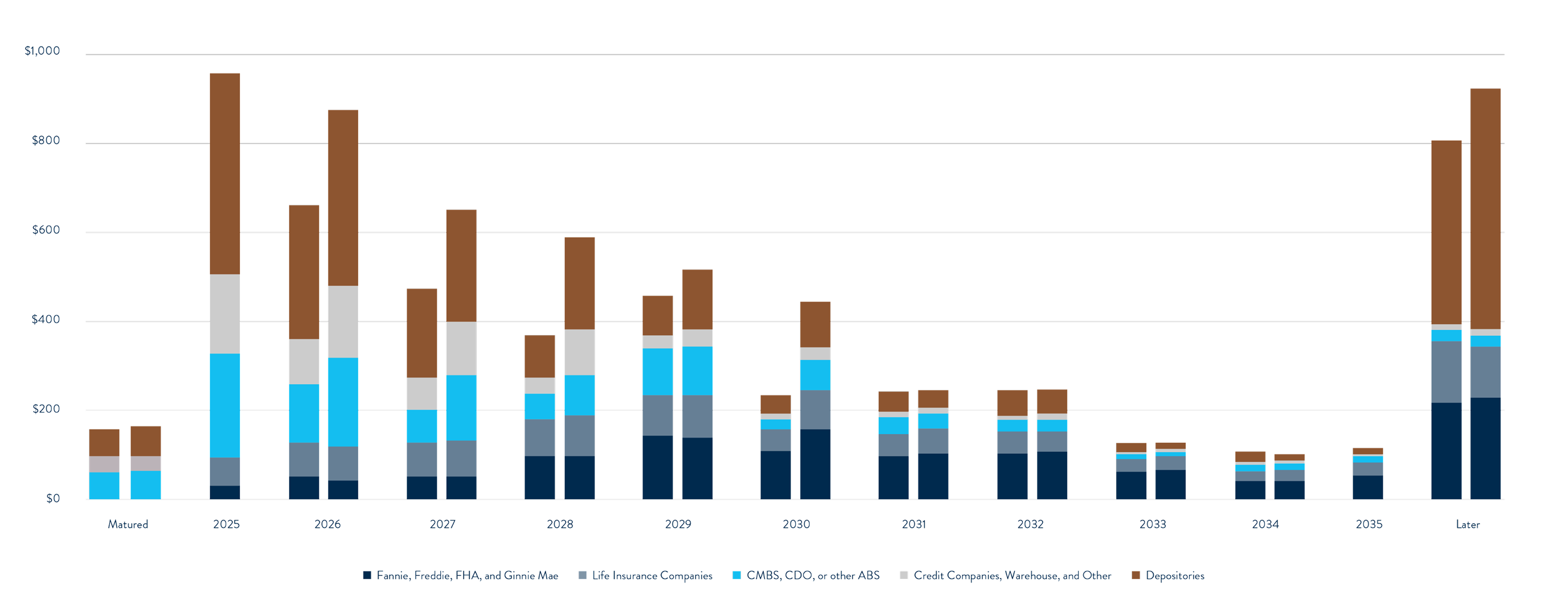
Source: Mortgage Bankers Association Real Estae Survey of Loan Maturity Volumes
Loan maturities are bringing a new set of decisions into focus. Owners and lenders are reassessing what each property can support today, how its performance has changed, and whether the economics still work under current financing conditions. An appraisal connects property-level performance with market evidence and current financing realities, providing a well-supported foundation for decisions around refinancing, recapitalization, or other next steps.

What to watch: Capital markets

As market conditions evolve, several indicators will shape valuation activity throughout the year:
- Debt service coverage and refinancing proceeds
- Lender appetite by asset type and market
- Loan extensions and modification activity
- Sponsor strength and capitalization
- Execution certainty in competitive financing processes
- Changes in capitalization rates and exit assumptions


Policy, regulatory, and risk considerations
Risk is becoming more localized
Broad market trends provide important context, but they often overlook the factors that have the greatest influence on an individual property's performance.
Since value is shaped by local supply, operating costs, insurance, property taxes, utilities, payroll, repairs, regulation, and property condition, property-level analysis is more important than ever.
Alex HoeNIg, MAI

Better assumptions support better decisions
Independent valuation helps clients evaluate uncertainty by testing assumptions, comparing scenarios, and identifying where risk is concentrated.
Operating expenses remain a significant pressure point. Insurance, property taxes, utilities, payroll, and repairs influence underwriting assumptions and property performance. According to the Urban Land Institute, insurance premiums have increased sharply in parts of Florida, California, and Texas, where exposure to hurricanes, wildfires, and other catastrophic events has driven higher ownership costs. Development restrictions, zoning requirements, permitting timelines, and other local policies can also affect project feasibility and long-term performance, reinforcing the need for localized analysis.
These risks are not emerging uniformly across markets or asset classes. As refinancing activity accelerates, lenders and investors are monitoring asset-level performance more closely to determine where assumptions remain sound and where changing market conditions may require a different strategy.
What to watch: Operating and local risk
As market conditions evolve, valuation professionals will closely monitor several property-level factors that directly influence underwriting and investment decisions:
- Insurance premiums
- Property taxes
- Utility costs
- Payroll pressures
- Repairs and maintenance expenses
- Permitting timelines
- Zoning and development restrictions
- Local supply conditions
- Exposure to weather-related insurance risk


Headwinds and tailwinds influencing valuation activity
Many forces are reshaping commercial real estate valuation simultaneously. Some create new challenges for owners and investors, while others are expanding opportunities for valuation professionals to provide more strategic guidance throughout the investment lifecycle.
Headwinds
Market uncertainty
Shifting interest rates, inflationary pressures, labor market uncertainty, and changing economic conditions complicate investment and financing decisions.
Regional supply imbalances
Elevated supply levels in some markets, particularly portions of the Sun Belt, are creating competitive pressures and uncertainty around future performance.
Rising operating costs
Insurance premiums, property taxes, and other operating expenses remain important considerations in underwriting assumptions and asset valuations.
More selective capital markets
While liquidity remains available, lenders maintain disciplined underwriting standards, leading to increased scrutiny of asset quality, sponsorship, and market fundamentals.
Tailwinds
Growing demand for strategic insight
Clients are using valuation services to support refinancing, portfolio management, development planning, financial reporting, and risk assessment. This shift is expanding the role of appraisals across the investment lifecycle.
Refinancing activity
A significant volume of commercial real estate loan maturities is driving demand for updated analysis, market insight, and risk assessments as investors and lenders evaluate financing options.
Growth in advisory services
Demand for market studies, feasibility analysis, financial reporting valuations, rent studies, and forward-looking advisory work continues to grow as stakeholders seek greater clarity around future conditions, supply pipelines, and development opportunities.
Technology-enabled efficiency
Connected workflows, integrated intelligence, and artificial intelligence are improving consistency, transparency, and quality throughout the process while improving the overall client experience.
The future of valuation
The most significant change shaping commercial real estate valuation is not technology alone. It’s that clients are engaging in valuation much earlier in the investment process. Clients are seeking insight before committing capital, using valuation to test assumptions, understand risk, and make better strategic investment decisions.
For Apprise, the future of valuation lies in combining experienced professionals with technology that delivers earlier, more consistent, and more transparent insights. As commercial real estate conditions evolve, clients will continue to rely on valuation to establish value, understand risk, evaluate alternatives, and make more informed decisions throughout the investment lifecycle.


Our Valuation Experts
The value of an appraisal extends beyond the final number. The underlying analysis can help clients understand what is driving value, where assumptions may be changing, and which factors deserve closer attention as they evaluate their options.
Apprise combines local market expertise, rigorous analysis, and national perspective to provide a well-supported view of properties and markets when important decisions are being made.











More from Apprise


.avif)

.svg)
Discover expert commentary on commercial real estate, leadership, capital markets, and emerging opportunities. Explore the research, analysis, and industry conversations helping investors and operators navigate change and identify what's next.
- Valuing through complexity: A look at NYC’s evolving multifamily market

- How property tax changes are reshaping multifamily valuations in the Carolinas
- Multifamily underwriting trends in 2026: A shift toward discipline
Subscribe to receive the latest news, insights, and future Outlook releases from Walker & Dunlop.

Hosted by Willy Walker, Chairman and CEO of Walker & Dunlop, the Walker Webcast features conversations with leaders shaping the global economy, spanning capital markets, real estate, and select asset classes influencing long-term growth.