Seizing Opportunity Amid Global Shifts with Gillian Tett, Journalist, King's College Provost, Financial Times Columnist
Willy Walker: I'm going to have Gary Pinkus, who is a Walker & Dunlop board member and former McKinsey partner and Chairman of McKinsey North America, come out to interview Gillian Tett. I'm super excited to have Gillian here. I will give you one quick anecdote on Gillian. Last year, Mohamed El-Erian came here and spoke. Mohamed was fantastic. I got incredible feedback from many of you who were here about how great Mohamed was. Mohamed happens to be the head of Queens’ College. He's the dean of Queens’ College at Cambridge and is actually running to be the head at Cambridge University right now. There's a vote that's going on with the alumni right now to see whether he becomes the next chancellor of Cambridge University. Anyway, after he was done speaking, my parents, throughout my entire life, have always played on Christmas Eve Nine Lessons and Carols, which is the chapel service that happens at King's College, Cambridge, every Christmas Eve. It had always been a dream of my parents to go to that service. My dad had gone out to try and find tickets, and it's extremely hard to get tickets because the service is held for the community of Cambridge. It's mostly the dons at Cambridge and the choir and members of the community who come to it. So I said to Mohamed, “Could you get us tickets?” Mohamed said, “You know, I've never been asked that, Willy, but I'll take a look.” So he goes away, and he comes back to me and says, “Whoa, that's harder than I thought.” I said, “Well, I'd love to go”. So he puts me in touch with Gillian, and Gillian's provost of Cambridge University, and she comes back and she says, “How many tickets do you want?” I said “Well, it'd be really nice if I could get four. One for my mom, one for my dad, one for girlfriend Sarah, and one for me.” Gillian writes me back and then she goes, “Whoa, whoa, whoa, whoa. I thought you were looking for like one or two, but four, there's no way we can get four tickets.” I said, “Okay, slow down. How about we get tickets for my parents, and you put Sarah and me on kind of the wait list, and if two tickets open up for us, we'll go. But otherwise, just my parents.” She comes back and she says, “I've got two tickets for your parents, but you and Sarah are firmly on the wait list.” Sarah and I fly to London on a Friday before Christmas Eve. We don't have tickets. Saturday comes, we're sitting in London, no tickets. Sunday comes and they write us and they say, “We have two tickets for you and Sarah. You can come with your parents.” So on Christmas Eve, Tuesday of this past year, my mom, my dad, Sarah and I hop in a car. We go up to Cambridge. I thought because of the way we got the tickets that we would be sitting on the lawn in the back, and using this as the same thing and we walk into the chapel at Cambridge University, a beautiful, beautiful cathedral, 650-year-old cathedral. As you walk into it, there's the Henry VIII altar, which is about halfway through this beautiful chapel. As we walked in and I'm looking up at the altar and all the real action happens on the other side of the altar, I'm sitting there going, “They're going to seat us right here in the back and I'm just happy to be in here.” We start to walk and we walk and they keep passing us forward and passing us forward and we then walk through the Henry VIII altar and now we're back with where the choir is. They say, “Keep going.” We keep walking. Then they say, “Take a right here,” and we go in, and we are in four seats, with these beautiful mahogany seats, sitting right behind the choir of King's College, Cambridge. My mom and my dad are sitting there crying with tears of joy, and we watch the most beautiful service. Afterward, we flew here to Sun Valley and it was just such a gift for me to have been able to go and give my parents this amazing experience. Sarah and I had an amazing time ourselves just being there. I saw Gillian yesterday, and I thanked her again for getting us there. She said to me, “That's so special. It's so nice to allow for dreams to come true.” Gillian truly made a dream of my mom and my dad and for me come true last year. So it is a real pleasure to have someone who not only helped us there, but is so insightful on the world markets, writes so beautifully about what is going on in the world economy, and has such great perspectives on the US, on Europe, and the rest of the globe. So with no further ado, Gary Pinkus and Gillian Tett.
Gary Pinkus: Morning. Oh, that was a little louder than I expected.
Gillian Tett: Well, good morning, everyone, as well. Is this working? Great.
Gary Pinkus: I'm going to give you a quick introduction to Gillian. Actually, it's not that quick an introduction because there's a lot to tell you about Gillian. Then I'm going to ask Gillian a few questions just to get things started, and then go to you as the audience to ask some questions, and we'll go back and forth and make this very much about your thoughts, my thoughts, and Gillian's thoughts. Just to get us started, Gillian has had a remarkable career. It sounds like also as an event planner, from what Willy said.
Gillian Tett: I'd like to say thank you to Willy for doing an advert for King's College in Cambridge. If any of you ever want to come and see it, I can't promise to get you all tickets for the carol concert, but the chapel is open most of the time and it is indeed spectacular. A bit like Notre Dame meets Sacré-Cœur.
Gary Pinkus: It is. I have been there too, but I have not had those tickets. So I'm going to have to come to you on those. Gillian's been a journalist, a writer, a speaker, as Willy mentioned, now the provost, and we'll talk a little about what that actually means at King's College, Cambridge. I'm not going to do justice to the full range of career roles, awards, and other honors she's achieved. But let me give you just a quick short list. She was the former chair of the editorial board and editor at large at the Financial Times, where she's had numerous postings over what's been now a 30-plus year career. Since that day job wasn't keeping her busy enough, she also authored four books on a variety of economic topics with Fool's Gold about the creation of the shadow banking system becoming a New York Times bestseller. As a result of all this, she's won numerous awards. I was going to go through the list of awards, but it's actually too many to cover. Let's just say comfortably we're in the double digits. In her spare time, she founded Moral Money at the Financial Times, which focused on socially responsible business. And probably very importantly for this audience, in 2007, she correctly predicted and then began writing about the precursors to the global financial crisis. We're going to talk a little more about that in a bit. She was ultimately awarded the President's Medal from the British Academy, and all of this was before the last year and a half where she became provost of King's College, got married, and was awarded the Order of the British Empire. For the Americans in the audience, which I think is almost all of us, that means she has been knighted by the British government. Gillian, it's a treat to have you here.
Gillian Tett: It's great to be here as well. I should say that I'm also an American, so just to add to the complexity.
Gary Pinkus: Congratulations. We are going to talk a little bit about that British-American view of what's going on here through the eyes of someone that's seeing it both from over there and here. But before we do, before we cover the economy, before we cover the threat of AI, as Willy talked about, geopolitics, et cetera, let's go all the way back. You got your PhD in archaeology and social anthropology from Clare College in Cambridge. I think your doctoral field work was in, if I can pronounce it right, Tajikistan.
Gillian Tett: Rajeev Gistani.
Gary Pinkus: Tajikistan. How did you make the transition into journalism from that background? And then how is your learning and passion for anthropology informing that journalism?
Gillian Tett: Well, I think that's a polite way of asking the question of, how come you're so completely weird? Because I can tell you that having gone around and done economic journalism for many years, I'm often asked by central bankers or financiers or investors, “How the heck is it you have a background in Tajik wedding rituals, was my PhD topic, and you're writing about finance?” And what I say is that cultural anthropology is all about studying what makes humans tick. You do that by observing human beings in any context, whether it's in Tajikistan or Papua New Guinea or a Wall Street trading floor or a real estate company. You're basically looking at how and why humans behave the way they do. And that's kind of similar to being a journalist. Journalists do the same thing, just a lot faster with a much broader audience and with less debt. In my case, I did my PhD in cultural anthropology in the former Soviet Union. I was actually enrolled in the Soviet academic system to do that. Then the Soviet Union broke up, and there was a war where I was reporting. I became a war reporter, and one thing led to another. I decided to study economics and finance.
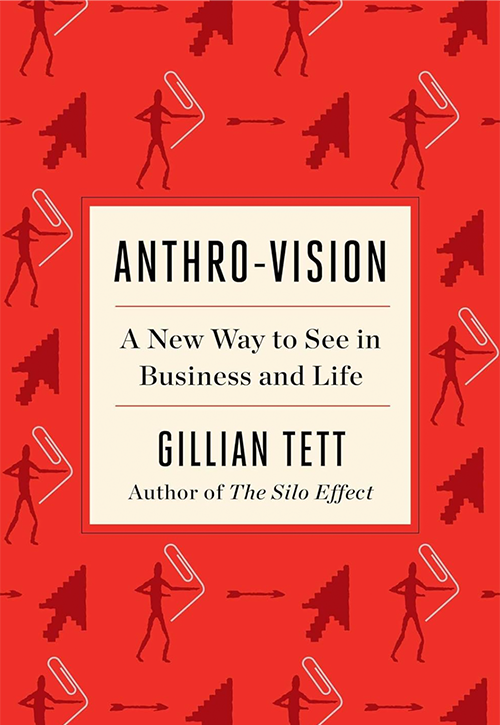
Gary Pinkus: Well, so go from that. I think one of the books she wrote was called Anthrovision. So there was some connection between your view of anthropology, human behavior, and economics. Maybe talk about that for a moment.
Gillian Tett: Absolutely. What I want to communicate is this, in so far as anyone knows anything at all about anthropology, and let me ask, “Is there anyone in the audience who's got any background studies in anthropology?” No, okay.
Gary Pinkus: Okay.
Gillian Tett: Well, I'm often asked by parents of kids who are going to college and threatening to study anthropology if it's completely useless. Will they ever get a job? The answer is you will, because what cultural anthropology actually does is install a chip in your brain that is like a superpower. I'm passionate about the secret superpower of anthropologists, because anthropologists are on a three-part journey. The first part is to immerse yourself in people who think differently from you. So that can be on the other side of the world, like Tajikistan. It can be down the end of your street, people who might (shock, horror) support a different political party. But the idea is to deliberately try, respectfully and with an open mind, to immerse yourself into someone else's point of view and life that feels really alien to you. So you do that to, as anthropologists say, make the strange familiar and to understand this really obvious point that just because you think the rest of the world should automatically think and look at the world like you do, they don't. You might actually learn something from somebody else, which is really important in an era of globalization and political polarization and generational change. Having done that, you then immerse yourself in someone else's perspective, and then flip the lens and look back at yourself with fresh eyes. Because the Chinese have an amazing phrase, which is that a fish can't see water. A fish can’t see water. None of us can see the assumptions that cause blind spots unless we jump out of our fish bowl, go swim with other fish, and look. When we do that, we can see, not just the obvious parts of our life that we know about, but also what anthropologists call social silences—all the assumptions that we inherit from our surroundings which can blind us to both risk and amazing opportunity. So that is what anthropologists do. It's not just Indiana Jones for grownups, which is what people tend to think. It's just not about going somewhere wacky and wild and collecting great stories about seemingly exotic people. It's about a mode of philosophy and a way of looking at the world that is just as relevant in Tajikistan or the Amazon jungle as it is in the modern economy. I would argue that the need to take an insider outside view is absolutely critical today for anybody trying to do business or invest in a world where Donald Trump is turning most of our normal assumptions upside down.
Gary Pinkus: So stay with that for a sec, the fish can't see water, because I think it's fair to say, at least in the US and probably globally, the first Trump presidency came as a surprise to a number of us, as did Brexit come as a surprise to a number of us. You commented to me over dinner, I think, even for you, it was a surprise. What did we miss there that was right in front of us but the fish couldn't see the water?
Gillian Tett: I think there are two areas where a fish couldn't see water in 2016. The first area is very much on people like me who are part of what might be called the “globalized liberal elite,” and journalists in particular, academics, many of the people who control the debate on television screens or in public, and what we missed was a degree to which we had slipped into this tribalism and this assumption that the people who control language, who can speak with words very articulately, have a God-given right to credibility and status and power. We had missed the fact that we had slipped into such an arrogant worldview that we were basically controlling the world, shaping the world in an unthinking way, that we failed to recognize how many parts of the voter base were very angry with the arrogance or the detachment of this group and the point it came home to me was in the autumn of 2016. I was running the FT in America. I was sitting on the editorial desk when the debates happened and Donald Trump used the word “bigly.” Every single person in that newsroom laughed, including myself. I laughed, and then I stopped and thought, “Hang on a sec, why did I laugh? Why do I find it funny that a would-be president candidate is saying bigly?” I realized that that really exposed this, if you like, epistemological divide, the fact that there were people who assumed that you had to speak in a certain way to run the country, and there were people who hated that. So that was the first big blind spot. The second big blind spot, which I will talk about more, is that anybody of our age, and actually most of you look a bit younger than me, so anyone really over the age of 35, 30, has grown up in a world where we have absorbed, without even realizing it, most of the ideas of the neoliberal economic consensus that dominated since the 1980s. So we've all grown up assuming that free markets are a good thing, that government intervention, excessive government intervention is a bad thing, that internationalization in general was good. We've also grown up assuming something really important, but which we take so much for granted we never talk about, which is that the concept of economics as a distinctive thing in its own right that can be analyzed with charts and calculators and computers, and it's treated as numbers, and that economics drives politics, not the other way around. We have that assumption partly because the whole neoliberal economic revolution that happened in the 1980s was all about the idea that the markets existed as a thing in itself that was subject to laws, that you could basically plug into a computer using models borrowed from physics or mathematics, and come out with these amazing forecasts that seem very precise. That idea, which is completely alien to the way that people have looked at the political economy during most of history, became very popular in the ‘80s and ‘90s, partly because it came at a time when the financial industry was exploding, when you had a new class of professionals who needed things to sell, a story to sell and you had a computing revolution that suddenly gave all of us in the room almost godlike power to perform really complicated calculations. You couldn't do that before. So those three things coincided and gave birth to this explosive activity of creating models to look at the economy, to look at real estate, to look at finance, and to assume that these models not only pumped out the precise answer to everything with their forecasts, but they were universal and consistent. We all put our faith in these models and this math, and we take it for granted that the economy is something separate that we can model. We fail to realize that this idea, which has shaped us all very deeply, very profoundly, that we never question, is both alien to the way that people looked to the economy for most of history, and most importantly, it's somewhat different from how Donald Trump's team imagine the economy right now. So much of the shock is about the fact that we're actually undergoing a zeitgeist shift, which is challenging many of our core assumptions around how business and economy actually operate. I can talk more about how Donald Trump is different if you want, but I cannot stress strongly enough that we are all creatures of our environment. You have all unthinkingly absorbed what's been taught on MBA courses, CFA courses, economics degrees, that economics drives politics, that it's subject to universal laws that you can model, and that models are essentially the guide to the future, the compass you use. Right now, that world view is coming under attack.
Gary Pinkus: It's interesting as I hear you say that I agree with everything you just said that is absolutely my world view. It is absolutely under attack and I'd be interested in your perspective, not just about the attack, but are we right to have that world view and the attack is what's so dangerous? Or are we wrong to have the world view, and is the attack going to point us in the right way?
Gillian Tett: Well, I'll say this. I think that this world view was always something of a self-deception, because any model is only as good as what you put into the model, and what you leave out, the so-called externalities. You can afford to ignore if those externalities are irrelevant or stable. But if they're not, it really matters and the same is true of balance sheets. Basically, you can create a beautiful balance sheet of a company that looks amazing and neat and tidy, but it’s only as good as your inputs on the balance sheet. And if everything you put into your footnotes is really important, then that matters. I'd argue two things. Firstly, starting in about 2005 or 2006, the question of what was left out of the economic models became more and more important, in that the things that have been left out of the economic models since 2007 include issues like medical risk, pandemic threats, environmental change, tech change. I mean, on the issue of tech, one of the things that models have ignored and company balance sheets have ignored is that so much activity today happens without money because it's basically people swapping data for services in a way that economists can't track, but which are critical to the modern economy. Models ignore social conflict, populism, and they also ignore what the World Economic Forum calls interstate tension, i.e. war. So all of those issues have been out of the models, and all of those are what's blown up our vision of forecasting in the last 15 years. But in addition to that, I would argue that Donald Trump has come in with a different set of instincts about how the political economy operates, and I'm not pretending for a millisecond that Donald Trump has a neat plan. He doesn't have a PowerPoint presentation like a McKinsey consultant, laying out what he's going to do for the next four years or remaining three and a half years. But one way to imagine what he is doing is to borrow something that Goldman Sachs used to tell its new recruits, which is to distinguish between goal, strategy, and tactics. Goal, strategy, and tactics. Donald Trump has an instinct, and the instinct can basically be summarized by that last slide of Willy's presentation, which is to be a lion. Donald Trump wants to be dominant and big. He wants to make America great again. He wants to make his family very rich, probably the other way around. But that's his kind of instinct, which is half articulated. Around him are people like Scott Bessent, like Steve Moran and others, who actually have something of a strategy. And their strategy is to remake the global financial and economic system, to essentially end the pattern of post-World War II, and to focus on America first, a much more nationalist agenda and a much more mechanicalist agenda. And then they have tactics. The tactics are the tariffs. It's a deliberate confusion. It's a shock and awe; it's a flood the zone approach. It's all of these things that dominate the headlines each day. It's also a distraction. They're masters of distraction. People confuse the tactics with the strategy and the goal. The tactics are not the goal, and I would argue the tactics are not the strategy either. And overarching all of that is a vision of the political economy, which basically sees politics as driving economics, not the other way around. I can't stress that strongly enough. The neoliberal order was all about economics first, politics second. Right now, it's politics first, economics second. And also, coming out of this, it’s about nationalism; it is localization, not globalization. It's about a zero-sum game mentality, about relative welfare between countries, not absolute welfare. It's also, ironically, about industrial policy. The last thing I want to say is that the first expression of people's awareness that you could not capture everything with a model or balance sheet, the fact that there's actually stuff outside the model that matters, the first impression of that was the rise of environmental, social, and governance investing, stakeholderism, ESG. Because what ESG essentially is, is a way of saying, there's life beyond the balance sheet. There are all these things that are affecting companies that we have to pay attention to, because otherwise it may blow us up, either because of reputational risk or regulatory risk, or our millennial or Gen Z employees will all have a tantrum, and they won't want to work for us. So ESG, at its core, is actually about risk management. It's about risk management of life beyond the balance sheet. Now, in a world where ESG is being really aggressively attacked by the political right, that means that this idea of stakeholderism, of caring about more than shareholders and caring about stakeholders, you might think that that's dead. I would argue that's totally wrong, because what's actually happened is that the right-wing political groups who are attacking ESG today are, generally speaking, not saying they want to go back to Milton Friedman and shareholder-only capitalism. What they're saying is that they want different stakeholders to be observed and recognized. They want stakeholders like national security interests, like conservative Christian values in some cases, like energy security. It's different stakeholders that they're looking at. So the real issue today is not about whether or not you're going to have stakeholderism. It's about which stakeholders you're trying to honor or rather, to put it another way, if anyone thinks that the contract between business and government today is the same as it was during the neoliberal era, or that it's the same, as you were taught in your MBAs or your CFAs or your economics degrees, if you imagine we're living in an era of shareholder-first capitalism, dream on. Because a world of what people are calling geoeconomics, where politics is driving economics, is a world where the social contract between business and government is being remade to a lesser and greater degree, but also in a potentially unpredictable way.
Gary Pinkus: So stay with that last thought because I think in many ways the ESG phenomenon started to play out in ways that felt increasingly predictable. That is, you were measuring it. Larry Fink was talking about it. There was a set of things your companies had to do in order to play within some of those lane lines. With what you just described, are we going to see similar lane lines emerge or is it going to be something where you're going to have to kind of guess at what may or may not offend the body politic?
Gillian Tett: I think that the honest answer is we just don't know right now because I think this transition is quite an early stage, and it's still being very much contested. If you look back at previous moments in history where there's been a big zeitgeist shift in how we imagine the political economy, I would argue there's been three or four of those since 1900. One was in 1914, one was in 1945, one in the 1980s, and one is today. Those have taken some time to play out. Margaret Thatcher and Ronald Reagan did not arrive in office with a clear-cut PowerPoint plan of how they intended to unleash free market ideologies at all. There was a long battle, and so I think we are currently in a moment of flux. I do think that anybody who's involved in business or investment today needs to recognize the range of possibilities of what could happen. In terms of government intervention in the economy right now, it is very wide. You're dealing with both extreme right-wing populism and extreme left-wing populism, and they could both impinge. On the left-wing populism idea, you're seeing just in New York right now, if you look at Mamdani and what he's talking about to do with rent controls and all types of populist left-wings slogans and ideas, that is a kind of warning shot across the bows of anybody who's trying to discount populism going forward. That's an indication of the kind of things we could be seeing. On the right-wing side, you've started to see measures from Donald Trump banning, say, Chinese investment in agriculture. It's entirely possible to imagine a scenario, for example, where in a few years' time, foreign investment in American real estate starts to be curtailed quite severely on national security grounds. So trying to play out the whole range of potential populist impacts on that contract between business and government, I think it's going to be very important. To take another small example, cybersecurity. Security. If you go back to the Obama era, when the White House first started suggesting that it might be a good idea for American companies to start protecting themselves against cyber risks in collaboration with the military industrial complex, or rather the Pentagon, the US Chamber of Commerce was so horrified by the apparent incursion by the government into private company matters that they fought Obama's proposals tooth and nail and said, “No, we as companies do not believe that we should be subject to the US government telling us what to do about cyber risks.” Fast forward to today, and not only has the US Chamber of Commerce and the Business Roundtable dropped any opposition to the government essentially having the right to get involved in American company affairs around cyber risks, but there are active debates going on inside the administration and around the edges of it about whether there should actually be rules going forward prescribing which vendors American companies can use to try and curtail the cyber risks, because most of the cyber hacks right now come through vendors, not through the actual company. That debate would have been unimaginable. Can you imagine? I mean, it's not here yet. But can you imagine going to your board of your company and saying, “Actually, we've been told by the American government that we can only use two vendors? Even though we think we can be cheaper and more innovative by using other vendors, they're telling us today we can only use these vendors because of national cybersecurity risks.” We're not there yet, but you can imagine that happening quite easily in a few years' time, given the direction we're currently going in.
Gary Pinkus: I'm going to go a slightly different direction, because I'm harkening back to our dinner last night and a topic that I suspect will be of some interest to this audience and one that Willy touched on, which is the Fed and interest rates. If I think about government intervention, our president is certainly trying to intervene in that process. A couple different things, and go wherever you want with this, there's a few different topics. You had mentioned a number of conversations you were having with the Atlantic Fed. How they were thinking about the monetary supply. You mentioned conversations, I believe, with Jerome Powell, where, given the pressures he's under, both politically, but also what's happening in the economy at large, what might happen with interest rates. Wherever you want to go with all of that, and I suspect we'll have a few questions from the audience too on this.
Gillian Tett: Well, again, the Fed is a very important symbol of how the way we imagine the political economy is being remade, because during the neoliberal era and after Volcker, the idea really took hold that you needed to have an independent Fed almost at all costs to maintain credibility of monetary policy and the currency and to fight inflation. It wasn't so long ago, back in 2000, I believe 2005, that you had books coming out about then, Alan Greenspan, calling him the maestro because in the run up to 2007-8, the Fed was worshiped, and central banks were worshiped for having delivered the so-called great moderation of seemingly high growth and low prices. And then after the financial crisis, again, the Fed, although it was criticized, rightly, for having missed many of the important signals about the crisis coming, remember, Alan Greenspan said there was a flaw in his thinking. After the 2008 crisis, the Fed still remained very dominant for a long period of time, because it seemed to be rescuing the economy. Again, there was a lot of respect for the Fed being credible and the central banks being credible for many, many years. Now, of course, we're going back to the future, where essentially you have a President, Donald Trump, attacking the Fed consistently and aggressively. He did that in his first term. In fact, Wilbur Ross, who's been a friend of mine for many, many years, was actually asked by Trump during the first administration to call up Jay Powell and to threaten him. Wilbur, who comes from this old era of, if you like, neoliberal belief, actually got quite nervous about doing this and tried to persuade Donald Trump that it wasn't a good idea to attack the Fed. He did actually have a conversation with Powell in the end, but Trump backed down to some degree and everything carried on as normal. What we're seeing now, of course, are very explicit attacks on Powell by Donald Trump. My best guess is that Trump is doing this to have someone to blame if or when the tariffs cause the economy to slow down. Powell is being set up as a very convenient scapegoat for any economic slowdown that's coming down the tracks. That's certainly how people like Chairman Powell and others inside the Fed see what's going on today. All this game around the Fed expenses, around the redevelopment and stuff, I mean, this is just finding an excuse to keep attacking him and making him the center of attention and keep the focus on that. The more that they can keep the focus on the headlines on Powell and criticizing Powell, the less they're hoping that people will start asking questions about what tariffs are doing to inflation or demand or business investment and things like that. What I can say, though, are two or three things. Firstly, Powell is not going anywhere. When he came under severe attack four months ago, and there were suggestions that he might even be temporarily banned from going into the building, he was literally planning to go to the front door and stand outside and defy them to actually arrest him or stop him. He is absolutely resolute that he will go down fighting no matter what. He has nothing to lose. The only thing that might possibly stay his hand and give him pause is the ongoing security threats against his kids and his family right now. I mean, what a shocking state of affairs that we're sitting here in 2025 in America where a Central Bank governor is concerned about security threats to his family. But he is absolutely resolute and determined to fight and he has the backing of almost all of the board behind him very, very strongly indeed. I think that if he is in any way forced out or undermined or if somebody comes in after him who appears likely to sell the independence of the Fed down the river, Powell will stay on to 2028 because he's slated to remain a governor and he will defy the White House to remove him. So we have the makings of a potentially very nasty showdown. You just need to see how the markets have reacted to any suggestion that he's going to be removed to see the dangers to the administration of trying to remove him. It's worth stressing that if you look ahead to the next 12 months, it's actually $9 trillion worth of debt that Bessent now needs to sell. He is selling that debt into a horrific set of circumstances, where inflation is quite likely to rise, where the dollar has weakened 10% already this year and could well continue to weaken, where essentially you have the debt exploding. Deficits exploding in the eyes of everybody apart from Donald Trump's economic team, and you have the Fed Independence potentially being undermined. That is a horrific set of circumstances to be selling nine trillion dollars worth of debt into. So playing with fire in terms of undermining the credibility of the Fed is a really bad idea right now, and Scott Bessent understands that pretty clearly. Out of the slate of candidates with whom they could replace Powell, if somebody like Kevin Walsh comes in, he probably will be moderately reassuring to the markets. I can talk about him more if you want. I know all these candidates pretty well. Kevin Hassett would probably be pretty reassuring as well. I think Chris Waller would create a lot more concern at the moment, who knows? But certainly the Fed at the moment is determined to go down fighting in its current composition of leadership and when it comes to things like the Atlanta Fed, I mean, I'll just say one little tiny vignette, which is maybe interesting given the terrible tragedies which have unfolded recently in Texas. One of the very unexpected things that's happened recently inside the Fed system is that notwithstanding all of the explosion of interest in cryptocurrencies, digital payments, credit card payments, the fact that probably most of you do everything these days without cash. Usage of cash has actually been rising, and focus on cash inside the Fed has exploded in the last couple of years, not because of anything in terms of cryptocurrencies, but because of natural disasters. Because something that they've discovered is that every time there's even a whiff of a natural disaster, demand for cash explodes, not just in that area, but more widely. And so now, what you don't know is the Fed is rushing to anywhere where there's a bad weather forecast these days and stocking the ATMs to the max because they know that if there's any kind of crisis these days, the first thing that everyone wants is cash above all else. By the way, we saw that in Spain with the Spanish floods recently. So it's an interesting counterpoint to this idea that we're all going permanently into a digital world.
Gary Pinkus: Take a moment and open to the audience on this question, maybe just around the Fed, around interest rates, around cash and monetization of cash. See if there's any questions from the audience on that and we'll see…
Gillian Tett: And just while you're thinking about a question, can I jump in and say two other quick things? Firstly, Willy mentioned earlier about the impact of the SLR on rates, and the fact that Scott Bessent is absolutely pushing to reform the SLL to essentially unleash bank demand for debt. That's completely correct, and I think he will get his way, and quite a lot of it is priced in, but there's probably more to go. I'll simply say there are two other tricks that Scott is trying to use right now to keep the treasury's market calm. One is stablecoins, because there is a theory going around in the White House that if you unleash the stablecoin market, that's going to create a huge explosion of demand for treasuries to basically back stable coins. Some estimates reckon that could be two to three trillion. Personally, I'm very, very doubtful about that, but if you want to understand what's driving some of the stablecoin issuance right now, that's certainly one factor. And it's setting up the US for a very interesting contest with Europe, because Europe is actually turning its back on stablecoins and going down the route of digital currencies. So that's another very important point. Yet the third point that Scott Bessent is also using to try and keep the treasury's market calm is to essentially increase issuance at the short end quite considerably instead of at the long end. Ironically, Steve Moran and Scott Bessent were very critical of Janet Yellen for doing exactly that. However, they're being pragmatic. But they also know that they're doing that because, although Donald Trump is obsessed with the Fed, in terms of setting policy rates, short-term interest rates, in reality, what matters to you in the audience is long-term rates. You're already seeing the curve steepening quite dramatically. I would predict that that's going to continue because of all these issues around fiscal risks. So I think, to a certain degree, Donald Trump has missed the real picture, which is it's not short-term rates that matter most right now; it's 10-year rates.
Gary Pinkus: And his control over that would be more around fiscal policy, presumably, right? Yes. To the extent he can control it at all. Exactly.
Gillian Tett: By the way, there is a fourth idea which is floating around the White House to keep the Treasury's market calm, which is to essentially force countries enjoying the US military umbrella, like Japan, like to some degree Saudi, to basically go out and buy lots and lots of short-term, sorry, lots and lots of long-term government debt as well. And that's really the other aspect of the way that the Trump team is changing the political economy zeitgeist today, which is they're bundling together economic, trade, military, tech, culture issues all into a single package and using that to negotiate with other countries in a way that's completely alien to the neoliberal world view.
Gary Pinkus: Actually, I promised we would go to the audience, but I'm going to take a second on that. So the use of tariffs as a political lever to drive something beyond just pricing a product into the US would be an example of what you're talking about.
Gillian Tett: Absolutely. I mean, the tariffs are a case in point, where they are both using tariffs to try and shock and aggressively destabilize other countries and force them to cut deals. They're hoping that it also enables them to recoup some income, get some revenue, and pay down the debt that way. So it's a combination of motives that they're using for tariffs. Of course, tariffs are very likely to bleed over into capital markets, too, into capital controls in some form going forward. But you just need to look at the way that Trump, for example, has threatened Brazil with massive trade tariffs, not because of anything to do with trade, per se, although he claims it's part of it, but because of the legal suits against Bolsonaro. Again, that's an example of jumbling together all of these different issues, which in the neoliberal era were kept separate. So there is no model you'll be taught on an MBA course or a CFA course, or an economics degree in the US, about how to factor in a legal suit against a president or former president into the economic impact of tariffs. But that's where we are today.
Gary Pinkus: That would be comfortably outside the models.
Gillian Tett: Comfortably outside the models, not even in the footnotes.
Gary Pinkus: So thoughts or questions from the audience around this, or I'll open it up to other topics. I've got a lot more questions for Gillian, but I thought I'd give people a chance to get into the mix. We do have mics around, so put your hand up and make sure you have a mic, because this is also being recorded. If there is a, there we go, one right here in the front.
Speaker 4: Good morning, I have a two-fold question. Number one, on social media, there's been rumors about Powell being allegedly, I guess, accused of some self-dealing or something with Freddie Fannie. They’ve asked him to step down. Is there any truth to that? I've seen this come and go across the board. Even Scott Bessent suggested yesterday they should resign. And secondly, in June, about $137 billion allegedly was coming as tariffs, as new revenue to the United States. What are your thoughts on these two matters?
Gary Pinkus: The mic doesn't come through very clearly here if it lets me play back to you. The first question was around the accusations of I'll call it bad behavior by Powell presumably related to the construction project and then this maybe let's tell was
Speaker 4: It was through Freddie and Fannie. I think, there were some items around that. I don't know exactly what it was, but some allegations.
Gary Pinkus: Around allegations around Powell and corruption. Oh, yeah. Then we'll come to the second question. And we may need a little help because it's hard to hear up here.
Gillian Tett: Yeah, one of the bit of ironies about the current administration is they throw around the words fraud and corruption constantly. In many ways, this is the administration which appears to have the biggest, certainly image or grift of any administration for a very long time and there's a lot of grift happening around the edges. I have not done any investigations into these allegations. As far as I've seen, there hasn't been much in the way of credible investigations into these allegations. It seems to me that this is a very convenient excuse to keep criticizing Powell, but I would imagine there will need to be some kind of investigation going forward into this. One of the things about the Trump administration is a heavy reliance on the tactic of distraction and flooding the zone, overwhelming an institution or an individual with tasks, actions, and information to try and make sure they won't be in a position to fight back, and I'm sure that's part of what is going on right now.
Gary Pinkus: But presumably, unless those investigations lead to something that would force us to take the Fed chair out, to your point about resolution, he's not planning to resign just because of this.
Gillian Tett: My understanding is that Powell is definitely not planning to resign just because of this, and my understanding is at the moment that he has pretty strong support on the Hill, partly because of real concern about what this would do to wider investor confidence in the dollar and the bond markets.
Gary Pinkus: Maybe we'll go to the second.
Speaker 4: The second part was about the tariffs. By June, about $137 billion came in new tariffs. Is that an accurate figure?
Gillian Tett: Well, at the moment, it's very hard to be very confident about anything that's happening with the tariffs for three reasons. Firstly, the systems for actually measuring and collecting tariffs are still being put into place, and that's obviously one of the problems in terms of working out what's going to happen. Secondly, looking further ahead in terms of whether this is a benchmark for what we can expect going forward, there's a lot of modeling going on right now about the degree to which countries can or cannot reroute supply chains. McKinsey's just done a truly fantastic study that I would recommend to anybody which looks at how easy it is for American businesses to reroute their supply chains in different sectors. There are some really surprising findings in that, like the fact that it's very hard to reroute a supply of fireworks from anywhere other than China. But it's actually a lot easier to reroute other aspects you might not expect, including memory chips and things like that. So any attempt to model what's going to happen going forward with tariffs and revenue has to be treated with really big grains of salt because we just don't know the degree to which supply chains are not going to be rerouted. The third issue is that there's been a huge amount of stockpiling by American businesses to date because they didn't know whether tariffs are going to last or not. And that stockpiling was so massive in the early months of this year that it really distorted the first quarter's growth figures. So it's very hard to see exactly what's happening in terms of real growth in the US economy right now, because distortions have been so massive. It's a bit like the early days of COVID. There is, if you take that first figure of tariff revenue as accurate and an indication of what's going to happen, then you can presume, you can model out, if you believe the models, that there will be revenue coming in from tariffs that is notable and significant. How far that's actually offset by potential loss of investment by American businesses trying to work out what to do about this changing tariff environment, and the degree to which you're going to see any economic slowdown is, we just don't know at the moment. And the key thing to say is really twofold. Donald Trump has introduced these measures in response to a set of problems that are very genuine and very real and which have gone ignored for way too long. So the reality is that trade has been unbalanced. The reality is that America has had a more open market than many other countries. The reality is that there has been a real problem with swathes of the American population who've basically been tossed out of the labor market, and really been suffering because of massive structural changes, both because of trade and technology. So those problems are real. So for people who criticize Donald Trump policies, the onus is on them to say, “Well, you don't like these policies. What would you do to address these very real problems that really are there?” If you keep in mind this difference between goals, strategy, and tactics, you can have a strategy of re-industrializing America. You can use a tactic of tariffs and constantly destabilizing capricious policy announcements that change every five minutes as a way of shocking your opponents into submission. But the downside of that tactic is that the very uncertainty he's unleashing may end up dampening investment and confidence. That's a very serious risk that people in the White House do not appear to be taking very seriously at the moment. That really is a danger. Another potential downside risk of the whole uncertainty that's being unleashed is that you may have the rest of the world saying, “Well, we just can't deal with America anymore,” and go and start creating all kinds of alliances and ways of actually doing business without America and getting better and better at developing alternative channels. Of course, the other irony about what Donald Trump is doing, which is frustrating even many of his own economic advisors, is that if you think that tariffs are justified as one part of industrial policy, the other elements of industrial policy which should ideally be used in conjunction with tariffs, like training workers for new industries, like using the organs of state to support the development of new industries or investing in infrastructure to support them, or even just providing loans, that is not happening. One of the bitter, bitter ironies is you heard earlier from Willy, him saying that in fact most of the job growth has been in Republican states, red states in the last few years. That's absolutely true. A very large driver of that job growth, particularly in industrial sectors, has been the Inflation Reduction Act and all of those activities. It is bitterly, bitterly ironic that Trump says he wants to create more industrialization and more manufacturing jobs, even as he attacks the IRA, which was doing exactly that. Under Biden, you had the biggest explosion in industrial investment and in manufacturing jobs you'd seen for decades because of the IRA. So to be dismantling that is very contradictory. As I say, it's actually causing a lot of anguish amongst the economists who dreamt up the idea of tariffs in the first place.
Gary Pinkus: I want to go back to something you touched on a moment ago in terms of our standing as a country in the world, how others view us. It feels to me almost as though the Trumpian bet here is, if you'll pardon the expression, it may be crooked, but it's the only game in town. So the world will continue to beat a door to the US even if they don't like us. To leverage maybe your experience as both an American and a European, what is our standing in the world now, and how much does it matter?
Gillian Tett: The first point to make is that there is a real shock, and has been a shock for a number of months, about the fact that the post-World War II era is basically over. So that geopolitical order is over. It's taken countries, a long time to try and pass that and work out what that means going forward. The second point to make is that the White House does absolutely believe that they have the upper hand in almost every area, and there's a group of economists at Stanford and Chicago and Columbia that did some really interesting work looking at the new political economy zeitgeist in the framework of what they call hegemonic power, which is really a posh word for dominance. They argue that if you look at the world today, China has dominance over global manufacturing because it controls key supply chain nodes. America's dominance really rests on finance, and it's controlled of the financial system because it has a dollar as a reserve currency. Dollar-based financing accounts for the majority of trade invoicing, the majority of reserves, and the majority of currency trading and payment system operations. So at the moment, you've got America dominant in finance, China having control over manufacturing, as we just saw over things like the rare earth minerals. What the White House is basically trying to do is undercut Chinese dominance of manufacturing and to bolster American dominance over finance. The problem is that the moves it's making in the financial sphere are potentially quite contradictory to the idea of maintaining financial dominance in that they're giving other countries a lot of incentives to try and find alternative ways of making payments and having different reserve currencies. Now, at the moment, that's very hard for other countries to do, which is one reason why they've been dashing into gold. You're beginning to see efforts on a fight back to find an alternative all over the place. So in Europe, they're trying to bolster the euro. It's still got a very, very long way to go, but they're going in that direction. And the shock of Trump is actually achieving the near miraculous outcome of actually having European leaders coming together to try and start to create a new policy framework. I mean, Trump, for Europe, is a bit like the Sputnik moment was for America. It's a shock which is forcing people to rethink, finally. In the emerging markets and in Asia, you're seeing an accelerated amount of testing of alternative systems for payments, whether it's a system called SIPs that China's developed for payment systems that's really exploding in usage, whether it is a use of central bank digital currencies and across-border payments. There's a project called Enbridge, which is incredibly important in that respect, et cetera, et cetera. Although those other alternatives are still incipient, they are gradually taking root. What's most important is under Trump, the ability to imagine an alternative has taken off. In many ways, it's very similar to what happened in the interwar years when sterling had been dominant as a world's reserve currency. Most people could not imagine a world where it would lose that dominance. For a long period of time, and by that I mean a number of years, it was dwindling in dominance, but no one could actually quite conceive that it would ever be toppled and that it suddenly was. That could be the risk for the dollar, not right now, not in the foreseeable future, but in a number years' time.
Gary Pinkus: Play that out then because my sense is if we lose that status as the reserve currency, oh, it's lots of bad stuff happens.
Gillian Tett: Yes, I mean, basically, the US fiscal problems will explode dramatically. It will be very, very nasty indeed. I'm not saying in any way that we are there today, but it is a growing risk that's emerging and the biggest problem of all right now is the Trump team is trying to thread an almost impossible needle because they argue quite correctly that the category of a massive deficit in traded goods is a huge surplus in the capital account. So America is sending dollars everywhere else in the world. That has pumped up the price of the dollar to a point which has really contributed to the hollowing out of industry inside America. So the Trump team wants the dollar to weaken in a general sense, but they want to maintain it as a reserve currency and that's been a great challenge. Now, ironically, they've sort of half achieved it in the last six months by having the dollar drift down, just by verbal intervention. So in some ways, what's happened with the dollar is exactly what they wanted. But it's a very dangerous game to be playing.
Gary Pinkus: Please, because I was going to jump topics to AI, but let's spend a moment or two on this. We've got somebody in the middle.
Speaker 5: Hi, good morning. Can you speak to the perceived risk of leading an academic institution and the politicalization of our higher education, even if you're not leading a US institution?
Gillian Tett: Short answer is, it's a complete nightmare. I do spend a lot of time talking to my counterparts in American institutions. I was actually involved with Columbia for many years. The answer is, it's an absolute nightmare today. I think many leaders of American academic institutions would acknowledge that there were things that had to be corrected and that whether it's around the woke issues, whether it's around what happened on campuses, around anti-Semitism and things like that, whether it is an issue as simple as a fact that the cost of higher education has exploded to levels that are absolutely grotesque, and which are basically undermining social mobility in a way that's frankly indefensible, all of those issues meant that reform was needed. However, politicizing the institutions in this way, creating these ad hominem attacks and this cult of persecution is very, very unfortunate. The thing that has shocked me most of all about the Trump administration and people around the world has been the war on science and the attack on scientists, because science has been one of America's crown jewels. It's driven innovation. It's really been at the core of what's made America great. Its university science has been astonishing. Overseeing a college in Cambridge, where provost, I should explain, doesn't mean provost in the American English sense of the word, meaning in charge of the academic curriculum. It means more like a president, so I'm overseeing King's College in Cambridge. When I took on the job pre-Trump second administration, there was an inbuilt assumption amongst elite higher education institutions in Europe that we could never compete with American institutions for talent on salaries, that it was really hard to lure people over from America to Oxford or Cambridge because of the situation in America was so fantastic. We've been inundated with requests from people wanting to move. We've been inundated with students who were going to go to America, who are now looking at British institutions because of the visa requirements, and we're just gobsmacked by what's going on. You know it's not just a case of them, you know, cutting budgets or science budgets in a couple of areas. I mean, what's going on, according to the scientists that I speak to, is that it's almost like an AI program has gone through all of the research proposals and research grants that are currently in place, gone through looking for a dozen key words, like bi, gender, trans, shut down programs in all of those areas, irrespective of whether you're talking about things like binomial equations. That's an advanced branch of math. True story. That program was shut down. Transogenic mice. Again, I'm not a life scientist, but there's some kind of research going on into life science, using the word trans. That was shut down too. I have students at Cambridge who were on route to do post-doctoral work in AI at American institutions that we'll rename Nameless, which you would have thought was exactly the kind of research the Trump administration would want to back. Shut down. I mean, they're just killing off programs all over the place. It's completely shocking and unbelievable what's happening right now, and you've instilled a culture of fear which I think is going to take a very long time to unwind. That is an absolute tragedy for anyone involved in science. By the way, the last thing I'll say is that sitting in Cambridge, we've been swept up in that too. Cambridge University was receiving a bit of NIH funding that's been cut, and the American students who were studying in Cambridge, on forms of funding from the state government, that's been cut too. We've also had letters from the Department of Education in Washington asking us for our policies on climate change and demanding that we reply and give them an indication of what we think, which again, we regard as overreach because we're sitting in England.
Gary Pinkus: Let's just assume for a moment this continues for at least a little longer. Hopefully not much more. Does that cause a massive pickup of what research was being done in America elsewhere, or does it just not happen?
Gillian Tett: It's actually not clear yet, and that's the only honest answer. What you can see already very clearly in the numbers is quite a few Indian researchers and scientists are going back to India. There's a very active program to try and bring them back. Quite a few Chinese have gone back as well. Again, that was happening even before, but the Chinese government is leaning into that big time at the moment. There have been some fairly, thus far, token moves to places like France. France and Denmark and Singapore have been very aggressive in reaching out to people. Denmark sent out these lovely little memes on social media to scientists saying, come to Denmark, be normal, which has had quite a big impact. The Danes have been absolutely hilarious in terms of the way they've tried to use social media to push back against Donald Trump when he started attacking them over Greenland. They actually had a spoof GoFundMe crowdfunding campaign inside Denmark to raise money to go and buy California in response on the basis that the Vikings got there first. So why shouldn't they? And they had these lovely memes of a Mickey Mouse wearing a Viking helmet and having Danish bread all over Brude, or whatever it's called, and hugging all over California in that kind of response. But anyway, so the Danes have been pumping out social memes trying to recruit scientists, and the French have been down as well. As have the Singaporeans. I know the number of people going to Singapore right now. Another little interesting wrinkle of what's happened. I was down in Vanderbilt in the spring at what was supposed to be a national security conference with supposedly the top military officials from Washington who had been convened there to meet their Singaporean and Japanese and Australian and other Asian counterparts. A couple of days before the event happened, not only was Timothy Hawke fired, but all the military officials were told they couldn't travel to Vanderbilt. So all the Asians turned up with no one to talk to except for retired military officials. So that was the first black mark. The second fascinating thing was that I discovered in this conference that there's now an underground railroad of computer scientists and hackers, or rather anti-hacking white hat hackers who have been working for the American security establishment until now and are so shocked by this turmoil and these sackings that they're now being actively recruited by Singapore and Japan to go over to Asia and to set up, essentially, Asian cyber security, national security defense systems. Now, again, losing three or four dozen cybersecurity officials is not a big deal. America has a lot of those. But that's, again, emblematic of that type of shift. I'm told later this week there's the Aspen Security Forum happening in Aspen. Pete Hesketh has just recently, literally in the last 48 hours, decreed that none of the military officials from Washington can attend. They were all expected to go there, or a number of them were expected to go there. And again, you'll have all the foreign governance turning up with no one to talk to. So those are the kind of things that are happening today, which are definitely, if nothing else, undermining trust.
Gary Pinkus: And what's the administration logic for it?
Gillian Tett: In the case of Aspen, that it's a globalist forum that the Pentagon doesn't need. In the case of national security Vanderbilt one, that was a straight forward Doge attack. What happened back in April was that Doge was basically running amok all over the Washington institutions and a basic decree that nobody could travel, period.
Gary Pinkus: Let's take a moment and talk about AI. We had promised the listeners on the webcast we would. Willy sort of worked his way to a somewhat negative picture of how AI could play out. Any point of view on both where we are in that journey and the positive and negative views of AI? I know you've talked a little bit, written a little bit, around AI and human connection and AI and trust. Talk about that for a moment.
Gillian Tett: Yeah, this is an area where I'm doing a lot of work as an anthropologist right now, and there's lots of teams looking at the world of AI and digitization through the lens of anthropology and seeing how humans are adapting. The key point I'll make is this. We in the West are primed to assume that AI is dangerous. The reason is, going back to my point, that we all absorb ideas from our environment when we're growing up that we don't even think about, because we take them for granted. You know, we grew up watching things like Star Trek and Star Wars and 2001: A Space Odyssey, where, for the most part, robots and AI were depicted as dangerous things that would threaten humans and essentially either kill us or master us or essentially act like figures that were authority figures coming down on a vertical axis, and we were below and they were above. Two points to make. Firstly, other cultures have had quite a different media history around AI. To cite one example, Japan spent the 1980s and ‘90s looking at AI and robots through the lens of something called Astro Boy, and they have a very positive vision of AI. As a result, Japan is one of the countries where robots and automation is very beloved, even by the unions. It's also because of demographic pressures. It's also because of Shintoism, because Shintoism, unlike Judeo-Christian culture, doesn't draw a clear line between animate and inanimate objects. So, if you think that a rock can have a soul, it's quite easy to imagine that an AI device could have a soul as well. It's not threatening to your world view. So the American vision of AI is not universal. It's really important to stress that, because countries like Japan are developing different products and systems. Secondly, our vision of AI coming down in a vertical axis of authority and trust is actually quite different from how we live our lives today, because increasingly peer-to-peer relationships are much more important to us in terms of how we live our life and how we devise our ideas of what we can and can't trust. To give you a tiny example of that, some anthropologists have recently done a study looking at how Gen Z consumes media content. What they typically do is they read the headline first and then read the comments and only then read the actual article because they look at the comments to judge whether the crowd, the online crowd, thinks that an article is valid or not. Whereas someone of my generation is trained to read the head line and then the article because we trust in the authority of a news source or the journalist. So one's vertical, basically about institutional trust, and one is horizontal, which is peer-to-peer trust. What I think is happening is that contrary to our assumption that AI would come in as an authority figure, in fact, it's being introduced into our lives more like part of our online peer group, our crowd, because we tend to encounter AI now through our cell phones in a very intimate way that feels very personal to us. We like the fact that AI programs are personalized. They're customizable. They're basically serving us what we want. That feels very flattering. It's kind of part of being a pick and mix generation where we want to customize everything. And it feels very intimate and coming in on a lateral level. And that's quite different from how we imagined AI would be. It's scary in the sense that it can be open for manipulation very easily. It's scary because it could potentially reinforce a sense of echo chambers if we're not careful. It's scary because it would also cause us to switch off our brains in ways that could be very damaging long-term. But it's also potentially very positive because so far as AI starts being artificial intelligence and becomes augmented intelligence and enables humans to be more effective in doing their jobs if they retain control of it, it can actually be quite empowering as well. Agentic AI is a bit like having your own little personal digital servant or else do a lot of stuff for you. The one other thing I'll say, which I think people have barely begun to think about yet, is that in the studies I've been doing as an anthropologist looking at how humans are adopting AI and how tech companies are developing it, we hear a lot about the fact that AI programs can unleash our demons, if you like, and make us worse versions of ourselves. But something very interesting that most people didn't think about is that AI can also act as a fairly neutral moderator in conversations between humans, in ways that can potentially sometimes unleash the angels of our better nature. And by that I mean that there's a lot of research showing that if a conspiracy theorist is talking to another human being, then they often end up doubling down on their conspiracy theories and feeling very alienated. Any effort to debunk conspiracy theories becomes more counterproductive than useful. If a conspiracy theorist is dealing with a bot that's discussing with them their beliefs, it's dramatically more effective because the bot is not seen as being judgmental or patronizing or intrusive, and the conspiracy theory is seen as having more control over the conversation and feeling less alienated and less defensive. Similarly, the ethnography anthropology work I've been doing into how Gen Z uses AI shows that Gen Z in both India and America prefers to deal with an AI bot for medical advice rather than a human doctor and the reason is that human doctors are seen as being patronizing, they're hard to get hold of, they are intrusive. Ironically, Gen Z thinks that human doctors will be less good at preserving their privacy than a bot. Whereas a bot is something that you have at the end of your phone. You can use it whenever you want, retain a sense of control, and it doesn't lecture you. It's seen as being neutral. So AI could end up doing huge harm, but it could also end up delivering unexpected benefits as well. And the real question is how we actually try and devise the programs that are developing it in terms of determining which happens.
Gary Pinkus: I want to close on a positive note.
Gillian Tett: That was meant to be positive.
Gary Pinkus: And I think that's not too far off. Any thoughts, if we just roll it all the way back to the industry of our audience around real estate? Willy painted a very positive picture, not surprisingly, about where the industry could go as we enter a new golden age, trying to capture the total zeitgeist of what we've just spoken about. Does that resonate with you as to where we're headed or a little more pause along the way?
Gillian Tett: Well, I think there's several things to say. Firstly, I mean, commercial real estate has obviously had big challenges post-pandemic and in many ways, it may in some areas and some sectors of the country been to the worst and actually rebounding as a result of the some of the worst of the rot being flushed out. As far as I can tell, that hasn't happened across the board, but some of the rot has indeed been flushed out. That's good news. Looking ahead, the questions I would have around commercial real estate, which are not the obvious ones, are firstly, obviously, around the interest rate environment going forward. I am under no doubt that Donald Trump will try and force down short-term rates. It's not clear to me that he will have as much success in forcing down long-term rates. The only way, essentially, he will probably be able to do that in a really long-term way would be if they engage in financial oppression. If anyone in the audience doesn't know what financial oppression is, I would strongly advise you to go and find out, because financial oppression was a main tool used to cut debt after World War II in both the UK and the US. So if people think that debt after World War II came down just because of growth or because of austerity, think again. It wasn't that. It was because you had, yes, growth, but you also had financial oppression in the sense that there was enough control over the financial industry in those days to force lots of institutions to buy lots of government bonds at rates that were essentially negative real rates over a number of years, and there was a bit of inflation too, which enabled them essentially to pay a stealth tax to bring the debt down. Now, one of the really interesting questions today is whether the American government or anyone else could actually do financial oppression again now, because they don't have the same degree of control over the financial markets or capital controls at the moment. But if you're being super, super, super, super cynical, you could say that one reason why Scott Bessent wants to do the SLR reforms is because persuading all the big banks to load up on treasuries in the next year or two is a first step toward financial oppression. Are they going to do capital controls? Can you actually do financial oppression in a world where you have internet banking and open, at the moment, open financial markets? Probably not. But that could change. But the question of what's going to happen to the long-term interest rates is obviously pretty uncertain. And my best bet, given that I think it's mathematically impossible for them to cut the debt any time soon, is that rates are heading up on the long end of it, unless there's a real recession. But the other questions I think that commercial real estate people should be thinking about is this political climate, about the risk of populism on both right and left, and what that could do. Those are tail risks. They're not majority risks. But it's not impossible to imagine a scenario in 10 years' time where we've had debt crises, where we have a real blow-up in the economy, and where suddenly a movement toward right-wing populism that we've seen flips into left-wing populism, and people start talking about things like wealth taxes and things like that. That would obviously have an impact. Another big question is climate change. Because whatever you think the reasons are for climate change, it's pretty clear that the climate is changing. And the question of how... Not only are we going to have actual tangible impacts of a changing climate on real estate, but the tail risk that we could see some pretty extreme regulatory interventions in the next 10 years in response to that is very real in my view. Whether those regulatory interventions could go all the way from a complete evaporation of any insurance market, or the state may feel real pressure to come in and be an insurer of last resort, or you could potentially have all kinds of other measures about forcibly moving people out of areas that are at risk, or moving buildings out. Essentially, you could have all kind of things potentially happening if this accelerates. So that's another area of potential risk in my mind. Then you have the other unknowable question of whether Gen Z will ever truly fall back in love with the office again.
Gary Pinkus: We were meant to end on a happy note.
Gillian Tett: The one thing I would say though, by the way, and this is really important, if you want to feel really upbeat, is that of course in a world where so much is to play for and there are such big tail risks around the future of fiat currency, tangible investments like gold, like timber, like real estate, are going to become more attractive. And that, if nothing else, is a reason to feel cheerful about the business you're in, because at least you collectively are not facing quite the same level of existential risks that we could see unfold in either the stock market or around the dollar. It's good not to be fiat currency right now.
Gary Pinkus: And there we go. Thank you, Gillian. That was fascinating.