Willy Walker:
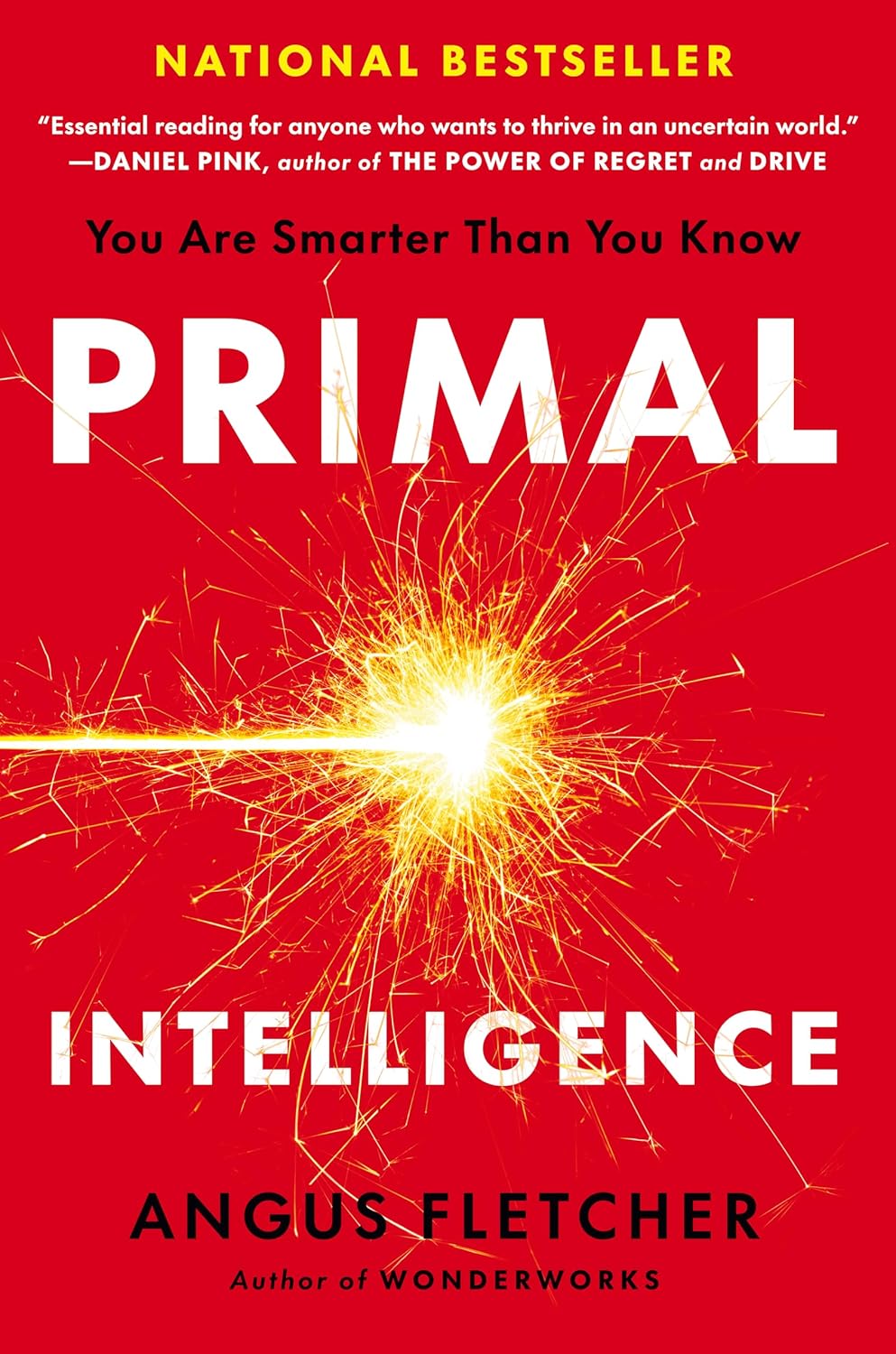
Good afternoon, and welcome to another Walker Webcast. It is my great pleasure to have Angus Fletcher with me to talk about the brain. Angus, I mean, there's much of your background that is so interesting. And I clearly want to dive into your latest book, Primal Intelligence. But at the same time, I think, to start off, you, of anyone who had that on the Walker Webcast, reading your bio would be exactly the wrong thing to do in the sense that you are a storyteller par excellence or someone who understands the need for storytelling or why our brains adapt to our lives in stories. Let's say that talking about a journey from the University of Michigan to Yale to Stanford and back to Ohio State University is just data points on a narrative that is much deeper about who you are, what ideas, thoughts, and research you have pursued over your career. And so I want to turn it to you actually, in a moment to give us your bio in narrative form, because it's a lot more impressive than me listing all the accomplishments off. Before I dive into that, though, you were asking me before we started what I was eating. It's kind of fitting that we are having this podcast today on the brain and on primal intelligence.
When I am recovering from a pretty bad concussion that I suffered last Saturday in a bike crash, and I had the crash and thought I was just had bad road rash on the side of my body and would just kind of recover. But I clearly had a bad concussion in the fall, and almost a week later, I'm still trying to dig out from it. Find myself being kind of pulled back into exhaustion, and headaches, and things of that nature.
One of the interesting things for me on prepping for this conversation was that this topic is something that I'm super excited about. Yet, as I was doing all my research on you, I kept getting fatigued and reading all about you and reading your book and all that great stuff. I was like, there's a reason this is hitting you at exactly this time. What was kind of fun about it, to be honest with you, was I then kind of listened, and I put your book on audio tape and was able to kind of listen to the words rather than reading the words just because it allowed my brain to shut down a little bit. And it was fun to listen to the stories and not actually be reading the stories. With that as a little bit of a background, why I might be a little bit slower today than normal, and why I was downing a, a piece of chocolate before we started to try and get a little bit of energy going. Let me turn it over to you for a moment on the Angus Fletcher bio in narrative form.
Dr. Angus Fletcher:
Thank you for sharing that story about your recent past, and just to give you some comfort, the great thing about the brain is that it's smart enough to heal itself. It really knows how to heal itself.
I could say this because I've worked with a lot of army special operators who've had traumatic brain injuries and you can still see those injuries persisting in the brain tissue years later, but those operators have figured out how to get back their performance, how to develop the same aptitudes they had before, because the brain is able to always discover these workarounds, which is why, of course, it's the smartest thing on earth.
To me, basically my journey starts a long time ago, I guess about maybe over 20 years ago now, when I was working in the University of Michigan at the medical school in a neurophysiology lab, and I was studying the brain, totally fascinated by the brain. I think for the same reason that everybody's fascinated about the brain. I mean, on the one hand, many incredible things come out of the brain, many great artists and scientists and innovators and entrepreneurs, all these folks that we admire, they somehow have these spectacular thoughts, these visions of the future of, or just like, where is that coming from?
How's this tiny little thing on the top of the human body able to have these just world-changing imaginative leaps? That side of it was fascinating to me. I was also fascinated by the fact that my own brain, not always perfect, is riven with fears and anxieties and stupid thoughts. I just thought, let me just take a little bit of time. I'm here in college. Everybody knows that most of your time in college is wasted in class because you don't learn that much in class. Let me instead hang out in this neuroscience lab, and that kind of launched me on this career in neuroscience, studying the brain.
But at the same time, as it launched me on this career, I started to depart from a lot of the orthodoxies or the ways in which people were thinking about the brain at that time. The big one is that they were thinking about the brain as a kind of computer. A computer, obviously intelligent in certain ways, very powerful.
But what makes a computer powerful is its ability to take lots of information and crystallize that into patterns and into probabilities and to make decisions based off enormous amounts of facts and numbers. The human brain is not great at that. The human brain gets overwhelmed pretty quickly when it's faced with a lot of facts, and data, and information.
I started to realize, the brain, the neuron, is operating differently than a transistor. Something different is happening here. One of the things I started to realize is that what's really remarkable about the brain is its ability to think in actions. And it's your ability to think in actions. That's what allows you to initiate new behaviors, which on a very basic level is how things survive in the wild. But it's also what allows you to innovate. And when you start to think about initiating, not just one action, but a group of actions, an action followed by another action followed by another action, what's happening there in your brain is your brain is starting to tell a story because the sequence of actions, a sequence of events, is a narrative, is a story. Why is it that your brain would think in story? I mean, what could be the possible use of that?
We've been taught for years that stories are just kind of made-up nonsense that we use to communicate with people who are too stupid to understand the facts. What would be the value of a story? Another word for story is a plot. Another word for a plot is a plan.
Essentially, your brain is thinking a story because it's inventing plans for the future plans, strategies. I became convinced that one of the keys to understanding human intelligence and why human intelligence is different from AI and computational intelligence was understanding how stories worked. Then I went on this journey. I won't go through all the details of the journey.
Willy Walker:
One thing just there for two seconds, Angus, because when you thought about that, that's long before that there was plenty of conjecture that we were going to get further on artificial intelligence at that time. But I mean, it's important for us to stop and say, this is 20 years ago, when artificial intelligence and machine learning were very small thoughts. Some of the most advanced thinkers in the world were really thinking about it or actually investing in it. But this is long before anthropic, and ChatGPT became household names.
Dr. Angus Fletcher:
That is true. Although I have been involved in natural language processing, which is the basis for ChatGPT and all these LLMs, for over a decade now.
A lot of the stuff you're seeing hit the market now in terms of AI has been percolating for a while, as I know but yes, it was definitely before that back then most AI was symbolic. That was certainly where the emphasis was, as opposed to on neural nets and some of these black box systems we have. But anyway, computers were still a big deal back then. People, for example, Daniel Kahneman is a good example, thought that the brain was essentially a computer that the more you could get the brain to operate like a computer, the more you could get it to make rational decisions, the more you could eliminate bias, the more you could do all these kinds of things, the more you could improve performance. That's definitely not wrong in high data environments.
But as I said, I was interested in how the brain operates in low information environments, of which the most obvious one is the future, because we have actually no information about the future at all.
That was when I decided I wanted to study story. I went to Yale, got my PhD in Shakespeare, because I figured that Shakespeare, the master of story, pretty much drove everyone at Yale nuts, because no one had ever arrived at Yale before with a neuroscience background wanting to study how Shakespeare made plans and strategies. Sort of treated me like a bit of a philistine for a while, but they let me through.
Went off to Stanford. That was when I made friends with folks at places like Pixar, start to be able to understand story from an actual practical perspective. Not just reading books about it, but starting to understand how innovative stories like Up were actually being made, what the processes were behind that.
Went to LA for a while, worked at the University of Southern California, worked with the Academy of Motion Pictures, Arts and Sciences, and then got recruited here to Ohio State at Project Narrative, which is the world's leading institute for narrative, for reasons I can explain, people often think it's weird that the world's experts in narrative all come to Ohio.
But then about five years ago, I got contacted by the US Army Special Operations, and they said to me, hey, Angus, we know you're a little bit of a maverick. We know that the fact that you think that the brain thinks in story is very different from what most people think.
And we know that a lot of people are interested, but also kind of skeptical of your work. We're just wondering, would you like to come and test some of your theories with our elite units? Because a lot of the stuff that you're saying about how the human brain needs to be smart with little information, and how we have to be able to spin up plans faster in order to deal with unexpected events, a lot of that's what we're seeing in terms of our own processes and workflow.
We've also got some pretty good AI here over at Special Operations. It wasn't to your point, Willy; it wasn't much the LLMs, it was more visual processing AI, but for target recognition and things like that. They're saying, and we're noticing some of the problems that you're talking about in terms of the fact that these systems can be very powerful when we give them a lot of data, but they tend to shatter around edge cases, where humans perform much better.
Would you like to come and test some of your theories with our units and see if they actually pan out? Or if it turns out you're just like most academics, and you're kind of a crank, and you've got a lot of interesting ideas that don't actually pan out. Anyway, to cut to the chase on that, I won't pretend that all my ideas panned out, but we did develop a kind of core set that did work.
We also expanded a lot of the theories based on work with Army Special Operations. They ended up giving my lab a couple of medals for that work. We've since taken it not just into businesses, but I'm most proud to say we're taking it into schools.
We're working with a lot of local school districts, and we're starting to put it here into our core curriculum at Ohio State's Fisher College of Business.
Willy Walker:
It's an incredible path and journey. During that period of time, was the intent always to stay on the academic and research side? Or was there? I know you've written some scripts, for instance, on movies. Was there ever a time where you said, I've now gone and studied neuroscience. I've now gone and studied Shakespeare. I want to take all this learning and, actually, if you will, go commercialize it rather than continue to research it and take that path?
Dr. Angus Fletcher:
There are all these geniuses like Jim Simons, for example, at Renaissance, who developed this entire theory of algorithms. He was like in this math department, you couldn't make anyone in the math department listen to him, essentially. So he was like, fine, I'm just going to go make $100 billion. Then you're going to see that I'm right.
I had the opportunity when I was in LA and Hollywood, I've had the opportunity to work with some of the biggest stars, all the big studios, big producers. I've had a chance to do all those kinds of things. That's definitely very fun and gratifying work. But the reality is that I'm much more interested in learning than I am in making money. For me, learning always occurs in these edge instances, which are ahead of the market in a lot of ways, because the market kind of hasn't caught up yet. That's why I generally have ended up working with folks like Army Special Operations or whatnot, because they're willing to kind of take high risks. Even Pixar, I had the chance to work with Pixar, and that was great, but Pixar then got folded into Disney because it got successful, and they stopped taking risks, and now they're making sequels.
There's this real tension, I think, if you want to study innovation or something like that. You can see the same problem, obviously, with Apple and some of the other companies I've worked with. If you really want to understand something like innovation or volatility or chaos, you kind of have to be out there on the leading edge. That's not where the risk appetite for most money is.
Willy Walker:
Most people view intelligence in an EQ, IQ framework. We all grow up with the IQ foundation of what's the kid test that from an IQ standpoint, is he or she on a high intelligence path, a lower one, what have you. They kind of think about being book smart.
And then there's the EQ, which is the emotional intelligence behind you and I looking at one another and kind of assessing one another pretty quickly. I can sit there and say, Angus looks like this or acts like this, or I could be a really good friend of his or actually, whoa, he's not the type of person I want to be close to or whatever the case might be.
Your research kind of puts IQ and EQ to the side and looks at primal intelligence. Explain for our listeners what is distinct on primal intelligence versus IQ and EQ.
Dr. Angus Fletcher:
IQ is how computers think. I mean shorthand for IQ would be math, or your ability to perform a standardized test. What's happening there is your ability to take a lot of information, find patterns in it, and then identify the significant pattern and pick the correct answer. That is a computational process.
IQ is essentially measuring your ability to think like a computer. Then what happened is people start to realize, well all these people who have really high IQ scores are not performing that well in the real world. There's this weird thing happening where they seem smart on paper, but they're not doing that well in life. That was where the theory of EQ came from. EQ was an attempt to basically troubleshoot the theory of IQ.
It was saying, well there must be these other abilities, and they must be emotional abilities. The kind of core of EQ then becomes empathy. The idea being that basically what I do is I learn to understand my emotions, and then I learn how to pattern match and ID my emotions in you. And that allows me to kind of think and understand you, and on and forth.
There are numerous problems with the theory of EQ. First, it's been totally debunked empirically, but more to the point, it's obviously nuts because it suggests that somehow our emotions are psychic.
It's also wrong because actually smart people, people who have good people skills aren't reading themselves and other people. That actually is a sign of actually what we would call low EQ. High emotional intelligence is your ability to understand why other people are special and to very quickly spot what's unique about them. Then to be able to leverage that, to honor that, respect that, communicate with that. EQ is really your ability to do the opposite of IQ in the sense that, instead of thinking in patterns, it's your ability to think in exceptions and what's unique. It turns out what drives that power in the brain is not emotion, but it's narrative.
Narrative hinges on what's unique, what's special, what's exceptional. This is why the stories that stick with you are the stories that have very vivid and unique details. This is why the first thing that you're told when you try and take a basic writing course is write what you know, because by writing what you know, you're able to say things that are more specific and therefore engage the narrative parts of your reader's brain more.
What I study is I study narrative intelligence, and narrative intelligence explains a lot of the things that EQ explains, but it also helps you get better at them. One of the kind of core problems with EQ has always been that it's kind of circular. People identify as having EQ, and therefore they have good people skills, and you can kind of select and assess them out, but it's very hard to raise someone's EQ except by telling them, be more empathetic or listen more closely or something like that.
But the thing about once you identify the narrative origins of those things we associate with EQ, you can then very quickly develop ways of training them up and you can see people getting much better at them faster. I just came from a little session we did where we taught people to have better conversations, for example, by just giving them some basic narrative tips.
Willy Walker:
Take that down to primal intelligence and how you can, if you will, train it, how you can become better at it to your point about conversations and some tips. Your comment about EQ and being good or not that good at understanding what makes someone you're talking to tick, if you will, trying to understand who the person is. In our business and commercial real estate lending and services where we're saying to somebody, give me your building to sell for you or let us go find financing options.
I often focus on the fact that if you look at some of our top bankers at Walker & Dunlop, there is no one formula that makes one of them the very best. There are three prototypes that I underscore to talk about the difference in that one might be the very best analytically. You've got a really difficult deal to do, and this banker is going to figure out how to do the art of the impossible of, we can structure it this way and get this kind of capital to it, and it'll work, just kind of a very creative mind from a financing standpoint.
Then there's another banker who just has the gift for gab, knows how to go out to dinner with a client and remembers the client's kid's name and remembers the client's anniversary and just kind of has that ability to create an ongoing relationship with the client that makes the client say, hey, next time I have a deal to finance, I'm going to give it to you because you just seem to be a trustworthy great person who has that gift for gab, if you will.
Then the final prototype would be somebody who's just diligent and perfect on all the loan documentation that they dot every I, they cross every T, that if you give them the opportunity to work on a deal, nothing's going to fall through it. It gets on track, it stays on track, it gets closed on time, and it's that ultimate efficiency, if you will, that makes that banker good. I sit there, and I think about primal intelligence and about the skill set that each of them has underpinning those qualities that I'm perceiving in them on the outside about how they're successful at winning deal flow and producing loans.
I'm just curious about, okay, those are the three prototypes. Think about how their primal intelligence feeds into them being successful. Then, I guess more importantly to it, Angus, is how do I then say to some up-and-coming banker broker at W&D, this is what you should focus on from a primal intelligence standpoint to become equally as successful as those three prototypes.
Dr. Angus Fletcher:
This is the best question I've ever gotten on a podcast. Thank you for asking me because it's specific and I think useful. So let me cash it out for you in terms of primal intelligence.
The first group that you were talking about, the guys who are analysts, what's critical there is you're talking about how they're able to come up with these creative financing methods. The primal power that they're using there is what we can talk about in more detail is imagination.
The second group that you're saying they have the gift of the gab, what they're able to do is they're able to make a client feel special. They're able to make that client feel uniquely valued. You make someone feel uniquely valued by being able to identify that person, what makes them tick, their why, better than anybody else can. That person is like, wow, you know me maybe better even than I know myself. That's not just about conversation. That's the primal power we call intuition. Intuition is your ability to notice what's unique, or special, or exceptional about things.
In the final case, the folks that are really good at kind of being, having everything buttoned up, we call that common sense. Common sense is this incredible power that humans have that AI does not have. This is one of the things that has historically baffled people about computers and about AI is AI can have all this data, but just completely lack any basic common sense. Then you think, how can that be? It's the same thing when someone spends their entire life in a library; they can tell you like millions of things about every single item on the planet, but they can't figure out how to make a basic, common-sense decision.
Those are the three things that your, your teams are using. They're using imagination, intuition, and common sense. We can walk through each of them quickly. Then, if you want to go into more detail, we can go into detail about any of them, but intuition is the basis of why the child brain is as powerful as it is.
Children have incredible intuition. Children are incredibly powerful at spotting what's unique about things. That's why if you take a child anywhere, they're always pausing and wanting to look at things. They can see something special about every unique, every blade of grass, and you're always having to kind of like haul them down the sidewalk. A lot of actually what makes folks have high intuition is that they've escaped the school system. A lot of times they seem uneducated, or a lot of times, they'll say to me, oh, I've got like ADHD or something. I can't pay attention to class, but actually, they've protected their brain from the school system, and they still have this childlike power of wonder. They're genuine, genuinely curious about everyone they meet, just like every child is genuinely curious.
Willy Walker:
Can I pause on that for two seconds? I guess it's just too good that you bring that up. It's it just brings back in just stark color to me.
My middle son, Charlie, when he first started playing. My eldest son, Jack was a great youth athlete, if you will. We put them out on the soccer field for the first day at youth soccer when he was like four years old, and all the kids are running around following the ball, and Jack grabs the ball and runs down and scores, and everyone's like, oh wow, that's a kid's a gifted athlete.
Then all of a sudden, we put our son Charlie out on the youth soccer field. The ball has gone off into the corner, and all the four or five-year-olds are running after it like an amoeba moving, moving across a Petri dish. Charlie's in the back, looking up at the sky and looking at some butterfly flying up above him. I'll never forget just like sitting there and being like embarrassed that like all the other kids had gone off like lemmings following the ball into the corner. And there was Charlie, kind of looking at the butterfly and being amazed at this butterfly flying about the field. I'm like, Charlie, it's the soccer, like it's the ball, like go follow, go play the game.
Hearing you say that just makes me realize these imaginative brain was just opening up at that moment and following what he wanted to follow and not necessarily what all the other kids were doing.
I've shared that story with plenty of friends of mine over the years. Every once in a while, I find somebody who can associate with that and say my daughter was exactly that way. Or my son was that way. It's just fun to hear you say that as it relates to that differentiation and allowing the child brain to express itself.
Dr. Angus Fletcher:
That's exactly right. That's a beautiful story. Thank you for sharing that. That's the point. When everyone else is chasing the ball, you see the butterfly.
Willy Walker:
Yeah.
Dr. Angus Fletcher:
That power is what allows you to see the possibility and the opportunity in every client you're talking to, because everyone else just sees a number or they see a deal to close or something like that, but you see the butterfly in the person. You see what's special about that person. It's the power to turn that on and turn it off that makes an effective adult.
Children can't turn it off. Children are always chasing butterflies, but what makes you effective as an adult is your ability to be like, okay, where's the butterfly in this situation? You turn it on, that's your intuition, then bang, you're able to see what makes that person special and unique. That's that power. There are a lot of ways to boost that up, but I mean, basically, it comes from doing things like traveling or whatnot, things that put you in situations where you basically are forced to be a child again. So that's kind of how you work that up.
The next thing is imagination, which is that group of traders you're talking about who are really incredibly creative with their financing. What's remarkable about that is if you take five or six creative investors, they'll all come up with different creative answers.
What that's telling you is something about the nature of creativity, which is there's not a right answer. We know in general that the more that someone believes there's a right answer, the less likely they are to come up with a new answer.
To train people in imagination, we do a shift that we call moving from probability into possibility. Probability is how computers think. Probability is always trying to find the optimum answer, the best thing. Probability is generated off of all the things that have happened in the past. You crunch all those data points, and then you triangulate based on them to come up with what you think is the most likely answer.
Possibility is something that has never happened before. It can't be found in the past. But it can happen because it doesn't contradict the rules of your environment. The simplest classic example of this is the invention of flight in 1903. In 1902, the world's smartest man, Lord Kelvin, mathematically proved that it was impossible for an airplane to fly. This actually led the U.S. Navy to declare that they would never be an air force, and it would be boats all the way to give us the entire Pentagon budget, essentially, before there was a Pentagon.
Why did Lord Kelvin think that there was never going to be an airplane? Because there never had been an airplane. But the Wright brothers saw that it was possible, and that's how they were able to invent it. What we do when we're trying to get people to think in terms of possibilities, we get them out of the mindset of what's the best possible answer, because that always gets you locked in the past and probability. Instead, you say, what's something we haven't tried before?
I don't care how likely you think it is to work or not. What's something we haven't tried before? And you start kind of developing that part of your brain, that imagination muscle, and that's kind of what opens the door.
Then the final one, which is common sense. Common sense is something I learned about a lot by working with Army Special Operations, because Army Special Operations had this incredible ability to follow what worked in the past, exactly as long as it is working. But in the moment things change, they immediately stop doing that and do something new. They have these things that they call special operating procedures or SOPs, and they develop them rigorously, and they train them over and over and over and over again they never, ever make a mistake. But then, the moment that there's volatility or uncertainty, they're able to let them go and create new SOPs. It's that ability to move immediately from old standard operating procedures to new ones that is common sense.
The other group that does this really well are astronauts. Astronauts have this amazing ability just to fly by the book the entire time that things are boring. But in the moment, there's an emergency, they just throw the book out the window and just improvise crazily, just like the best fighter pilot would. That ability, that common sense, interestingly, that comes from understanding your own anxiety levels.
Anxiety emerged in the human brain as a way of measuring unknown unknowns in your environments. A lot of people don't understand how anxiety works nowadays. They try and suppress it, or they think it's bad. But the more you tune your anxiety, the more you're in tune with your environment and the level of instability in your environment. We find that people with very high common sense have just the appropriate amount of anxiety in every moment. That makes them really diligent when they're doing forms and things like that. But that also allows them to notice when their anxiety is getting really high, wait a minute, there's a problem here. We've got to do something different. And that's what kicks in that other level of conscientiousness, which allows them to go beyond just being a robot, but really kind of dig deep and be incredibly diligent when the situation requires it.
Willy Walker:
It's funny how you add that anxiety definition. I just now, in thinking about the bankers and brokers at W&D who are at the top of that, if you will, cohort, I can put that anxiety piece into it. It kind of makes sense in some ways.
It's interesting there, when you talked about special ops, Angus, about the ability of astronauts to go by the book, but then have the capability to audible, to being exceptionally capable at throwing the playbook out the window and dealing with what you're faced with at that moment. That makes me think that they have the ability to do that because they're typically dealing with life and death instances in doing so, that their bosses have to allow them to do that. Because if they don't, they might die on the hill. The spacecraft might blow up on the other side of the moon. As a result of that, there's always that, okay, stick to the plan until all of a sudden, your life is threatened. Now, all of a sudden, you can kind of throw the playbook out.
99.9% of the population doesn't deal with life and death situations as the reason to throw the book out the window. How do you get corporations, how do you get schools, how do you get governments to think where there's a set of rules, but then we want people to be able to kind of dispel them, to push them to decide, to think creatively, to allow them to act in these innovative ways rather than just sitting there and being the lemming that I talked about previously, where you're going to go off the end of the cliff and you don't know that there's a cliff coming up.
Dr. Angus Fletcher:
I would be honest to say you're probably much more the expert on this than I am because I'm very good at understanding individual brains, but I'm very bad at understanding systems. My sense to answer your question is kind of twofold.
First of all, I think people have to start to realize that actually a lot more of life is life and death than they realize. I think that we have created this weird artificial sense of comfort in the modern world. Like, somehow, I go to my job, and of course, my job is always going to be there. Then I go to the supermarket, and of course the supermarket's always going to be there and there's always going to be bananas in the supermarket at 99 cents. That's not true.
The world is this way because a lot of people work really hard to make it that way. I think we're starting to see now, over the past few months and years, that's starting to unravel pretty quickly. I think I would encourage people to realize they're actually a lot closer to life and death more of the time than they think. That the people that they have in their care, the decisions that you make as a boss, that has real and profound impacts on their livelihood, their ability to sustain themselves and their children.
The first thing is, I would say we need a little bit of a mindset shift. I think we don't need to act as though we're in an active war zone all the time, but I think we have to realize that there is real stakes in what we're doing on a daily basis.
Then the second thing to your other point is a lot of this comes from leadership. I mean, leaders have to give permission to their teams.
The reason that special operators are good at making those transitions is because they train it. They train it in practice settings. That means under the watchful eye of their leaders, they're improvising, and they have a culture that leadership accepts.
Leadership just doesn't say, I can't see what you're doing, but leadership actually participates in encouraging initiative, encouraging. That's why when you move out of the training environment into the real world, operators are able to do it. I would say that a lot of leaders need to be more courageous and need to encourage more of their teams to take on risk, because otherwise, what you're doing as a leader is you're turning your team into management.
You're basically saying, I'm the one who makes the decisions, and you guys enforce them. Whereas a really effective organization, the leader produces other leaders and those leaders can act with initiative. Then you, as a leader, are kind of building a team.
And you can tell that this is happening in an organization when the leader doesn't need to be there. The system can handle a crisis just fine because the leader's already kind of passed their way of doing onto the rest of the team. But if you always need the leader in the room to make hard decisions, something's kind of gone a little bit askew in the culture of the organization, because the leader isn't comfortable helping the team take the risks that are necessary to make that leader redundant.
Willy Walker:
It's fascinating. I had dinner last night with the mayor of Denver, Mike Johnston, and we were talking about education and education reform, and the fact that in Colorado, the school budget has gone up dramatically, yet the outcomes haven't improved. My question to him was, how do we improve the school system?
There are all sorts of answers to that, Angus, that someone can come up with that says, oh, we need to fund this, or we need to focus on that, or whatever. He basically said, as long as you have centralized decision-making, where the curriculum is standardized, where the way of managing the school is standardized, you will never get ownership at the actual school level. He said, what you need to do is to break that and give autonomy to the actual principals, the school leaders, and have them decide, do we want to have a busing system here, or do we want to fund that, or do we not want to bus, have everyone get here on their own, and put money towards AP calculus? Do we want to have free lunches for everyone, or do we not want to have free lunches for everyone and take that money and put it somewhere else? But until you create that autonomy at the operating level, you will not get the buy-in and the management at the local school, and therefore, you'll never improve outcomes.
He said, outcomes come after you take ownership of what happens in that school on a day-to-day basis and entrust it to the managers at the local level. Hearing you talk that through, I mean, it's less than 24 hours after Mike said that to me last night at dinner, but he talked about New Orleans after Katrina and how they redid the entire school system in New Orleans because Katrina had wiped everything out. From what Mike told me last night, the New Orleans school system and the prevalence of charter schools and every school kind of standing on its own, he said, go to New Orleans in late August, early September, and you would think that it's Mardi Gras because all the schools are trying to attract students. There's like this competition because if you've gone and invested in busing rather than in a free lunch or in AP calculus, you've got to attract the students and the parents to say, I want my child to go there.
And it's that competitive force in the school system that creates great outcomes. What you just said, that's one example of how that breaking of the consistency across everything creates that, not just entrepreneurial nature, but an outcomes approach.
Dr. Angus Fletcher:
Mike has my vote for president. I don't know if he's running for president in the near future, but I totally agree with him. I'm not an expert on the school system, but I work quite a lot with Columbus city schools here. I've heard exactly the same thing from the administrators there that essentially charter schools are eating a lunch of public schools all over the place because of that decentralization. I think that decentralization in good schools goes beyond just decentralizing power to the principal. The principal then decentralizes that power to individual teachers. Individual teachers can decide how to set up their classroom and how to teach their students. Then you decentralize that as a teacher to your students, and your students start to discover, okay, what is my course? What is the reason that I'm here in class? What is it that I want to learn?
Then that's really when you start to get back to the origins of America and the difference between America and other countries. I don't want to go on kind of like a patriotic soapbox here, but I'm an immigrant. I'm a naturalized citizen. I chose to become an American. That gives me a slightly different view than some Americans have of what it means to be an American.
I come from an old world in which the king had the power, and we had the ultimate centralization of things. We all looked to the king to tell us what to do. Then America was founded by a bunch of people who were like, we don't want to be told what to do. We want to do it our own way. America just grew up with this kind of like an interesting collection of mavericks, essentially. It's that culture, which has always, I think, made America a little bit scared of people on the outside, but which has been generative and which has produced such amazing opportunity for individual Americans.
I think we need to get more of that into our school system. Our school system is not working because it's essentially socializing kids into thinking that there's a right answer and the system has it. The moment that you think that you become dependent, you give up your own imagination.
Willy Walker:
What's interesting about you, the point you just made, Angus, is you turned it into a story. You didn't just make a statement about what's wrong with our school system and say, this is the reason why we've got these rote outcomes and this and that. You went back to the history of our country, and you talked a story through where all of a sudden, I sat there and said Boston Tea Party.
There was a reason they threw the tea into the Boston Harbor. You can then associate with it. Two things on that. One, we're talking about education. To that, what advice would you give to employers as they go to recruit? Because other than employers looking at schools, I mean, you may say schools shouldn't look at ACT, SAT scores as heavily as they do. They ought to be doing more interviewing to bring the kids into colleges. That's one part of it. But most of the people who listen to this podcast are in business.
The question that I have for you is you're interviewing someone to either join your lab at Ohio State or you're consulting to me on hiring a new analyst to come to Walker & Dunlop and hopefully become a great banker or broker at some time in their career here at Walker & Dunlop, is looking at their GPA, the proper thing that I ought to be doing is looking at their summer work experience, what I ought to be doing, or should I be bringing them in and taking them out for a five mile jog, seeing how they react to the stress of a five mile jog in 92 degree heat, and then sitting them down and asking them what's the most impactful thing that's ever happened to you in your life?
What out of your whole primal intelligence research will allow us to understand who the kind of, not the winners and the losers, but the best candidates to bring into an organization are.
Dr. Angus Fletcher:
That last test that you suggested is very close to what special operations does. That suggestion of putting someone under a degree of physical duress, which is to say, making them run for a while. I won't comment on whether they should run in those heat conditions or not, but you know, basically putting them under a degree of physical duress where they start to get a little bit tired and then ask them to tell a story because that's what you're doing.
When you're saying, tell me about the hardest challenge you face, what you're actually saying is tell me a story. What you're trying to kind of nose out there is, first of all, is this story in any way convincing? In other words, is it vivid?
Is it specific? Is it unusual? Or is it generic? Is it something that this person got off the internet, and they figure out how to hack this question? They're just telling me some kind of idle pablum, basically, or is there something unique, distinct about it? The first thing is you're just measuring the quality of the story. Through that, you're essentially measuring the authenticity of the story. Is this person telling me the truth?
And then the second thing you're looking for is how original is this person's way of responding to that challenge? The originality is telling you how good they are at initiating new plans. Because that's what imagination is. It's your ability to initiate new plans. If that person comes into your office after sweaty and exhausted, says to you, oh my goodness, I faced this real challenge when I was 15 or, or when I was in college two years ago, I faced this real challenge. They're specific about it and vivid about it. You're like, okay, I believe that.
And then they give you some amazing, imaginative, creative solution to it. You realize this person has initiative. This person has entrepreneurial ability.
This person has the ability to think for themselves. This person has the courage to do things that they thought of themselves. They've got emotional resilience, they've got the package.
I would say that would be a great way to test someone. I think in general, getting people to tell you true stories about challenging moments in their past and how they responded to them. That's when you get an understanding of their character and also their intelligence. Those are the two things you're really looking for. I think, as an employer, what is this person's character? Who are they under duress? What comes out in difficult moments, and then how smart are they at adapting to situations and not just kind of going back through a book and works what worked in the past, but seizing the initiative and taking a crisis and turning it into an opportunity.
Willy Walker:
We started this conversation, having you basically tell the story of your career, rather than your bio. One of the things that I found very interesting that you write about is the narrative of not only life, but of in our world business, and businesses that are good at telling a story.
Whenever we sit down with investors, Angus, it's funny. When I first started meeting with institutional investors and heard the first person say to me, I'm new to the story. I'm like, new to what story? We're a company, we're not a story. They're like, I'm new to the story. Tell me tell me about it.
It took me a while to understand that many investors are doing just that. They're looking for a story. Clearly, the other thing about it is that in that meeting one-on-one, you darn well better not finish the story on where you are today. You better have those the upcoming episodes, the upcoming chapters that you can outline to the investor that says, this story goes on and let me try and paint a picture for you about where this goes in the future. Then you either are going to invest in that final couple chapters, if you will, or you're not.
It does, as I'm asking you this question, it makes me think about the successful television series and how some of these streaming services sit there and say, we'll just let you download the entire thing right now or we're going to make you sit around on pins and needles all week with bated breath waiting for the next release of the series. As a fan of quite a number of series, I sometimes love it when it allows me to binge watch it. Sometimes I kind of enjoy the waited anticipation.
But how would you counsel, consult to corporations as it relates to the importance of storytelling to both their internal resources, external partners, potentially investors, if they happen to have external investors, how important is the, not only the development, but the retelling of that story?
Dr. Angus Fletcher:
You've got two things when you're trying to sell yourself: you've got data, and you've got a narrative, and the data essentially is going to speak for itself without any narrative. I would say most of the time, if you've got a smart analyst, you can see, is this company making more money this year than last year? Is it on a growth curve? Then everyone can see those numbers, and they can look at those.
But your point, the other point, the other part of it is the stuff that's not in the data. If you're talking about someone like Warren Buffett, what is Warren Buffett looking for? Warren Buffett is looking for the narrative of the leaders. He's looking to understand why they came to the company. What kind of decisions they make in their personal lives, because what Warren Buffett is looking for is the story of the individuals in the company, because that allows them to say, these individuals are good. Therefore, I'm going to invest in this company, whether or not I care about the company or not, because I know if it has good individuals, they're going to carry the story into the future.
The other method is to look at the company's story. What is this company's origin? Where does it come from? Where is it going? To your point about TV, a company has a good story when it creates suspense in you, when you're genuinely interested to know where it's going to turn out. There are companies that will inspire that when you sit down with them, you don't feel like they're selling something to you. You're like, this is really interesting.
I actually can kind of imagine where this might go in a couple of years, but I'm not totally clear on it. What's happening there is when a story creates suspense in you, it's creating suspense because you're starting to imagine the company story yourself. As a person selling yourself, that's what you want.
You want the person listening to be imagining your story without you telling it.
This is why famously Nike was successful with their advertising, because you weren't actually thinking about Nike. You were thinking about what you were going to do with the shoe. You were thinking to yourself, when I put on those shoes, what sports am I going to win? What victories am I going to claim? You pass over the story to the story listener.
The thing about investing in story is, I think the most important thing you can do as a company. But most people think of story as a form of marketing. They start by thinking to themselves, what is it that my listener wants to hear?
How do I reverse engineer what they want to hear and give them that?
The problem with that is that any experienced listener will immediately know that it's BS, because it will feel like pandering. You instead have to do the opposite. You instead have to have the courage to go into your story and start to look at the moments that are challenging for you to disclose. Why are those challenging to disclose? Because they reveal some kind of limit or some vulnerability in you.
Those are actually the first things you have to get out in the room, because why? That builds trust. Now the person knows, oh, this person's being honest with me.
Then, once you start to tell those true parts of the story, you then start to tell the possible parts of the story. You start to say, here's what we've done, but here's where it could go. Then, because you've built trust by telling the truth, you build excitement by telling the possible.
None of that is marketing, and none of that starts by pandering to your audience. All of it starts by having the courage to tell the truth about yourself and then having the imagination to see where your company could go.
Willy Walker:
I've done 280 of these interviews, 285, I don't know. What you just said is like incredibly, it's like manna. It's incredibly important.
I have many, as you were talking that through Angus, I have many different examples of where, for instance, our story either resonated or didn't resonate, where we took risks as it relates to outlining what we wanted to go to try and accomplish versus just telling people what they expected us to do.
One just example in the last 24 hours, we were pitching, we have a debt fund at Walker & Dunlop, and we were making a pitch yesterday to a bunch of investors. I've done my opening, and now our team is stepping in to talk through the various component parts of the fund. As one of my colleagues is talking about the fact that we launched this fund in 2024, we've raised $260 million on a billion-dollar goal. I'm writing a note saying, we might not want to highlight the fact that we started this over two years ago, and we've only raised $260 million on a billion-dollar target.
At that exact moment, Angus, in the chat on the side, one of the investors puts into the chat, why have you guys only raised $260 million on a billion-dollar raise? Is that just a really challenging investment environment? I jump in, I put down my iPhone where I was writing notes to my team, and I jump in and I say, it has been a challenging environment, but to be honest with you, our team has been better at finding investments and in deploying capital than they have been at raising capital.
The investor jumps back in and goes, thank you for your honest, straightforward answer. I can almost guarantee you that, first of all, the returns on the fund are fantastic. So, that was in some ways both pointing out a weakness on our team, but at the same time, also underscoring the fact that they've made great investments that have had fantastic returns on them. But I can almost guarantee you, and I'll follow up on it, but I can almost guarantee you that investor sat there and said, that is honesty and clarity as to what they're good at and what they're not great at that says to me, man, if I put an incremental dollar in there, they may not be good at raising more dollars from other people, but at the end of the day, my dollar is going to go into great deals and get great returns. I like that. That narrative wins.
Dr. Angus Fletcher:
No, that's exactly right. This is why you don't need to be on the podcast, because you already figured it out.
Willy Walker:
No, I did not want you on the podcast to reinforce things that I think in my own mind. That is not why I had you on the podcast. I had you on the podcast because I saw your book and I said, this is a very interesting, not only is it interesting take on intelligence, but then I want to, and I just cut you off, and I want you to finish that thought, but I also want to talk about the fact that we're all freaked out about AI taking over the world and disintermediating every thinking individual on the face of the planet. There's a lot of fear out there.
One of the things that I found in your book is that it basically says the human brain is unique and computers and AI are going to do certain things that quite honestly, we don't do as well as they do. That does not in any way eliminate the need for all the things that you and I are talking about today, but finish your thought, because I cut you off on that as you were heading down there.
Dr. Angus Fletcher:
No, let's talk about AI because I think AI is the important conversation that's in everyone's minds. This is why I get flown all around the world now to talk about stuff is the AI concern. I think one of the things that makes me unique just in terms of my research is that there are people who like AI, and then there's people who hate AI, but there are not a lot of people saying, what's the human alternative, and how do you train that up? And that's kind of the thing that I think you and I've been talking about on this podcast.
As far as AI goes, I've been working for over a decade now in something called natural language processing, which is the AI foundation of LLMs, which are these chatbots. I've published a whole series of papers; I'm not going to bore your audience with them, in which we've identified endemic problems with LLMs that are never going away because they're actually the flip side of what's good about these systems.
What we've seen as Grok, Claude, and OpenAI's various systems have gotten better and better; the strengths of these systems that were developed about a decade ago have gotten stronger and stronger, but the weaknesses have also been magnified. The key thing for your audience to remember is that what AI does is it takes one part of human intelligence, and it optimizes it, but all the rest of it, it throws out. AI is like taking a narrow part of what makes humans smart and doing it much better, which is why AI can be a great partner for you, particularly in information-dense environments. It's very powerful, but the more that people rely on AI, what we find is they start losing their natural human intelligence and they start deferring to the AI. They lose their initiative, they lose their imagination, they lose their confidence. The one thing that AI will always be dreadful at is strategy.
AI thinks in lists. If you ask an AI something, it'll give you a list of things, a bunch of bullet points. I just love doing that. Strategy is about clarity. It's about establishing the top priority. If you have a clear strategy and you're challenged on it, you'll double down on your strategy.
Whereas if you challenge an AI, it'll immediately give you another item on its list. That's just because of the way that AI thinks. That's endemic to its thinking. That's not a flaw of AI. That is AI. That's exactly how it thinks.
What you got to remember is that as a human, your ability is to be a leader, is to identify things that are not provable with data yet. Because as a human, you're not trying to predict the future, which is what AI is trying to do. You're trying to make the future. How do you make the future? You tell a story that is possible and you act on it faster. Every deal that you've ever closed in your life, I would imagine, you saw what could happen in that deal. You saw the possibility and you moved faster than the people who were competing with you in the environment. That's how you won. You didn't predict the future.
You made the future.
I just want to say to everybody out there, AI is real. AI can do good things. AI can do a lot of damage. AI is with us probably forever, but AI is not going to replace humans. On the negative side of that, that means there are a lot of problems in this world right now, which we've got to figure out how to fix.
We need a lot of good people spending a lot of time thinking about how to straighten things out on this planet. We've talked about the school system. There are other things that are a mess right now on Earth.
But it also means that the most exciting opportunities, the biggest transformations and transitions, and innovations in technology, in business, in art, in science, those are going to come from the human brain. We need to start cultivating and creating environments and cultures that really nurture that, that support that, that reward that. I just say to people out there like yourself who are successful, have these abilities, the next step is to pass them on and to start to realize how do I give those abilities to my team and to the next generation that's following me, and worry a little bit less about AI and focus a little bit more on our human task.
Willy Walker:
I have plenty more questions for you, but I'm not sure I want to go on after that because I was just down at Arizona State University on Wednesday, giving a talk. The first question that came in was AI, and are we going to find jobs when we get out of ASU at companies like Walker & Dunlop? I was at Chapman University the week before that. I was at the University of Miami a month before that. That's all that's on the mind of these kids is like, am I going to have a job? Is there going to be a future for me?
I think one of the interesting things about it right now, Angus, is that we do seem to be somewhat in no man's land where there's this thinking that AI is a zero-sum game, that the computer does it, therefore a human doesn't do it. Therefore, the computers are just going to get rid of all of these things that humans do. Therefore, what are we going to do? We're going to sit around and stare at our navels and be unemployed.
Lots of talk about universal income and the need to take care of all these people. Because of that and where we are, we have not had the opportunity for people to understand the benefits of it and see how it has created new ideas, new companies, new opportunities for growth and employment. So what seems to be sensationalized in the media is the billion dollar startup that has two Stanford graduates who are sitting around playing with some LLM and not the thought that my son graduating from the University of Colorado might end up being wildly entrepreneurial to be able to do a startup with a fraction of the resources he normally would need to do a startup and can use AI to help him launch this new company that may end up employing one person. It may end up employing a thousand people. But we just haven't been at it long enough to sit there and say, it's like the Pillsbury Doughboy, where you push it on one side, and it comes out on the other side. Right now, we think that the finger goes into the Pillsbury Doughboy, and it just stays in. And we haven't seen the other side of the Pillsbury Doughboy pop out, if you will.
Dr. Angus Fletcher:
A really smart student can give an AI an idea for a new company that the AI can go and start to build some pieces for. But you need that human visionary to tell the AI what to do. If you just leave the AI alone, it's not going to come up with anything interesting. The students who I see being successful now are essentially using AI to kind of fast prototype ideas that they have for products and services. They say I think there's this hole in the market, or I think there's an opportunity, on and so forth. Rather than in the old days, you would basically do a hand diagram. Then it was, I'm going to do a pitch deck. Now you can have an AI basically create a little bit of a working prototype. It's another way of kind of communicating your story is what it is. You tell it and then you tell it what story to make. Then you kind of work with it to kind of get that story that other people can see it and give you real investment to build the actual product. But it is not going to replace that human ingenuity, that human imagination.
The problem is that schools, for too long, are not in the business of teaching students to have imagination, to have entrepreneurial spirit, to have initiative. That's not really what schools do. The reason that kids are panicked is they bought into a system which is like, as long as I can get grades, I'm going to have a job. AI is going to take away any job that you can be programmed to do, because that's the whole point of AI is to automate stuff like that. We have to have a radical shift in the way we think about how we're training these kids and get them to lean back into some of the stuff that we're training out of them.
Willy Walker:
It's fantastic. I could keep talking to you for hours. I hope to keep the conversation going.
Angus, I'm appreciative of spending this hour with me to talk about your book, your research, your lab, all of that. I have one final question. As a graduate of the great University of Michigan and as a researcher and professor at The Ohio State University, when they go head-to-head, which side of the stadium do you sit on these days?
Dr. Angus Fletcher:
I roll with the team. I roll with the team, but I can be honest with you that my kids cheer for Michigan; we have a divided house. We have a divided house, and we'll see how long that house can stand.
Willy Walker:
That's great. Go blue, because they certainly had a very successful March Madness and almost pulled it off in hockey, although the University of Denver, that small private school here in the city where I am sitting right now, has won three of the last five national championships and took down a very strong Michigan team and then a very strong University of Wisconsin team in their reclaiming of the national championship. That would have been quite something if Michigan had won both basketball and hockey.
Anyway, Angus, I greatly appreciate you taking the time to join me. Thank you very much. Congrats on an incredible book. I hope everyone who's listened to this will go out and buy it. I hope you and I can continue the conversation.
Dr. Angus Fletcher:
Absolutely. I look forward to continuing that conversation soon.
Willy Walker:
Great. Thanks very much. Have a great day.