
Sahil Bloom
Author, Investor, Entrepreneur
On the latest Walker Webcast, Willy was joined by Sahil Bloom, entrepreneur, investor, and author of the instant New York Times and USA Today bestseller, The 5 Types of Wealth.
Together, Willy and Sahil dove into the formative moments from his upbringing that shaped his perspective, insecurities that he had to confront, how to bridge the gap between spoken and lived priorities, and the core ideas behind redefining wealth — from auditing your time and energy to embracing small habits that compound into meaningful change.
Watch or listen to the replay.
At a glance
1. Who is Sahil Bloom?
Sahil Bloom is a New York Times bestselling author of 5 Types of Wealth and the creator of a widely read weekly newsletter with roughly 800,000 readers. He draws on his background in investing and his personal experience rebuilding his life around time, relationships, health, and purpose to share practical frameworks for living with more intention. He also sets an ambitious goal of positively impacting one billion lives through his writing and ideas.
2. What are the top reasons to listen to this webcast?
- Hear Bloom’s story of redefining success after chasing the traditional scoreboard, and why he believes actions reveal true priorities more than words.
- Learn Bloom’s 5 Types of Wealth framework and how he uses it to make decisions around time, relationships, health, purpose, and money.
- Get Bloom’s practical tools for cutting noise, protecting energy, and investing in relationships through small habits that compound over time.
3. How does Bloom explain the insecurity that shaped his early drive?
Bloom says insecurity often comes from an internal belief that you are not enough, which can fuel a constant drive to prove yourself through achievement. He calls this a narrative fallacy, the tendency to gather evidence that confirms a story you have told yourself about who you are. He argues that real growth begins when you question that story instead of trying to outrun it through performance and external validation.
4. What does Bloom mean when he says strong relationships combine high expectations and high support?
Bloom describes two pillars that hold up healthy relationships: high expectations paired with high support. He says high expectations without support breeds resentment, while support without expectations creates complacency. He credits his parents with pairing belief in his potential with consistent support while acknowledging how difficult it is for kids to overcome insecurity without seeing that internal work modeled.
5. How does Bloom describe the “15 more times” moment that reshapes his priorities?
Bloom says a friend helps him see time as finite by calculating that if he sees his parents once per year and they are in their mid 60s, he may only see them about 15 more times. He says the gut punch forces him to confront the gap between the priorities he claims to have and the priorities his actions show. He and his wife decide to reclaim agency, and within 45 days, he leaves his job, sells their house, and moves across the country to live near family, turning “15 more times” into hundreds.
6. What are Bloom’s Five Types of Wealth, and why does he put time wealth first?
Bloom lays out five forms of wealth: time wealth, social wealth, mental wealth, physical wealth, and financial wealth. He says money is measurable, which makes it easy to over optimize for, but that measurability can distort life if it becomes the only scoreboard. He argues that fuller definition of wealth helps people avoid winning financially while losing in health, relationships, purpose, and freedom.
7. Why does Bloom use Warren Buffett to illustrate the true value of time?
Bloom asks whether someone would trade lives with Warren Buffett and says most people would not, even for $130 billion, because Buffett is in his 90s. He says the thought experiment reveals that time has incalculable value in a way people intuitively understand. His point is that people protect money fiercely, yet give away time casually to energy- draining commitments, distractions,that do not align with what matters most.
8. What practical method does Bloom use to protect time and manage energy week to week?
Bloom recommends auditing your calendar and labeling activities as energy creating, neutral, or draining. He says outcomes follow energy, so the goal is not to eliminate all draining tasks but to improve the ratio over time by making small changes. He frames the process as regaining control of time by gradually investing more hours in what lifts you and fewer in what depletes you.
9. How does Bloom separate signal from noise, and why does he consume far less news?
Bloom says constant news consumption changes how people perceive reality because news is biased toward negativity and driven by incentives for attention. He argues that increasing the frequency of observation increases noise relative to signal, meaning more updates can actually reduce understanding. He believes cutting news consumption dramatically can make people better informed while freeing time for longer- lasting inputs like books, essays, and meaningful work.
10. How does Bloom suggest people rebuild social wealth when relationships feel thin or neglected?
Bloom says compounding applies to relationships the same way it applies to money, and anything above zero compounds. He urges people to stop letting perfect get in the way of beneficial, because a short text, quick walk, or small check- in builds connection over time. He also emphasizes quality over quantity, arguing that a few deep relationships matter more than a large loose network, and that surrounding yourself with people who hold high expectations for you can.
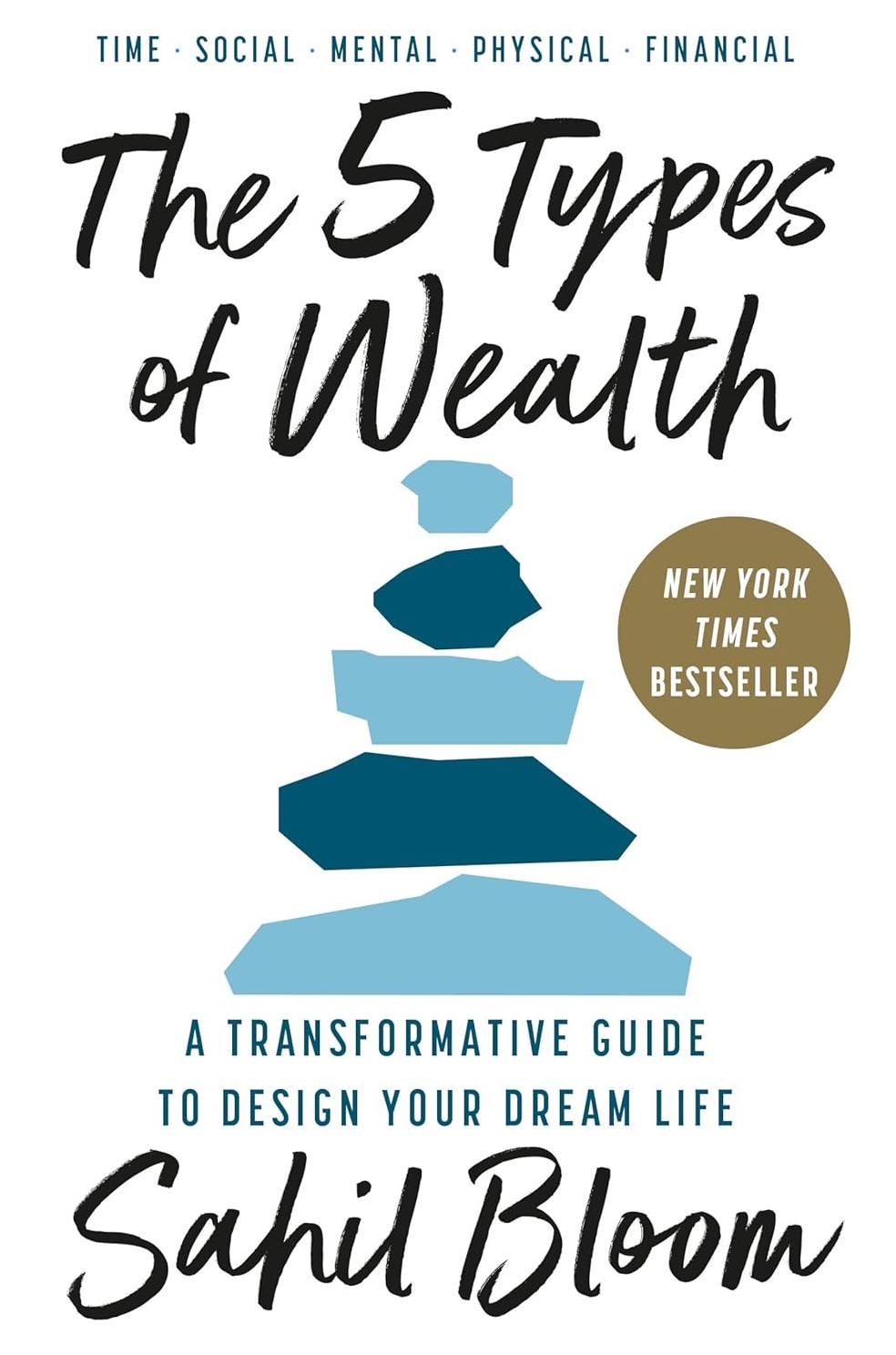
The 5 Types of Wealth
Lorem ipsum dolor sit amet, consectetur adipiscing elit. Suspendisse varius enim in eros elementum tristique. Duis cursus, mi quis viverra ornare, eros dolor interdum nulla, ut commodo diam libero vitae erat. Aenean faucibus nibh et justo cursus id rutrum lorem imperdiet. Nunc ut sem vitae risus tristique posuere.
Lorem ipsum dolor sit amet, consectetur adipiscing elit. Suspendisse varius enim in eros elementum tristique. Duis cursus, mi quis viverra ornare, eros dolor interdum nulla, ut commodo diam libero vitae erat. Aenean faucibus nibh et justo cursus id rutrum lorem imperdiet. Nunc ut sem vitae risus tristique posuere.
The 5 Types of Wealth reframes success beyond money, offering a practical framework for building a truly rich life. Sahil Bloom introduces five interconnected forms of wealth that shape long-term fulfillment and sustainable achievement. Blending research, storytelling, and actionable insights, this book helps leaders align their time and priorities with what matters most. Highly recommended.
Related Walker Webcasts
Beyond the World Cup with Andriy Shevchenko
Learn More
July 15, 2026
Sports & Health
The Metabolic Mind with Dr. Chris Palmer
Learn More
June 3, 2026
Sports & Health
Team-First Mindset with David Carle
Learn More
May 6, 2026
Sports & Health
Insights
Check out the latest relevant content from W&D
News & Events
Find out what we're doing by regulary visiting our News & Events pages
